A year-long plan should create momentum, not trap your fashion brand in a rigid calendar. A practical 12 month fashion brand program gives you a clear sequence for turning an idea into focused action, while leaving room to learn and adapt.
Product, positioning, marketing, and sales are connected. The challenge is deciding what deserves your attention first and making commercial choices without losing the creative vision that makes your brand distinct. Online activity alone isn’t progress unless you can see what it helps you achieve.
This roadmap breaks the year into manageable phases, from clarifying your foundations and shaping your offer to building your marketing, strengthening sales, and reviewing results. You’ll see how to connect creative direction with practical business decisions, choose useful measures, and adjust your priorities as you learn. Build with focus, and make each phase support the next.
Key Takeaways
- Use a 12 month fashion brand program as a flexible sequence of priorities, tests, and reviews, not a fixed promise of results.
- Start by connecting audience insight, brand positioning, product focus, and one clear commercial goal.
- Test whether people are likely to buy before treating attention as proof of demand, then choose sales channels for their distinct roles.
- Build a regular review rhythm around customer response, sales signals, and the time and capacity you have to execute.
- Use year-end evidence to decide what to keep, stop, or revise, then carry the strongest priorities into your next plan.
What a 12-Month Fashion Brand Program Should Help You Build
A year-long fashion brand roadmap is a sequence of priorities, experiments, reviews, and adjustments that helps a creative business make better decisions as it grows. It provides structure without assuming every brand will launch, sell, or scale at the same pace.
Designing a compelling product is only one part of building a fashion brand. The business also needs a clear customer, a reason to choose the label, a path to purchase, and a way to learn from results. Social media activity may create visibility, but it doesn’t tell you by itself whether the offer resonates or supports sales. Effective fashion marketing strategies connect the brand’s identity to how customers discover and respond to it.
Use a 12 month fashion brand program to decide what to focus on now, what to test next, and what evidence should shape your next move. If customer feedback challenges your assumptions or a sales path isn’t working, adjust the plan instead of treating the calendar as a promise. Progress means making clearer decisions, not simply completing a checklist.
Who benefits from a structured year-long fashion brand roadmap?
Early-stage designers can use a year-long structure to test an offer and clarify who they intend to serve before expanding their product range or marketing effort. Established labels can use it to replace scattered activity with a stronger online sales routine and sharper priorities. The framework should fit the business: a solo founder may focus on a narrow product range and a few repeatable tasks, while a team can assign owners and coordinate more complex work. Start with your current stage, not someone else’s timeline.
What should a fashion brand have in place before month one?
Begin with a working snapshot, not a polished business plan. Write down what the brand makes, who it is for, what makes the offer distinct, and where customers can discover or buy it today. Then record the evidence you already have, such as sales patterns, customer questions, website activity, social responses, or feedback from direct conversations. Don’t delay planning while waiting for perfect data.
- Known evidence: Information you can observe or document, such as completed orders, repeated customer questions, or current sales channels.
- Assumptions to test: Beliefs about who will buy, which product will attract them, or what message will prompt action.
Keep those categories separate. You may believe a particular audience values a design feature, but until customers respond or purchase, that belief remains a hypothesis. This honest starting point gives the roadmap something useful to measure and helps connect commercial decisions to the creative vision.
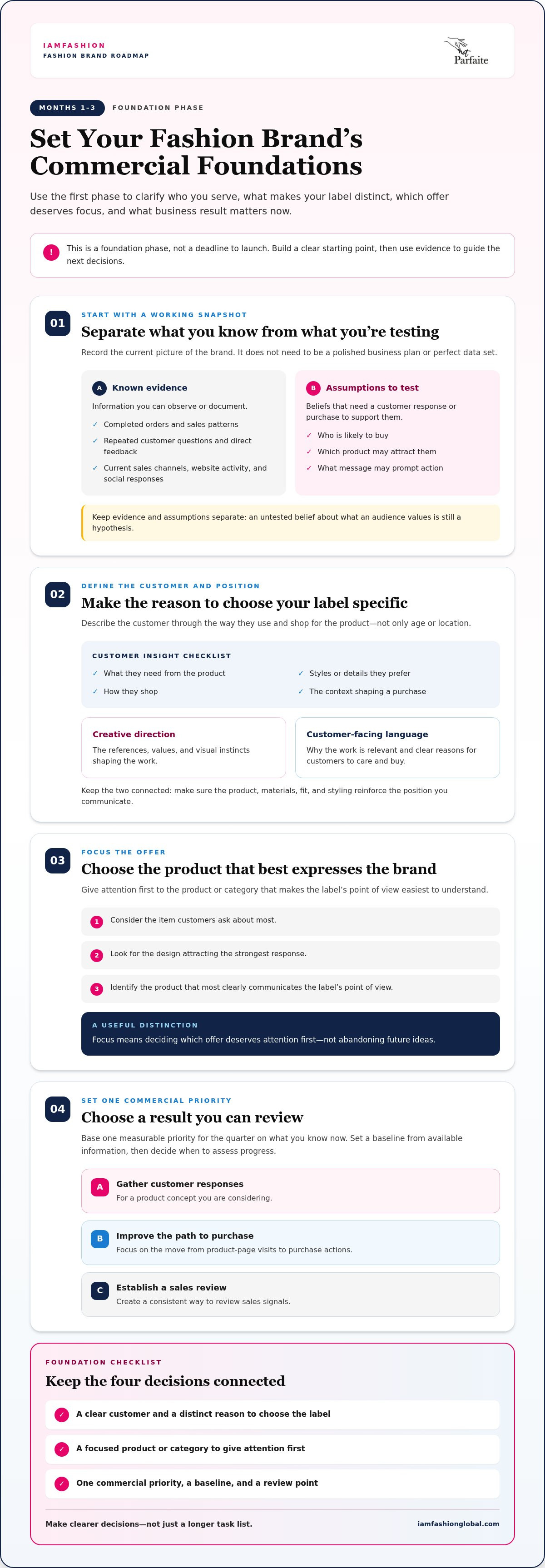
Months 1-3: Set Your Fashion Brand’s Commercial Foundations
Treat the first quarter as a foundation phase, not a deadline to launch. A new label may be testing its first offer, while an established brand may need to sharpen its direction before expanding. The goal is to make the next decisions more deliberate: understand the customer, define the position you want to own, focus the product offer, and choose one commercial priority to guide the work.
Keep creative direction and customer-facing language distinct but connected. Your creative direction expresses the references, values, and visual instincts shaping the work. Customer-facing language explains why that work is relevant and gives people clear reasons to care and buy. One protects the vision; the other helps customers understand it.
Clarify the customer, positioning, and reason to choose your label
Describe your intended customer through more than age or location. Consider what they need from the product, which styles or details they prefer, how they shop, and what context shapes a purchase. For example, a label designing adaptable pieces for frequent travelers would make different product and messaging choices from a label focused on occasion dressing.
Next, state the label’s distinctive value in plain language. Replace broad claims such as “premium quality” or “modern luxury” with specific, supportable details: the silhouette, use, design point of view, or customer need that makes the offer relevant. Then check whether those words match the product. If your position emphasizes ease of movement, the materials, fit, and styling should reinforce that idea.
A defined audience sharpens fashion brand decisions because it gives each product, message, and sales choice a clear customer to serve.
Choose a focused product and business priority
Identify the product or category that best expresses the brand’s proposition. It may be the item customers ask about most, the design that attracts the strongest response, or the product that makes the label’s point of view easiest to understand. Focus doesn’t mean abandoning future ideas. It means deciding which offer deserves attention first.
Choose one measurable commercial priority for the quarter based on what you know now. Make it specific enough to review, such as gathering a defined set of customer responses to a product concept, improving the path from product-page visits to purchase actions, or establishing a consistent sales review. Set a baseline using available information, then decide when you’ll assess progress.
- Focus: Which product or category best represents the brand?
- Priority: What single business result needs attention this quarter?
- Measure: What evidence will show whether the work is moving?
A long wish list scatters time across tasks that may not support the same goal. A focused plan makes execution easier to manage and gives you a clearer basis for adjusting the next phase. IAMFASHION’s Brand Boost offers structured mentorship to help fashion founders turn priorities into consistent action. Explore Brand Boost mentorship for fashion founders.
Months 4-6: Test Demand and Build a Fashion Brand Sales Path
Use this phase to answer a commercial question: does the intended customer show signs of wanting the product, and can they move from discovery to purchase without confusion? Attention can help you learn, but likes and impressions alone don’t prove purchase intent. Treat each test as evidence for a decision, not an automatic reason to add more activity.
Test product and message interest before expanding activity
Keep early tests small and focused. Share a product concept with a relevant group of potential customers, compare two clear descriptions, or present a simple product page and track meaningful next steps. Ask what they understand, what they would use the item for, and what might stop them buying. Look for specific responses, not just compliments.
Record the test, the audience, the result, and the decision in a planning document. For example, if people visit a product page but don’t inquire or order, review the offer and purchase path before increasing promotion. If several potential customers ask the same question, make the answer easier to find. When signals conflict, run another focused test instead of treating one response as a final verdict.
Create a clear path from discovery to purchase
Map the customer’s experience: they discover the brand, consider a product, find the information they need, and decide whether to buy. Social channels can introduce the brand and guide interested people onward. An owned e-commerce store can present products and support checkout. Other sales paths, such as pop-ups or marketplaces, may also suit the customer and product. Choose channels by their function and customer experience, not by how many you can maintain.
Check each step for friction. Are product details and images clear? Can shoppers find sizing guidance, understand what makes the label distinctive, and navigate the purchase process? Give every marketing action a useful next step, such as viewing a product, asking a question, or completing checkout.
Track a small set of signals consistently. Qualified visits show whether relevant people reach the offer; inquiries reveal questions or buying interest; completed orders show that a transaction happened. Compare signals across channels and review changes in context. More visits without orders may point to an information or checkout issue, while inquiries without purchases may reveal unanswered questions.
| Channel | Purpose | Signal to review |
|---|---|---|
| Social discovery | Introduce the label and guide interest onward | Qualified visits or product inquiries |
| Owned e-commerce | Present products and support purchase | Product views and completed orders |
| Pop-up or marketplace | Offer another relevant way to encounter or buy | Customer questions and completed orders |
Keep the strongest path, refine weak points, and change the test when customer evidence shifts your priorities. Creative Founder OS workflows can help organize tests and follow-up tasks as the plan evolves.
Months 7-9: Strengthen Fashion Brand Marketing and Review What Works
Use the evidence you’ve gathered to improve the sales path with the clearest potential. Don’t add channels just to look active. A 12 month fashion brand program should help you decide what deserves more focus, what needs adjusting, and what no longer earns the time it takes.
Set a repeatable review rhythm that fits your business. A monthly review can compare customer responses and sales signals, while a shorter weekly check can keep execution on track. Keep founder capacity in view: a marketing plan that depends on more time than you have isn’t workable. If priorities or results change, adapt the next actions rather than following the original calendar blindly.
Turn customer and sales signals into better marketing decisions
Separate signs of attention from signs of intent. Reach, impressions, and likes can show that content was seen or prompted a reaction, but they don’t establish that the right customer is considering a purchase. Review more direct signals too, such as qualified visits, product-page activity, inquiries, checkout actions, and completed orders.
Review the product, message, channel, and timing together before changing direction. If a post draws attention but few relevant visits, the audience or next step may be off. If people reach a product page but don’t continue, inspect the offer and information before blaming the channel. Useful performance evidence points to a customer decision; vanity metrics show activity without explaining what to do next.
Use AI and modern marketing without losing the brand’s voice
AI-assisted tools can support practical tasks such as organizing content ideas, shaping a draft for review, grouping customer questions, or summarizing performance patterns. Treat the output as a starting point, not a finished brand decision. A tool can help you move faster through routine work, but the founder remains responsible for accuracy, creative direction, and what the label stands for.
Test one workflow at a time. For example, use AI to group common product questions, then check that the summary reflects real customer language and use it to improve product information. Keep the workflow only if it saves effort or helps you make a clearer decision. IAMFASHION’s Brand Boost combines AI-driven marketing techniques, modern brand strategies, and hands-on mentorship to help founders put a disciplined approach into practice. Explore Brand Boost for fashion brand growth.
Close each review by choosing one next action, not by creating another sprawling task list. Use this checklist:
- Signal: What changed in customer response or sales activity?
- Diagnosis: Is the issue tied to the product, message, channel, timing, or capacity?
- Decision: What will you keep, adjust, pause, or test next?
- Follow-up: When will you review the result?
Months 10-12: Turn Fashion Brand Progress into a Focused Next-Year Plan
Use the final quarter to turn a year of activity into better decisions, not a longer wish list. Compare the goals you set with what you did, how customers responded, and what sales activity revealed. A result that missed its target can still provide useful evidence if you understand what happened and what the business could realistically execute.
Build the next-year plan from evidence, not wishful targets
Start with a simple review of each priority. What did you intend to do? What was completed? What customer or sales signal followed? Note the strongest learning, the most persistent constraint, and the next decision each one suggests. For instance, if customers respond to a product but hesitate at purchase, improving product information may be more useful than adding another marketing channel.
Then decide what to keep, stop, or revise. Keep work that supports customer response and business progress. Stop activities that consume capacity without a clear purpose. Revise promising ideas when the evidence points to a fix, such as refining a message or changing how a product is presented. Don’t treat one quiet period as a final verdict. Consider the context and quality of the evidence before changing direction.
Turn each selected priority into an operating plan. Name an owner, define the next action, set a review point, and describe what progress would look like. A goal such as “grow online” is hard to act on. A more useful priority identifies the specific sales path or customer experience to improve, the work required, and the signal you’ll review. Match the scope to your team and available time so the plan can hold up alongside daily operations.
- Keep: What showed a useful customer or business signal?
- Stop: What took effort without helping the current direction?
- Revise: What has potential but needs a different approach?
- Assign: Who owns the next action, and when will progress be reviewed?
Where Brand Boost and Creative Founder OS fit
A useful roadmap creates direction; consistent execution keeps that direction alive. Brand Boost is IAMFASHION’s comprehensive 12-month program for designers and creative brand owners building and scaling their businesses online. It combines modern brand strategies, AI-driven marketing techniques, and hands-on mentorship to support founders as they put priorities into practice.
Creative Founder OS serves a complementary role. Its workflows, strategic tools, and execution roadmaps help organize the work of a creative business. They don’t replace brand strategy or the founder’s judgment about what the label should become. Choose the support that fits the challenge in front of you, whether that’s shaping direction, building marketing capability, or creating more consistent workflows.
If you’re ready to carry your learning into a more structured year of action, explore IAMFASHION’s Brand Boost program.
Make Your Next Growth Phase Intentional
Your next move doesn’t need to be bigger. It needs to be clearer. Use what you’ve learned to choose a priority your team can execute, a signal you can review, and a date to decide what comes next. That’s how a 12 month fashion brand program becomes a working tool for progress, not just a plan on paper.
IAMFASHION’s Brand Boost is a comprehensive 12-month program for fashion designers and creative brand owners, combining modern brand strategies, AI-driven marketing techniques, and hands-on mentorship. Creative Founder OS offers workflows, strategic tools, and execution roadmaps to help organize the work behind your vision.
Explore IAMFASHION’s programs and choose the structure that fits your next growth phase: Brand Boost and Creative Founder OS.
Frequently Asked Questions
Is a 12-month fashion brand program suitable for a new designer?
Yes. A 12 month fashion brand program can give a new designer structure for building the commercial side of a label without requiring every detail to be settled upfront. Start with one product idea and describe who might want it, what need or preference it serves, and what you still need to learn. Keep early work manageable, then use customer responses to shape the next decision rather than treating the original plan as fixed.
Can I follow a 12-month fashion brand roadmap while working another job?
Yes, if the roadmap fits the hours you can reliably give it. Choose one or two tasks that move the current priority forward, and set aside a work block you can protect, such as an evening for customer research or product-page updates. Avoid scheduling every spare hour. Check regularly whether the workload still fits your job and personal responsibilities, then adjust the pace while keeping the business goal in view.
How do I know whether my fashion brand is ready to scale?
Look for evidence that the next step is manageable, not just exciting. Can you explain why customers choose the product, identify where purchase interest comes from, and handle the extra work that more orders or inquiries could create? Review the people, time, and processes required before expanding. If customer interest is real but fulfillment or communication feels strained, strengthen that part of the business before increasing demand.
What should I measure during a fashion brand growth program?
Measure what can change a decision. If you’re refining an offer, track customer questions and responses to the product description. If you’re improving online sales, use consistent definitions for a qualified visit, inquiry, and order so comparisons remain meaningful. Record the timeframe and activity behind each result, too. A simple monthly note linking an action to the observed response can be more useful than a dashboard full of numbers you don’t act on.
Do I need a complete collection before promoting my fashion brand online?
No. You can introduce the label’s point of view or discuss a product concept before a full collection is ready, as long as you’re clear about what customers can currently buy. Ask focused questions about design details or intended use, and note which responses come from people who fit your target audience. Don’t treat positive feedback as proof that a product will sell. Use it to decide what to refine, develop, or test next.
What if my fashion brand’s priorities change during the year?
Change the plan when evidence or a real business constraint gives you a reason, not simply because a new idea feels more exciting. Before a test, write down what result might justify continuing, changing the offer, or pausing the activity. If circumstances shift, such as a key production delay, record how that affects the goal and timeline. This gives you a clear rationale for adapting while preserving the learning you’ve already gained.