More traffic won’t grow a fashion brand if visitors don’t become customers, and a first purchase means little if buyers never return. Learning how to grow a fashion brand online starts with connecting every step, from discovery to checkout to the next order, instead of chasing disconnected tactics.
If you’re unsure whether to focus on social media, search, your online store, or email, you’re not alone. Engagement can look impressive while sales stay flat, and limited time makes every experiment feel like a gamble. The answer isn’t to be everywhere. It’s to identify the biggest constraint in your customer journey and address it.
This practical 2026 playbook will help you build a focused growth system that attracts the right audience, turns interest into purchases, and gives customers a reason to return. You’ll learn how to prioritize discovery, improve conversion, strengthen retention, and track signals that show what’s working. Then you can make those actions part of a repeatable routine, so your brand grows with intention rather than guesswork.
Key Takeaways
- Find the biggest point of friction in your customer journey before adding another channel or tactic.
- Make your audience, brand point of view, and customer need clear and consistent across discovery channels.
- Improve product pages, merchandising, checkout, and trust signals by addressing the specific questions each one answers.
- Learn how to grow a fashion brand online with a focused review cycle: check useful signals, identify friction, test one change, and record what you learn.
- Choose one constraint, one action, and one signal to review so your growth plan becomes practical and repeatable.
How to grow a fashion brand online: diagnose what is holding growth back
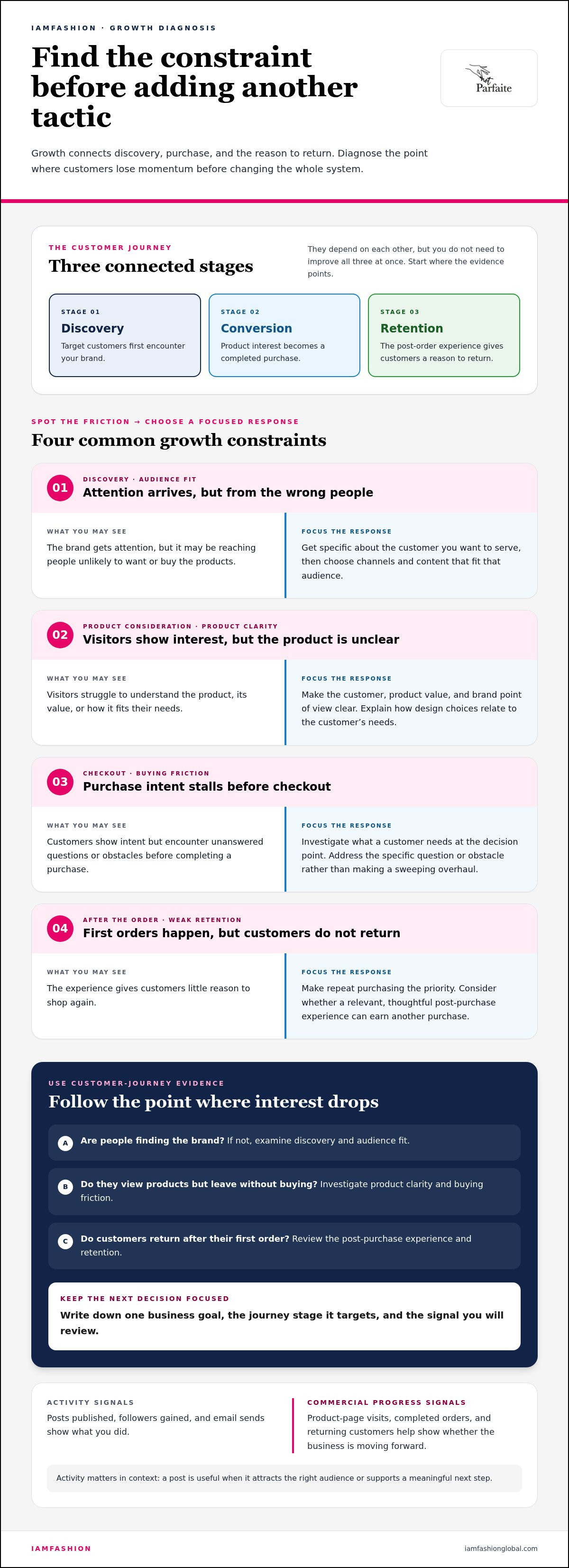
Creative attention can feel like momentum: people save a look, comment on a post, or visit your store. But attention alone doesn’t pay for production or create dependable sales. If you’re asking how to grow a fashion brand online, start by treating growth as a connected system: the right people discover your brand, understand why a product suits them, complete a purchase, and have a reason to return.
Thinking in stages makes diagnosis sharper. “Sales are low” is a symptom, not an explanation. More posting won’t fix a product page that leaves customers unsure about fit, and a smoother checkout won’t help if the people arriving aren’t your customers. Fashion marketing connects brand identity with product demand; the Fashion Marketing overview offers useful background on its role in brand development. For your next move, identify the constraint closest to the customer’s decision.
- Audience fit: The brand gets attention, but it may be reaching people unlikely to want or buy the products.
- Product clarity: Visitors are interested, yet struggle to understand the product, its value, or how it fits their needs.
- Buying friction: Customers show intent but encounter unanswered questions or obstacles before checkout.
- Weak retention: First orders happen, but the experience gives customers little reason to shop again.
Use evidence from the customer journey to choose among these possibilities. Look for where interest drops: Are people finding the brand? Do they view products but leave without buying? Do customers return after their first order? A focused diagnosis beats a sweeping overhaul. Choose the stage with the clearest friction, then investigate what a customer needs at that moment.
Which stage of the online customer journey needs attention first?
Discovery is where target customers first encounter your brand, through search, social content, or another route. Conversion is the shift from product interest to a completed purchase. Retention begins after the order: a relevant, thoughtful customer experience can earn another purchase. These stages depend on each other, but you don’t need to improve all three at once. Start where the evidence points.
Set a growth goal that fits your fashion business
Pick one near-term business outcome, not a collection of platform metrics. For example, if qualified visitors reach your product pages but hesitate, focus on increasing completed purchases from those visits. If customers buy once and disappear, make repeat purchasing your priority. Match the goal to your current capacity, product range, and customer. A narrow range may call for clearer product storytelling; a growing customer base may make post-purchase communication more relevant.
Separate activity from commercial progress. Posts published, followers gained, and email sends show what you did. Product-page visits, completed orders, and returning customers help show whether the business is moving forward. Activity still matters, but only in context: a post is useful when it attracts the right audience or supports a meaningful next step. Write down one goal, the journey stage it targets, and the signal you’ll review. That gives your next decision a clear basis.
Build online demand for a fashion brand with a clear audience and message
More channel activity doesn’t automatically create more demand. If you post across several platforms without a clear picture of who you want to reach, you can spend valuable time attracting attention that never turns into interest in your products. Start with the customer, then choose where and how to show up. That’s the practical answer to how to grow a fashion brand online: make every channel reinforce a message the right audience can recognize.
Get specific about the person you want to serve. Consider what they’re looking for in clothing, what shapes or materials they value, and what would make your design relevant to their wardrobe. You don’t need to appeal to everyone. A defined audience gives you a stronger basis for deciding which products to feature, what to say about them, and where to invest your attention.
Turn fashion-brand positioning into online content customers recognize
Build your message around three connected ideas: what you make, who it’s for, and what makes your approach distinct. Then translate design choices into customer-relevant meaning. Instead of describing a piece only by its cut or fabric, explain how its shape, feel, or styling suits the customer’s needs. Keep the language and visual direction consistent across your website and social profiles, so each encounter feels like the same brand.
Choose online channels based on audience fit, not trend pressure
Instagram and TikTok can help showcase a product through styling ideas, process, or founder-led storytelling, but the best fit depends on your audience and what you can create consistently. Search helps people find products and brands while actively looking; email gives you a direct way to reconnect with people who’ve chosen to hear from you. Treat each channel as a different job, not another box to tick.
Owned channels, such as your website and email list, give you more control over the message and customer experience. Social platforms can introduce your brand to potential customers, but you don’t control who sees each post or how discovery shifts. Balance the two according to your capacity. A founder who can produce strong, short-form styling content may test a social platform; a brand with useful product information can build search-friendly website content. Neither route guarantees reach or sales.
Before adding another platform, run a focused test. Choose one audience, one core message, and one or two channels that match your strengths. For instance, a brand might publish styling content on Instagram and improve product descriptions for search, then review which activity brings relevant visitors or product inquiries. Keep the test manageable and judge it by audience quality and meaningful next steps, not post volume alone.
- Audience: Who is most likely to value this product?
- Message: What should they understand about the brand or product?
- Channel: Where can you reach them with content you can sustain?
- Signal: What response would show that the message is attracting the right people?
Turn the answers into a simple channel workflow: plan a focused message, publish it where your audience is most likely to engage, and record the response. Creative Founder OS provides workflows, tools, and execution roadmaps for creative businesses, helping founders organize recurring actions. Explore IAMFASHION’s creative business resources as you shape a demand-building routine that fits your brand.
Convert fashion-brand website visits into orders: compare the key growth levers
A visitor can like a product and still leave without buying. The reason may be unclear product details, confusing store organization, a difficult checkout, or unanswered concerns about trust. These are separate conversion levers, so don’t change everything at once. Identify the customer’s likely hesitation, make one focused improvement, then measure what happens. That’s a practical way to learn how to grow a fashion brand online without relying on generic conversion benchmarks.
Use this comparison to find a useful starting point. Each lever answers a different customer question:
- Product-page clarity: “Is this the item I want, and do I understand what I’m buying?” Improve descriptions, imagery, and relevant product details so shoppers can assess the piece.
- Merchandising: “Where should I look, and which option suits me?” Organize products and categories so customers can find and compare relevant items without unnecessary searching.
- Checkout ease: “Can I complete this order without confusion?” Review navigation, form steps, and mobile readability to spot avoidable effort between choosing a product and placing an order.
- Trust: “Do I have enough information to feel comfortable buying?” Make essential details, including delivery, returns, and payment information, easy to find and understand.
These levers can overlap, but each points to a different fix. If shoppers browse several items but don’t add one to their cart, product information or merchandising may deserve attention. If they begin checkout and leave, inspect the steps and clarity of the purchase path. Treat these as clues, not proof. Use your own store activity and customer feedback to check whether a change addresses the actual friction.
Make product pages answer the questions that delay a purchase
Give every product a clear name, useful description, and imagery that helps customers understand what they’re considering. Present relevant details consistently, including fit, materials, care, and sizing where applicable. Then connect the design story to the shopper’s reason for interest: explain what distinguishes the piece or how it can meet a need. Strong product storytelling pairs creative intent with practical information.
Consistency matters. If one page explains fit clearly while another leaves it vague, shoppers have to work harder to compare. Use a repeatable structure for product information, but make each description specific to the item. Don’t rely on evocative language alone; pair the point of view behind the design with details a customer can use to decide.
Reduce avoidable friction between product interest and checkout
Review the store as a customer would. Start at the homepage or a product page, find an item, check its details, and proceed toward checkout on a mobile screen. Notice unclear navigation, hard-to-read text, repeated steps, or delivery, returns, and payment information that’s difficult to locate. Fix the obstacle you can identify before redesigning the whole store.
After making a change, compare the relevant signal with its earlier pattern, such as product-page engagement or checkout completion. Keep the review focused and record what changed. A page update may not resolve every hesitation, but a measured test gives you a stronger basis for the next decision than assumptions do.
Use retention and measurement to make fashion-brand online growth repeatable
A first order is the start of a customer relationship, not the finish line. Retention grows from what happens after purchase: whether customers receive useful information, feel understood, and have a reason to consider the brand again. A single campaign can prompt attention, but a consistent experience helps build a relationship that lasts beyond one transaction.
Make email useful, not noisy. Share relevant product information, brand stories, and updates that fit what customers care about and what your brand actually offers. A note about how to style or care for a purchased item can serve the customer differently from an update about a new release. Keep the message connected to the customer’s interests, and give each communication a clear purpose.
Track repeat purchases and customer feedback as separate signals. A returning order shows that a customer chose to buy again; feedback can help explain what they valued or where their experience fell short. One doesn’t automatically explain the other. Consider both before deciding what to improve in your products, communications, or post-purchase experience.
Review online growth signals without drowning in dashboards
Choose a small set of measures tied to your current goal. If you’re working on discovery, review traffic sources and the quality of visits. If you’re improving product interest, look at product-page activity alongside orders. For retention, track returning customers and feedback. The point isn’t to collect every available metric; it’s to use a few relevant signals to make a better decision.
Review patterns over a consistent period rather than reacting to every daily fluctuation. A change in traffic or orders can have several causes, so treat the numbers as clues, not a verdict. Keep a simple record of the time period, what you changed, what happened, and what you’ll test next. This creates a practical learning history you can use instead of relying on memory or guesswork.
Use this four-step cycle to make improvement part of your routine:
- Review signals: Check the measures connected to your current business goal, such as traffic source, product interest, orders, or returning customers.
- Identify friction: Look for the point where customers lose interest or where results don’t match the goal. Use feedback to add context.
- Test one change: Adjust one part of the experience or communication so you can see what the change may have influenced.
- Record learning: Note what you changed, what happened during the review period, and what question the next test should answer.
Keep the cycle manageable. If you’re trying to understand whether post-purchase email encourages return visits, focus the review on that communication and relevant customer signals rather than changing your site and social content at the same time. Clear records turn recurring actions into workflows. Creative Founder OS provides workflows, tools, and execution roadmaps for creative businesses, while IAMFASHION’s fashion brand growth resources can help you build a more structured approach to online development.
That’s how to grow a fashion brand online with more consistency: connect customer care to useful measurement, then use what you learn to choose the next focused action.
Turn your fashion brand online growth plan into a focused next step
A growth plan only works when it fits the business you’re building. Link discovery, conversion, and retention, but don’t try to overhaul every stage at once. Choose one current constraint, one action that addresses it, and one signal that will help you judge the result. That focus gives your creative direction a commercial purpose without adding a new list of disconnected tasks.
Use the next 30 days to move from diagnosis to learning. Keep the plan grounded in your capacity, product range, and customer, then write down what you intend to test before you begin.
- Week one, establish your baseline. Review the customer journey and select its most important constraint. Note the current signal you’ll use to assess it, such as visits from a relevant source, product interest, completed orders, or returning customers.
- Weeks two and three, make one focused improvement. Choose an action that targets the constraint, then communicate it consistently. If customers need a clearer reason to consider a product, for example, update its story across the page and the channel directing visitors there.
- Week four, review and decide. Compare the signal with your baseline, record what changed and what you learned, then choose the next practical test. The aim is a better-informed decision, not a promise that one change will transform sales.
Keep a short written record of the action, the audience it was meant to serve, and the result you observed. Repeatable workflows make useful work easier to carry forward, even when day-to-day demands compete for your attention. That’s how to grow a fashion brand online with discipline: build from evidence, not pressure to be everywhere.
Create a 30-day online growth action plan
Use this month as a focused learning cycle, not a deadline for perfect results. Set aside a review point at the end of week four, and resist adding extra changes before you can assess the first one. A clear record helps you separate what you tried from what you learned, so the next test builds on experience rather than starting from scratch.
When structured fashion-brand guidance can help
Some founders want support turning a plan into consistent execution. IAMFASHION’s Brand Boost is a 12-month fashion-business development program combining AI-driven marketing techniques, modern brand strategies, and hands-on mentorship. Creative Founder OS provides workflows, tools, and execution roadmaps for creative businesses, helping founders organize recurring actions.
Choose the level of structure that matches your next challenge. If your priority is guided development, explore Brand Boost; if recurring tasks need clearer workflows, consider Creative Founder OS. Either way, keep the operating principle simple: identify the constraint, act with focus, review a useful signal, and carry the learning into your next decision.
Give your next growth move the structure to scale
Your next step doesn’t need to be a bigger campaign. It needs to be a decision you can follow through on, learn from, and build into the way you run your brand. That’s how to grow a fashion brand online with intention: turn creative ambition into consistent action, then use what you learn to move forward.
IAMFASHION has supported brand growth since 2020. For founders who want guided execution, Brand Boost combines a 12-month development program with mentorship and modern marketing strategies. Explore IAMFASHION’s Brand Boost and Creative Founder OS to find structured support that fits how you want to develop your business.
Your vision deserves more than scattered effort. Choose your next move and build a more focused routine with IAMFASHION’s Brand Boost or Creative Founder OS.
Frequently Asked Questions
How long does it take to grow a fashion brand online?
There’s no reliable timeline that applies to every fashion brand. Progress depends on the offer, audience, starting point, and how consistently you execute and learn. Rather than setting a deadline for growth, choose a measure that matches your current goal and review it at regular intervals. For example, track whether a new product page brings more qualified inquiries over time. Use the pattern to guide decisions, not as a guaranteed forecast.
Can a small fashion brand grow online without a large marketing budget?
Yes, a small brand can build online growth by focusing its effort before expanding its spend. Get clear on the customer you want to reach, make product information easy to understand, and use owned customer relationships, such as email, thoughtfully. Try manageable experiments, like adjusting one product description or testing a content idea, then assess the response. This approach helps you learn with limited resources, but it can’t guarantee sales or a particular pace of growth.
What should a fashion brand post on social media to get more customers?
Share content that helps the right customer understand your products and the thinking behind them. Show how a garment can be styled, explain a design choice, answer a common product question, or share a behind-the-scenes moment that reflects your brand’s point of view. Keep the message consistent with the product and customer need. Watch for meaningful responses, such as product questions or visits to relevant pages, but don’t assume any post will guarantee reach or orders.
How can I get more traffic to my fashion brand website?
Focus on attracting relevant visitors, not simply increasing the traffic total. Choose discovery channels that fit your customer and the content you can sustain, such as search-friendly product information or social content that leads to a specific page. Set a measurable goal, such as more visits to a particular product category from a chosen source. Then review whether those visitors explore products or take another useful action, and refine the channel accordingly.
Do fashion brands need email marketing to grow online?
Email can help a fashion brand communicate directly with interested customers, share useful product updates, and stay connected between purchases. It isn’t the only route to growth, and it shouldn’t replace channels that help new customers discover the brand. Treat email as one part of a balanced plan: send relevant messages that reflect what subscribers care about, then consider engagement and repeat activity alongside results from other channels.
How do I know whether my fashion brand is ready to grow online?
You’re better prepared to grow when you can explain who your customer is, present products clearly, and handle the orders your business is working to attract. Check practical details such as whether product information is complete and whether your current operations can manage incoming orders. Also choose a few signals to review, like product interest or completed orders. Readiness isn’t about having everything perfect; it’s about being able to respond and learn.
What is the first step to growing an online fashion brand?
Identify the main constraint in your customer journey before choosing a tactic. If target customers aren’t finding your brand, investigate discovery. If visitors view products but don’t proceed, examine what may be unclear or inconvenient. If first-time buyers rarely return, look at the experience after purchase. This diagnosis gives you a more useful starting point than copying a trend. It’s the first practical move in figuring out how to grow a fashion brand online.