Your label doesn’t need more disconnected growth ideas. It needs a clear way to turn creative direction into business decisions you can repeat. The right online business program for fashion labels should help you set priorities, connect brand strategy with practical online growth, and move from planning to execution.
If you’re unsure whether a program fits your label’s stage, start by naming the business challenge you want to address. Growth takes more than inspiration: it calls for relevant guidance, focused priorities, and systems that help you follow through. You’ll learn what to look for, how to assess fit, and which outcomes matter beyond a credential.
IAMFASHION supports fashion designers and creative brand owners in developing their businesses online. Its 12-month Brand Boost program combines AI-driven marketing techniques, modern brand strategies, and hands-on mentorship for founders building and scaling online. For the execution side, Creative Founder OS provides workflows, tools, and roadmaps. This guide explains how to choose a growth path that fits your label and turn ideas into practical business action.
Key Takeaways
- Distinguish business development support from a degree or subject-based course by focusing on how learning applies to your own label.
- Assess an online business program for fashion labels by its focus, intended audience, practical application, guidance, and support for execution.
- Connect brand strategy, marketing, and business operations so your growth priorities work together instead of becoming another disconnected list of ideas.
- Turn what you learn into a focused action plan by choosing priorities that fit your label’s stage and translating them into practical next steps.
- Explore how IAMFASHION’s Brand Boost combines AI-driven marketing techniques, modern brand strategies, and hands-on mentorship in a 12-month program.
What Is an Online Business Program for Fashion Labels?
An online business program for fashion labels is founder-focused support that helps designers apply business strategy to building or developing their own label. Unlike a degree, which typically provides broader academic or career preparation, or a standalone course focused on one subject, a growth program connects learning to the decisions a founder faces in their business.
That distinction matters. A designer may have a strong point of view and a compelling collection, yet still need to decide how to position the label, reach the right customers, and direct limited time toward the most useful priorities. Strategy doesn’t replace creative instinct. It gives that instinct a commercial framework, so choices about the product, brand, and online presence support the same direction.
A fashion-label business program turns a founder’s vision into clearer priorities and practical steps for developing the label. The focus is not simply learning about the fashion industry; it’s learning to make informed decisions for a specific business. A fashion brand is shaped by how it distinguishes itself, so founders need to connect their creative identity with the way they present and market the label.
Who Can Benefit From a Fashion Label Business Program?
It can suit designers translating a concept into an online business, from clarifying who the label serves to deciding how its products and identity should be presented. It can also help an active label set sharper priorities for its next stage. The founder’s goal is to develop a business, not only to prepare for a fashion-industry role such as merchandising, design, or marketing.
For example, a founder might be weighing new product ideas alongside content, brand messaging, and customer outreach. A business-growth lens brings those choices back to the label’s direction and current needs. The aim isn’t to dictate what the designer creates. It’s to help the founder choose what to focus on and connect that work to a viable business.
What Makes Online Support Relevant to Fashion Brands?
Online delivery can make learning and guidance more workable for founders managing a label alongside other commitments. It also creates room to apply business concepts directly to current decisions, rather than treating learning as separate from day-to-day work. The format alone, however, doesn’t guarantee relevance. Guidance needs to account for fashion-specific questions, including how customers interpret a label’s positioning and how digital marketing expresses its identity.
Those questions are connected. A change in target customer may affect the brand message, product presentation, and marketing choices. Fashion-focused support helps founders examine these links in context instead of collecting generic tactics that may not fit their label. A new designer shaping an initial concept and an established label refining its direction may need different areas of focus, so assess whether a program’s approach suits the work in front of you.
Look for a growth path that respects the creative vision while making business decisions more deliberate. A good fit should help you move from broad ambition to choices grounded in the label’s stage, audience, and priorities.
What Should an Online Fashion Business Program Help You Build?
A useful online business program for fashion labels should help you connect the decisions that shape growth, not just collect ideas under separate topics. Strategy sets direction, marketing communicates why the label matters to its intended customers, and operations give the founder a way to carry that work forward. When these capabilities reinforce one another, a marketing choice can serve a clear business goal instead of becoming another task on an already crowded list.
Look for learning that leads to founder decisions. For instance, if a label wants to reach customers who value its design point of view, the founder needs to clarify the audience, communicate the label’s distinctive value, and choose marketing activity that supports that positioning. Operational routines then make the work manageable. Useful learning leaves the founder with a decision to make and a next action to take, not only notes to revisit later.
From Brand Strategy to Online Marketing Priorities
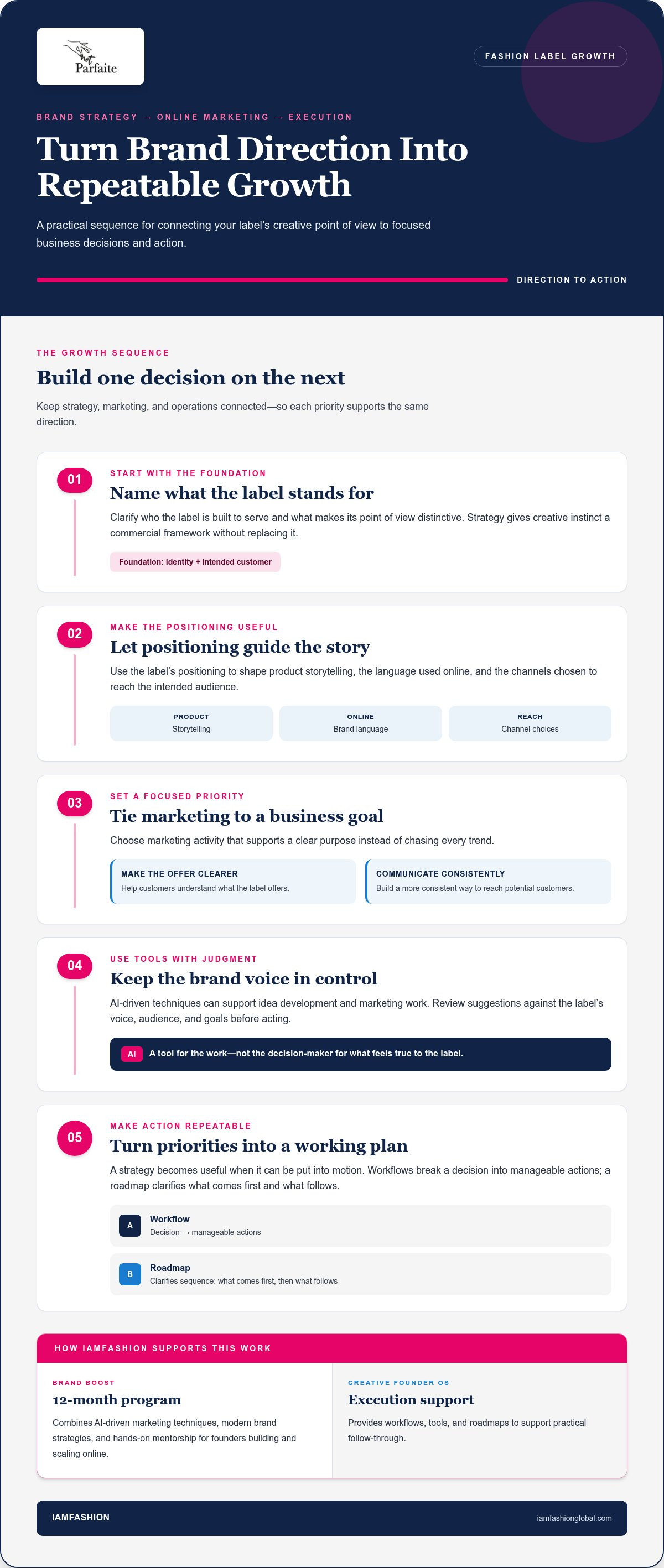
Start with what the label stands for and who it is built to serve. That positioning can guide product storytelling, the language used online, and the channels chosen to reach the intended audience. Then connect marketing priorities to a business goal, such as making the label’s offer clearer or creating a more consistent way to communicate with potential customers. This keeps the plan anchored to the brand rather than chasing every trend.
Fashion founders also benefit from keeping creative judgment at the center of modern marketing. AI-driven techniques can support idea development and marketing work, but they don’t decide what feels true to the label or relevant to its customers. Treat AI as a tool: review its suggestions against the brand’s voice, audience, and goals before acting. For broader context, the U.S. Bureau of Labor Statistics offers apparel industry economic data that can inform a founder’s view of the sector.
From Business Ideas to Repeatable Execution
A strategy becomes useful when the founder can put it into motion. Workflows break a decision into manageable actions, while a roadmap helps clarify what comes first and what follows. If a label chooses to strengthen its online presentation, for example, the founder can define the key message, identify the content needed to communicate it, and set a routine for creating and reviewing that content. The specific actions should reflect the label’s priorities, not a generic checklist.
An operating framework is different from a folder of unrelated tips. It connects decisions, tools, and repeatable steps so the founder has a process to return to as the business develops. IAMFASHION’s Creative Founder OS is a structured framework with workflows, tools, and execution roadmaps. For founders looking to build and scale online, IAMFASHION’s 12-month Brand Boost program brings together AI-driven marketing techniques, modern brand strategies, and hands-on mentorship.
How to Evaluate an Online Business Program for Your Fashion Label
Choose based on the business problem you need to solve, not the most impressive-sounding format. A degree, a focused course, and business development support can each be valuable, but they serve different purposes. Compare what you’ll learn with what your label needs to do next. The strongest fit should help you close a real gap, whether that means understanding a subject or making progress on your own business priorities.
Use these criteria to compare options:
| Criteria | Career education | Subject-based course | Business development support |
|---|---|---|---|
| Focus | Builds broad knowledge for fashion-related career paths. | Explores a defined subject, such as branding or marketing. | Connects business priorities to a label’s growth needs. |
| Intended audience | Students or professionals preparing for or advancing in industry roles. | Learners seeking to develop a particular skill or area of knowledge. | Designers and founders building or developing their own label. |
| Application | Applies learning across career settings and industry contexts. | Applies concepts to a specific topic or skill. | Relates decisions and activities to the founder’s own business. |
| Guidance | May follow a formal academic structure and learning pathway. | May focus on instruction and subject materials. | Can include guidance that supports founder decision-making. |
| Execution | May prioritize academic progress or career preparation. | May end with understanding a subject or completing learning activities. | Emphasizes translating business choices into practical next steps. |
This comparison isn’t a ranking. A degree or certificate can be the right choice if you want deeper study, academic learning, or preparation for a fashion career. A standalone course can make sense when you’ve identified a specific skill gap. Business development support is more directly relevant if your priority is applying strategic guidance to the label you’re building.
Match the Program to Your Label’s Current Stage
Match the program to your brand’s current development stage and business objective. The stages are defined by the work the brand needs to address:
- Beginner brands: Focus on achieving product-market fit, defining their ideal client profile, sharpening messaging, and establishing competitive positioning. Brand Boost aligns with this stage when the brand is aiming to generate up to €300k per year.
- Mid-advanced brands: Have an established best-selling product and previous sales success, but lack systems for consistent sales generation. Brand Boost aligns with this stage when the brand is aiming to generate up to €300k per year.
- Fast-growing brands: Need to drive consistent traffic and optimize their customer acquisition and retention systems. Brand Boost aligns when the brand is aiming to generate up to €300k per year; Creative Founder OS aligns with founders at €1M or more in revenue who need to optimize internal processes and reduce their operational workload.
Check for Fashion Context and Practical Application
Look for learning that understands the realities of a creative founder and connects brand strategy with online marketing and business decisions. Then assess how ideas become action: are there practical applications, a clear way to set priorities, and structured support for execution? Mentorship can also matter, especially if you value guidance as you work through decisions. Judge the support by its relevance to your label, not by broad promises.
Before choosing an online business program for fashion labels, write down one outcome you need and the obstacle currently standing in its way. Use those as your filter. A close match should make the next useful step clearer while leaving room for your label’s creative identity and stage of development.
How to Turn Program Learning Into a Fashion Label Action Plan
Learning creates value when it changes what you do. Turn useful ideas into a short plan for your label, then make room to act and review. This isn’t a complete scaling roadmap or a step-by-step marketing tutorial. It’s a way to keep new information from becoming another disconnected list of tasks.
Use this sequence to move from insight to execution:
- Name the business question. Identify the issue behind your current activity. Are you unclear about who a product is for, how to express the label’s value, or which marketing decision deserves attention?
- Choose one priority. Tie that question to a defined audience, a brand goal, or a specific marketing decision. Avoid adding several priorities at once; focus gives you a clearer basis for action.
- Define the next action. Make the priority concrete. If your question is whether your online messaging speaks to the intended customer, one action could be reviewing how your product descriptions communicate the label’s value to that audience.
- Assign ownership and a review point. Decide who will take the action, what work it involves, and when you’ll look at what happened. Choose a review rhythm that fits your business rather than relying on a universal target.
- Adjust based on what you learn. At the review, note what moved forward, what remains unclear, and what next action makes sense. Continue, refine, or replace the priority based on what you observe.
Choose One Priority Before Adding More Tactics
Start with the business question, not the tactic you feel pressured to try. If your label is publishing content but its intended audience and core message aren’t clear, more posting may not address the underlying issue. Clarify who you want to reach and what the brand needs to communicate first. Then choose a marketing action that supports that goal, instead of adding activity simply because a trend is getting attention.
Build a Short Execution and Review Rhythm
Keep the actions small enough to own and clear enough to revisit. A repeatable workflow can capture the priority, next step, owner, and review point, helping you make progress without turning the plan into an unwieldy roadmap. IAMFASHION’s Creative Founder OS provides workflows, tools, and execution roadmaps to support operational consistency. The aim is a useful rhythm: act, review, and decide what comes next.
Put the approach to work with the fashion brand growth guidance from IAMFASHION. A focused plan gives your learning somewhere to go: into deliberate choices, owned actions, and a review process that keeps the label moving without chasing every new idea.
How IAMFASHION Supports Online Growth for Fashion Labels
Choosing support is useful when it helps you move from a business challenge to focused action. IAMFASHION supports fashion designers and creative brand owners with online business development, bringing fashion-specific context to the work of building and developing a label. IAMFASHION has supported brand growth since 2020, with offerings designed around creative founders rather than a general audience of learners.
Two distinct forms of support address different stages and operating needs. Brand Boost is for brands aiming to generate up to €300k per year, bringing together marketing techniques, brand strategies, and mentorship for founders developing and scaling online. Creative Founder OS is for founders with €1M or more in revenue and is designed to optimize internal processes and reduce the operational workload on the founder through workflows, tools, and execution roadmaps.
Brand Boost: Structured Development for Fashion Founders
Brand Boost is designed for fashion designers and creative brand owners developing an online fashion business. Its 12-month structure combines AI-driven marketing techniques, modern brand strategies, and hands-on mentorship. These components connect different parts of the founder’s challenge: shaping a clear brand direction, considering how to communicate it online, and getting guidance while working through business decisions.
AI-driven techniques are part of the marketing approach, while brand strategy keeps that work connected to the identity and goals of the label. Mentorship adds a human guidance element as founders put those ideas in context. The program provides structured support for building and scaling online. Its focus is bringing these elements together for fashion founders.
Creative Founder OS: A Framework for Business Execution
Creative Founder OS focuses on how business work is organized and carried out. It provides workflows, tools, and execution roadmaps, giving founders a framework to structure their priorities and move through practical tasks. Think of it as operating support rather than a standalone fashion marketing course: it concerns the processes that help turn business decisions into planned work.
The framework can be relevant when a founder wants more structure around execution, while Brand Boost brings together strategic development, marketing techniques, and hands-on mentorship in a defined program. Both address the need to connect creative direction with business practice, but they emphasize different parts of that work. Consider which kind of support best aligns with your current priorities.
If you’re ready to explore structured support for your label, explore IAMFASHION’s programs and consider whether Brand Boost or Creative Founder OS aligns with the work you want to move forward. Start with the challenge in front of you, then choose the path that helps you approach it with greater focus and a practical basis for action.
Make Your Next Move With Purpose
Your label’s next stage doesn’t need another burst of inspiration followed by scattered activity. It needs a deliberate choice about what deserves your attention now. Before you commit to an online business program for fashion labels, name the business question you want to answer and the kind of support that would help you act on it. That simple filter can keep your growth path grounded in your label’s real priorities.
Then give your creative ambition room to become a business direction. Choose a focus, make a practical move, and use what you learn to decide what comes next. Progress isn’t about chasing every opportunity at once. It’s about building the judgment and structure to make each move count.
Build your fashion label with a clearer plan. Explore IAMFASHION’s programs and take the next step with focus. Your vision deserves a business strategy that moves with it.
Frequently Asked Questions
Is an online business program suitable for a fashion label that has not launched yet?
Yes, it can help a pre-launch founder turn a promising concept into considered business choices. An online business program for fashion labels may be useful as you define the customer you want to serve, clarify what makes your label distinct, and decide which launch questions to answer first. You don’t need every detail resolved before starting. Bring your current assumptions and use the learning to examine them, rather than treating them as fixed.
Can an online program help an established fashion label?
Yes. An active label can use a program to examine a specific challenge, such as inconsistent brand messaging or uncertainty about which marketing activity deserves attention. Bring a real example from the business, like a product page that doesn’t clearly communicate the label’s value, and use it to make the learning more relevant. Support is most useful when it helps you assess the issue and choose a practical next move, rather than adding tactics without a clear purpose.
How much time should I set aside for an online fashion business program?
There isn’t one time commitment that suits every online program or founder. Review the program’s stated schedule and learning format, then consider the time you can realistically protect alongside design work and business responsibilities. Leave space not only to engage with learning, but also to apply it to your label. A smaller, regular work block may be more workable than waiting for a free stretch of time that never arrives.
Is an online fashion business program only for designers?
No. Fashion designers can benefit, but so can creative brand owners who lead the business side of a label. A founder may shape the brand direction, manage marketing decisions, or coordinate business activity without personally designing every product. IAMFASHION’s programs are designed for fashion designers and creative brand owners. Consider whether your role involves building or developing a fashion business, and whether the support connects to the decisions you’re responsible for making.
Can AI replace a business strategy for a fashion label?
No. AI can assist with marketing work, but it can’t replace a founder’s understanding of the label, its customers, or its priorities. For example, a tool might help generate ideas for a campaign, but you still need to judge whether those ideas express the brand accurately and speak to the audience you intend to reach. Use AI as support for your thinking, not as the source of your business direction.
What should I prepare before starting an online business program?
Prepare a simple snapshot of your label, not a polished business plan. Note what you sell or hope to sell, who you believe the customer is, how you currently present the brand online, and the question that feels hardest to answer. Add relevant examples, such as a product description or recent marketing decision. This gives you a concrete starting point and helps you connect new learning to your own business.