AI marketing for fashion brands should do more than generate content. It can personalize product recommendations, improve shopping experiences, and help teams evaluate influencer campaigns using conversions, order value, and content costs. The strongest approach combines AI’s speed with human judgment, so recommendations and campaigns remain true to the brand.
Personalization can make product discovery more relevant, while virtual try-ons and AI-assisted creative tools offer new ways to engage shoppers. But adopting technology is not a strategy in itself. The key is choosing where it can improve the customer experience and business results. This guide explores fashion examples in recommendations, retail innovation, and AI-supported influencer marketing, then explains how to measure whether an idea is working. You’ll learn what AI can streamline, where creative direction matters, and how to turn useful experiments into a disciplined growth system.
Key Takeaways
- Use customer signals to make product recommendations more relevant, while keeping the brand’s point of view in control.
- Explore AI for retail experiences and creative workflows, then focus on the applications that make shopping easier or help your team work smarter.
- Measure experiments against conversion, order value, and content costs so you can distinguish useful growth from activity that only looks impressive.
Personalized customer recommendations
Personalization starts with useful signals, not a larger pile of customer data. Over 71% of consumers desire personalized brand experiences. For fashion brands, AI can use browsing behavior, purchase history, sizes, and stated preferences to shape product recommendations, styling suggestions, and campaigns.
Patagonia example: Customers browsing Worn Wear need relevant resale options. Patagonia uses AI to personalize recommendations and optimize inventory for its Worn Wear resale program. This supports more tailored product discovery and inventory planning.
Turn those signals into a practical workflow. Group products by attributes such as cut, color, material, and occasion. Use browsing and purchase patterns to recommend complementary pieces, similar styles, or suitable alternatives. Before launching a campaign, review the recommendations against your brand’s customer messaging.
Gucci example: Shoppers considering sunglasses couldn’t try every style through a screen. In 2019, Gucci partnered with Snap on an augmented-reality virtual try-on experience. It let shoppers see frames on themselves, making product evaluation more interactive.
AI-driven customer engagement can also support personalized styling. A shopping assistant might ask whether someone needs an outfit for work, travel, or an event, then suggest items based on their choices. AI shopping agents can organize discovery around those preferences, while a human editor keeps recommendations aligned with the collection and current trends.
For US marketing, handle customer data transparently, protect it, and respect people’s choices. Use images and other creative assets you own or have permission to use. Identify AI-created or altered content when needed to avoid misleading shoppers.
Keep human review in the loop. The National Institute of Standards and Technology warns that inaccurate data can contribute to bias and erode public trust. Check recommendations across customer groups, remove irrelevant or exclusionary results, and improve the experience using shopper feedback.
Risks include inaccurate assumptions about size or style, repetitive suggestions, and recommendations that limit discovery. Test one product category first, compare AI suggestions with human-curated options, and track whether the experience makes it easier to find relevant products.
AI marketing and retail innovation
The right AI tools depend on the task: product visualization, inventory planning, creative development, or customer engagement. Compared with traditional marketing, AI can identify patterns and support faster, more tailored decisions. Human teams still set the brand direction and approve the work.
Fashion brands use AI in design, shopping, and social media. Start with one business problem, then choose a platform that fits your data, workflow, and creative needs. Test it on a focused task before expanding its role.
Norma Kamali example: A designer’s archive held decades of visual references. Kamali trained a custom AI model on 57 years of fashion archives, turning that history into a resource for new creative exploration. The case shows how a brand can use its own distinctive material to develop ideas while preserving a recognizable point of view.
Collina Strada example: Translating experimental concepts into garments presented a creative challenge. The brand developed AI-generated garment concepts and brought them to life for its Spring 2024 collection. The result connected digital ideation with physical styles, rather than leaving the concepts on screen.
Tommy Hilfiger example: During Metaverse Fashion Week, the brand partnered with the Fashion Innovation Agency in 2023 on AI-driven generative design. The collaboration explored how digital environments could support fashion design and presentation.
Moncler and Valentino example: Both brands have created unique visual advertising materials with generative AI since 2023. Their cases show how AI can help develop campaign imagery, while brand teams retain control over the final creative choices.
To implement AI, map a repetitive task, define the desired result, and choose a small test. Review generated styles and copy for brand fit, then track workflow changes before scaling. For a fashion business, building a focused growth system can help connect new tools with commercial priorities.
The best AI marketing tools depend on whether a brand needs product visualization, inventory planning, creative development, or customer engagement. Choose a platform that fits the brand’s data, workflow, and creative needs, then test it on a focused task before expanding its role.
Measuring AI’s effects on conversion, order value, and content costs
Set a baseline before adding an AI-powered recommendation, styling feature, or content workflow. Record conversion rate, average order value, and production time for the same product category. Then compare the test group with a similar group using the existing experience.
For recommendations, track clicks, completed purchases, and basket value together. A higher click rate alone doesn’t show whether shoppers bought or spent more. Compare results by product type and traffic source, then keep the recommendation logic that contributes to business outcomes.
Rhone example: Rhone reported a 10x return on investment within 100 days. Treat that result as a case to examine, not a target for every brand. Before launching a project, define the investment being assessed and which tracked outcomes will count toward its return.
AI can enhance product photography and creative content by generating variations from approved campaign assets. Use it to explore backgrounds, crops, or styling concepts while preserving garment details and brand vision. Compare the workflow with your current production process, including editing time, review rounds, and the effort required to correct artificial imagery.
Tool costs depend on the platform, its features, usage, and integration needs. Compare these factors, then assess them against the tasks and content volume you plan to support.
Measure content costs per usable asset, not per generated image. Include human review and revisions in your calculation. If an AI workflow produces more drafts but adds correction work, the apparent time saving may disappear.
Run one controlled test at a time. Set a start date, choose a product category, and compare performance over the same period. Record the creative version, audience, and changes made. This helps teams distinguish a real improvement from seasonal demand, new promotions, or shifts in traffic.
AI-supported influencer marketing
Choose influencers based on customer fit, not follower count. For a new denim launch, define the audience, style preferences, and campaign goal before reviewing creators. AI-powered services like advocators.ai demonstrate how technology can sort public social media signals, captions, and visual content to find authentic messengers whose values align with those choices.
Example, creator discovery: A label wants to reach shoppers interested in occasionwear, but the creator pool is crowded and audiences vary. The team uses AI to group public posts by garment style, tone, and audience engagement. It then assesses whether shortlisted creators drive relevant visits and product interest, not just reach.
Example, campaign matching: A brand plans a capsule collection and needs content that reflects its design vision. It compares creator content with collection imagery and customer preferences, then asks human reviewers to assess tone and fit. This combines computer analysis with editorial judgment. Track referral visits, product views, and completed orders by creator to see which partnerships support the campaign goal.
AI can also support customer engagement after publication. A team can categorize comments and recurring questions, then prepare answers about fit, fabric, or styling for human review. This turns customer behavior into useful insight without letting automated replies speak in an unapproved brand voice.
Keep the process disciplined. Set a baseline, use consistent campaign links, and record each creator’s content format, audience fit, and results. Separate organic interest from paid amplification, and compare similar products or campaign periods. Review visual outputs for inaccurate garment details, misleading styling, or a mismatch with the collection.
The takeaway: let intelligence narrow the field and surface patterns, but keep creator relationships and creative decisions human-led. Start with one campaign question, such as which creator brings qualified product-page visits. Expand only when the evidence supports the next move. Build a focused fashion growth strategy that connects creator activity with your commercial priorities.
IAMFASHION: Brand Boost
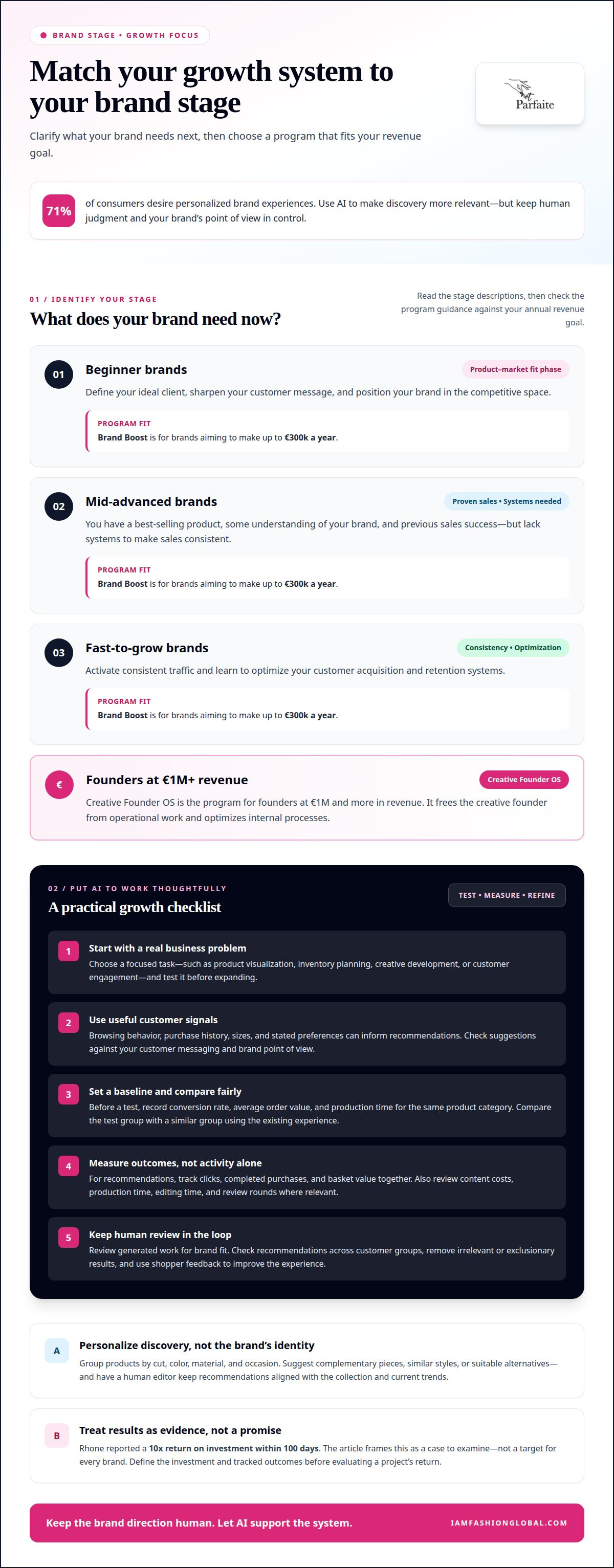
IAMFASHION’s Brand Boost helps fashion designers and creative brand owners build and scale their businesses online through a comprehensive 12-month program.
Choose Brand Boost if you’re a beginner brand seeking product-market fit and need to define your ideal client, customer message, and competitive positioning. It also suits mid-advanced brands with a best-selling product and previous sales success but no systems for consistent sales.
It helps creative founders reduce operational work and improve internal processes.
Turn your next AI test into a growth decision
Choose one customer or operational challenge, then decide what evidence would justify expanding the experiment. This keeps AI marketing for fashion brands connected to commercial priorities instead of letting new tools dictate strategy. Keep creative direction in human hands and build repeatable processes.
IAMFASHION offers Brand Boost and Creative Founder OS to fashion founders at different stages of business growth. The right next step depends on whether you’re strengthening your brand’s commercial foundations or improving how the business runs. Choose based on the constraint you need to solve, not the technology that happens to be trending.
Bring your goals and current challenges into a conversation. Contact IAMFASHION to discuss AI marketing and identify a practical direction for your brand. Your creative vision can lead, while a sharper operating strategy helps you move forward with purpose.
Frequently Asked Questions
What is AI marketing for fashion brands?
AI marketing for fashion brands uses artificial intelligence to support marketing decisions and tasks across a fashion business. For example, a team could analyze opted-in customer preferences to shape launch messages for different product interests. AI helps process information and generate options, while people decide what fits the brand, check accuracy, and approve customer-facing content.
How can fashion brands measure the ROI of AI marketing?
Compare the added value of an AI-supported activity with its full operating cost. For a campaign, track attributable sales or contribution margin, then subtract platform, production, and review costs. Compare the result with a similar campaign or control group, accounting for other changes such as discounts or traffic sources. Use the same method across tests.
What are the best AI marketing tools for fashion brands?
The best AI marketing tools depend on the task, such as product visualization, inventory planning, creative development, or customer engagement. Choose a platform that fits your data, workflow, and creative needs, then test it on a focused task before expanding its role.