Equity isn’t the only way to assess an accelerator’s value. To evaluate fashion accelerator program cost and ROI, compare the program’s full operating costs with the financial and business outcomes it produces. Then calculate the cost per founder and per clearly defined outcome.
That distinction matters. A program may help founders build stronger sales systems, validate products, or make business progress without taking equity. But ambition alone does not make the numbers work. Assess operating costs, define outcomes, and identify when measurable returns cover the spend.
This guide lays out a practical way to assess those returns, build a break-even plan, and track outcomes over time. You'll see how to separate direct program costs from broader operating expenses, choose useful founder and business measures, and interpret cost per outcome without mistaking activity for impact. The result is a sharper basis for deciding whether an accelerator model is sustainable and where to focus its next investment.
Key Takeaways
- Measure accelerator value without equity by tracking business outcomes and comparing them with program costs, not by relying on ownership returns alone.
- Plan for break-even by connecting operating costs, revenue, and gross margin; use the resulting picture to understand what must change for the model to sustain itself.
- Calculate cost per founder and cost per outcome separately. These measures reveal whether spending is reaching participants and producing meaningful progress.
Profitability and return on investment
Funding, grants, and investment are not automatically part of an accelerator. Founders receive capital only if the program provides it or they secure a separate grant or investment. Treat funding as a possible financing outcome, not guaranteed revenue for the accelerator.
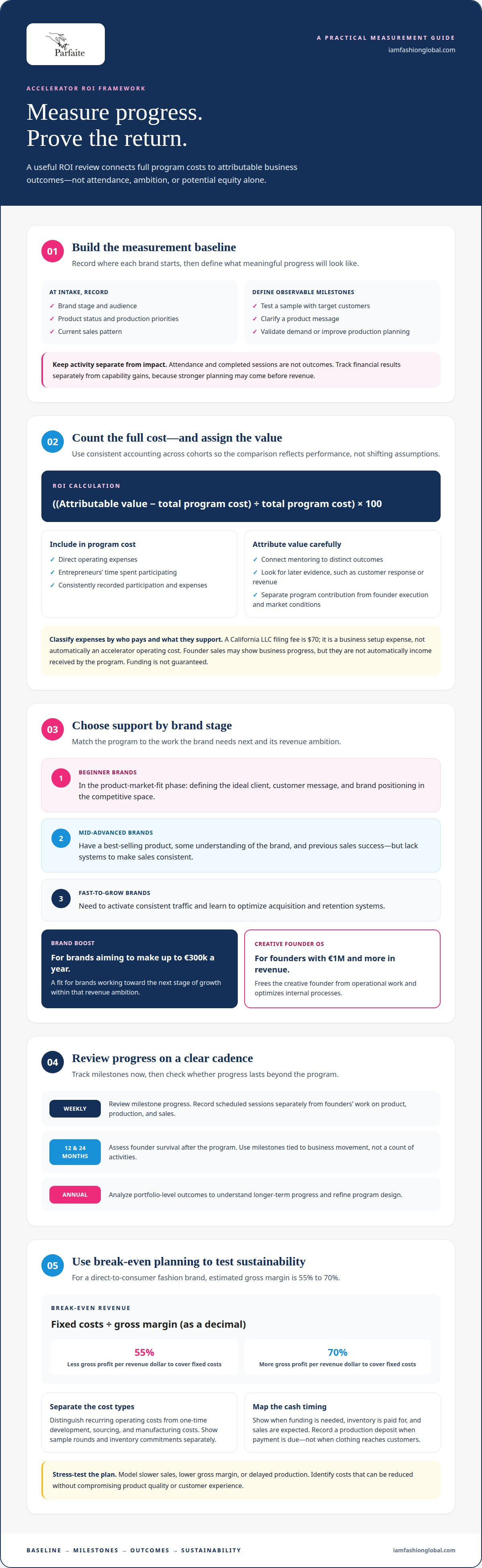
Measure return on investment by comparing the value attributable to the program with its full cost. A useful calculation is (attributable value minus total program cost) divided by total program cost, then multiplied by 100. Include direct expenses and the time entrepreneurs spend participating. Keep assumptions consistent across each cohort so the result reflects program performance, not shifting accounting choices.
Separate accelerator expenses from startup costs. For example, California’s LLC filing fee is $70, according to the California Secretary of State. That filing is a business setup expense, not automatically an accelerator operating cost. Categorize each expense by who pays it and what it supports. This gives founders and program operators a clearer view of capital needs and prevents business formation costs from distorting program profitability.
Trace value through a fashion business example. If mentoring helps a founder refine a sample, define an audience, and improve product positioning, record each as a distinct outcome. Connect those changes to later evidence, such as customer response or revenue, rather than counting every completed session as a financial return. Skills and progress matter, but linking them to business results makes the ROI assessment more useful.
For an equity-free program, don’t rely on potential future ownership gains to justify operating costs. Assess value through founder progress, stronger business decisions, or revenue development, and distinguish that value from cash received by the accelerator. A founder’s sales can show business progress, but they aren’t automatically program income. Specify who benefits from each result.
Compare the same measures across cohorts and time periods. Consistently record program expenses, participation, and defined business outcomes. Separate changes associated with accelerator support from those driven by the founder’s execution or market conditions. This helps entrepreneurs assess profitability, refine program design, and decide whether the model creates enough measurable value to continue.
Accelerator ROI measurement framework
Build the framework around a baseline, milestones, and outcomes that matter to a clothing business. At intake, record each brand’s stage, audience, product status, sales pattern, and production priorities. Link each strategy session to an observable change, such as testing a sample with target customers or clarifying a product message. That way, attendance does not stand in for progress. Track financial outcomes separately from capability gains, since stronger planning may come before revenue.
Fashion accelerators, general startup accelerators, and fashion incubators differ in focus and delivery, so compare what they offer before comparing ROI. A fashion program may address clothing development, sourcing, and fashion-industry sales. A general accelerator may emphasize broader startup growth, while an incubator may focus on earlier-stage development. Compare the support, access, time commitment, and equity terms with the outcomes each program targets. Applications may ask founders to explain their concept, audience, product status, and growth strategy. A concise account of each helps show how the program fits the brand.
Program length and weekly workload depend on format, curriculum, mentoring, and the work expected between sessions. Record scheduled participation separately from the founder’s work on product, production, and sales. Consider the trade-offs: sessions can take time away from customers, advice may not suit the brand’s stage, and equity terms can reduce future ownership. A brand preparing a sample may benefit more from focused product feedback than a broad growth agenda.
Review milestone progress weekly, then assess founder survival 12 and 24 months after the program. Use milestones that connect support to business movement, such as validating demand, improving production planning, or establishing a repeatable sales strategy. Don’t count every activity as an outcome; define what successful progress looks like before tracking it. Run annual portfolio-level analysis to examine long-term founder outcomes and refine the program. This separates a short-term burst of activity from progress that can support a sustainable fashion business.
Break-even planning
Set a break-even target based on actual operating costs, not an optimistic launch forecast. Treat it as a planning range, separating recurring expenses from one-time development, sourcing, and manufacturing costs. A sample round or inventory commitment can increase the cash needed before sales begin. Show these costs separately rather than hiding them in a monthly average.
For a direct-to-consumer fashion brand, estimated gross margin is 55 to 70%. Break-even revenue depends on how much gross profit remains after each sale to cover fixed costs. Use this formula: break-even revenue = fixed costs divided by gross margin, expressed as a decimal. At a 55% margin, each revenue dollar contributes less toward overhead than at a 70% margin. Keep the calculation tied to the brand’s actual product mix and selling costs.
Map cash timing as well as the final target. An emerging label may pay for development and manufacturing before launch, while customer revenue arrives later. A simple cash plan should show when funding is needed, when inventory is paid for, and when sales are expected to replenish cash. If production requires a deposit, include it in the period when payment is due, not when the clothing reaches customers.
Then model a downside scenario: slower sales, lower gross margin, or delayed production. Identify expenses you can reduce without compromising product quality or customer experience. Compare each scenario with the break-even target and note the gap. This turns “we need more sales” into a specific decision, such as adjusting sourcing, limiting an initial order, or revising the launch mix.
Finally, distinguish the accelerator’s break-even point from the founder’s. The program needs enough revenue or committed funding to cover delivery and operating costs. The brand needs enough gross profit to cover its expenses. Track these separately and review them against actual results as sales develop. A clear target keeps growth disciplined: capital should support the next measurable step, not simply extend an untested plan.
Cost per founder and cost per outcome
Divide total delivery costs by participating founders to calculate cost per founder. Then divide those costs by a clearly defined outcome to see what the program invests in measurable progress.
Fees, Equity, and Revenue Share
Accelerator fees, equity, and revenue share are different ways a program may receive value from participating founders. These terms affect both immediate cash needs and how much a fashion startup retains as it grows. Compare the full payment structure, including when fees are due and whether any share continues after the program. A low upfront fee can still carry a significant long-term cost.
What Program Fees Include
Program fees cover the specific resources and activities included in the accelerator’s offer. Review whether its stated scope includes learning sessions, mentorship, platforms, retail connections, or support with production decisions. Separate program access from expenses the founder pays directly, such as product development or inventory. This makes it easier to compare the value delivered with the cost per founder, rather than judging tuition alone.
Published Costs and Outcomes
For United States programs, use public materials that report both program costs and defined participant outcomes. Compare information from the same cohort, distinguishing founder counts from outcomes such as sustained sales or retail access. A published price without results, or results without a clear cost basis, cannot establish cost per outcome. Treat disclosures as comparison points, not proof of profit.
Calculate cost per outcome by dividing total program costs by the number of founders who achieve that outcome. For example, track how many participants establish a repeatable sales process, rather than how many attend a session. Define the outcome before measuring it, and report cohort size and measurement period alongside the result. This makes the calculation more useful for assessing learning, relationships, and business progress.
Choose outcomes that fit each founder’s stage. A brand still seeking product-market fit may value validated positioning, while a founder with retail traction may need consistent systems.
IAMFASHION
IAMFASHION helps fashion designers and creative brand owners build and scale their businesses online, turning growth goals into practical priorities. Choose support that fits your brand’s stage, not just its ambition.
Brands working toward product-market fit can focus on defining their ideal client, customer message, and position in the competitive landscape. More advanced brands with a best-selling product, a clear understanding of their brand, and previous sales success can strengthen the systems that support consistent sales. Fast-growing brands seeking consistent traffic can focus on optimizing acquisition and retention.
Contact IAMFASHION to explore which direction fits your brand’s current priorities.
Make the next move with intention
Use fashion accelerator program cost and ROI as a decision-making tool, not a verdict on creative potential. Turn the numbers into choices: where to focus your time, which capability to strengthen, and what support fits the business you’re building. Financial discipline and creative direction should work together. The right measure is the one that informs a real decision, not the one that looks most impressive in a report. Let that standard guide your next move.
IAMFASHION offers Brand Boost and Creative Founder OS for fashion designers and creative brand owners building online businesses. If you’re ready to connect your business priorities with a clear path forward, contact IAMFASHION to discuss your program.
Build with intention. Your creative vision deserves a business model designed to keep moving.
Frequently Asked Questions
Can I measure ROI if my program doesn't take equity?
Yes. An equity-free accelerator can measure ROI using outcomes tied to its goals, such as better sales operations or reaching new customers. Track which changes followed program support and distinguish them from progress founders made independently. For example, record whether a participant introduced a repeat-purchase process after receiving relevant guidance. Equity affects how a program captures financial value, not whether its impact can be assessed.
How do you calculate the ROI of a startup accelerator?
Compare program costs with the value reasonably attributable to its support, then assess the result against the program’s objectives. Separate cash outcomes from nonfinancial gains, and treat company sales, profit, and fundraising as distinct measures. Capital raised can indicate investor interest, but it is not the same as revenue earned or profit generated. Consistent definitions make comparisons across cohorts more meaningful.
What does a fashion accelerator program typically cost?
There is no single standard cost for every fashion accelerator. Assessing fashion accelerator program cost and ROI means looking beyond tuition to the format, duration, included support, and any equity or revenue-sharing terms. Also separate accelerator charges from a founder’s expenses for product development, samples, inventory, and marketing. Compare the full financial commitment with the support and access offered, then consider which costs the brand would incur regardless.
What is the typical ROI of a fashion accelerator program?
No single ROI figure describes every fashion accelerator, because programs define success differently and brands start from different positions. Fashion accelerator program cost and ROI depend on the outcomes measured and the founder’s starting point. A label validating demand may prioritize clearer customer insight, while an established brand may focus on profitable, repeatable sales. Treat a success story or fundraising announcement as context, not proof of financial return on its own.
How do fashion accelerator graduates measure sales, growth, and fundraising outcomes?
Graduates can track sales through order records and revenue reports, then review changes in repeat purchases, product performance, and sales channels. Measure progress against the brand’s starting position, including whether customer acquisition or fulfillment becomes more consistent. Record fundraising separately, noting capital secured and its intended use. A dated record of decisions and results helps show what changed after the accelerator and supports clearer stakeholder reporting.
How long do fashion accelerator programs last, and what is the weekly time commitment?
Program length and weekly workload vary by format, curriculum, mentoring, and work expected between sessions. The Fashion Business Accelerator is a 12-month program with one year of coaching; no weekly hour commitment is given.