A fashion brand grows when every decision reinforces the same identity. A fashion brand management framework connects brand positioning and product choices with pricing, packaging, and marketing, so each customer touchpoint feels consistent. Review the strategy quarterly as a starting point, and revisit it sooner when the brand is growing quickly or changing manufacturers.
Creative vision matters, but it needs a commercial system behind it. If a collection looks distinctive yet its price, packaging, or campaign sends a different message, customers have less reason to see what makes the brand valuable.
This article explains what brand management involves and how to build a practical framework around your brand’s identity, customer relationships, and growth stage. You’ll also learn how to review strategy and keep pricing, packaging, and marketing aligned as your collections and business evolve.
Key Takeaways
- Build your brand position around a clear relationship between price, quality, style, and the customer you want to reach.
- Use quarterly strategy reviews as a starting point, and revisit sooner when growth or operational changes call for it.
- Align pricing, packaging, and marketing so each customer touchpoint communicates the same brand promise.
What is Brand Management?
Brand management connects a fashion label’s identity to its products, customer experience, and market position. A practical fashion brand management framework aligns these choices, from collection design to the message customers see.
Price, Quality, and Style Positioning
Price, quality, and style position a brand by signaling its value and intended customer. A premium price should match the product’s quality, design details, and overall experience; otherwise, the offer can feel disconnected. For example, a minimalist label built around durable materials should reflect that promise in its products and presentation. This alignment gives customers a clearer reason to choose the brand.
Brand Identity and Lifestyle Positioning
Brand identity is the set of values, visual cues, and meanings a label expresses consistently. Lifestyle positioning connects those signals to how customers want to dress or feel, rather than presenting each item as an isolated product. For example, a label centered on relaxed city dressing can express that identity through styling, campaign imagery, and collection choices. A coherent identity helps customers recognize what the brand stands for.
Strategy for Fashion Market Positioning
Brand strategy defines the place a label aims to occupy and how its collections express that position. Fashion brands bring human, social, and industrial values into their identity, while products act as its ambassadors. In luxury and wider fashion markets, the same design choice can signal different value depending on craftsmanship, presentation, and context. Set a clear position before developing a collection, then check whether its style and message reinforce it.
Risks in Fashion Brand Management
Key risks include a mismatch between brand promise and customer experience, unclear positioning, and losing relevance as preferences shift. For example, a label that markets premium quality but delivers inconsistent products can weaken customer trust. Collections and featured products may change frequently, so teams must balance fresh ideas with a recognizable identity. Brand image also reflects customers’ perceptions, not just a company’s intentions. Manage these risks by documenting decisions and checking each collection against the brand’s values and position.
How often should I review my brand strategy?
Review your strategy quarterly as a starting point, then sooner when growth or operational change demands it. Assess each new collection against the strategy before product development begins.
Adapting Strategy to Business Scenarios
A conceptual brand strategy framework connects values, identity, customer perception, and risk reduction to a specific business scenario. This matters because a fashion business needs different priorities as its audience, products, or partnerships change. For example, an SME alliance entering a B2B export market can assess values, added value, identity, image, and risk reduction. A luxury label may instead focus its review on how product choices and customer experience support its intended position.
Use the same principles to adapt pricing. Consider product quality, design, production costs, and customers’ perceived value before setting a price. Then compare the proposed price with the brand’s position and audience expectations. A price that signals luxury needs to match the product and presentation; a discount-led approach can send a different message. Treat every pricing decision as part of the brand strategy, not an isolated sales tactic.
Reviewing Strategy and Measuring Performance
A strategy review tests whether brand choices still fit customer relationships and current business conditions. Schedule a quarterly review, and revisit sooner during rapid growth or a manufacturer change. Fashion collections move quickly, so review each new collection before development starts. Waiting six months can cost a brand attention and advertising efficiency. Use customer feedback and market analysis to identify shifts in the audience, then adjust the strategy without losing its core identity.
Fashion brands measure performance and ROI by comparing campaign investment with results such as sales, purchasing patterns, and customer engagement. Use these measures together: engagement shows audience response, while sales indicate commercial outcomes. For example, if a campaign attracts attention but does not support sales, review its message, audience, and offer before repeating it. Strategic alliances can also assess brand image and perceived added value, alongside commercial performance.
Brand consistency across pricing, packaging, and marketing
Customers experience a fashion brand through connected choices, not isolated departments. Align pricing, packaging, merchandising, and marketing so each communicates the same value and identity.
Start with a shared brand message. If a collection emphasizes considered design, for example, its price should reflect that position, packaging should support the product experience, and campaign copy should explain the design’s appeal. Track these decisions together rather than treating pricing, packaging, and messaging as separate tasks. This makes inconsistencies easier to spot before a launch reaches customers.
- Pricing: Connect the price to the product’s perceived value and the brand position.
- Packaging: Carry the same visual identity and tone into the order experience.
- Marketing: Use consistent language and imagery across social posts, campaigns, and retail materials.
Choose channels that suit the fashion business model. A direct-to-consumer label can connect social content, online product pages, and packaging into one customer journey. A brand selling through retail partners also needs merchandising and campaign materials that communicate its position at the point of sale. Digital and traditional marketing can work together: social media builds ongoing narratives, while fashion shows, retail campaigns, or printed materials create other customer touchpoints. Keep the central message recognizable across formats.
Make the experience tangible. Runway shows, pop-up shops, and exclusive events let customers engage with a brand beyond a product listing. For example, a pop-up can bring a collection’s styling, product details, and visual identity together in one setting. Social content can extend that story to audiences who encounter the brand online. In a fast-moving fashion industry, trends may shape a campaign, but they shouldn’t override the message customers already associate with the label. Align each activation with the collection and merchandising choices it supports.
Framework for managing a fashion brand
A useful framework links brand direction to product decisions, customer relationships, and day-to-day ownership. It turns seasonal demand into clear actions, not last-minute guesswork.
Product Development and Seasonal Merchandising
Product development and seasonal merchandising organize each style from concept to launch, with clear stages, next actions, and accountable owners. That structure matters because creative skills alone can’t keep multiple collections moving when responsibilities are unclear.
For each style, record its current stage, next action, and responsible person. Give specific feedback and document decisions at handoffs, so design, development, and production teams work from the same information. Merchandising can then connect the collection plan to customer demand instead of treating every product as an isolated idea.
Examples of Fashion Brand Frameworks
A useful brand framework maps dimensions such as values, identity, image, personality, relationships, added value, risk reduction, and brand evolution. This model helps teams see how a decision, such as changing a product’s visual details, could affect customer perception and the brand relationship.
An operational framework pairs that brand map with a tracked product workflow. For example, a team can assign an owner and next action to every style, then review collection progress before launch. Together, these models connect brand intent with execution, making them practical tools for managing a fashion label.
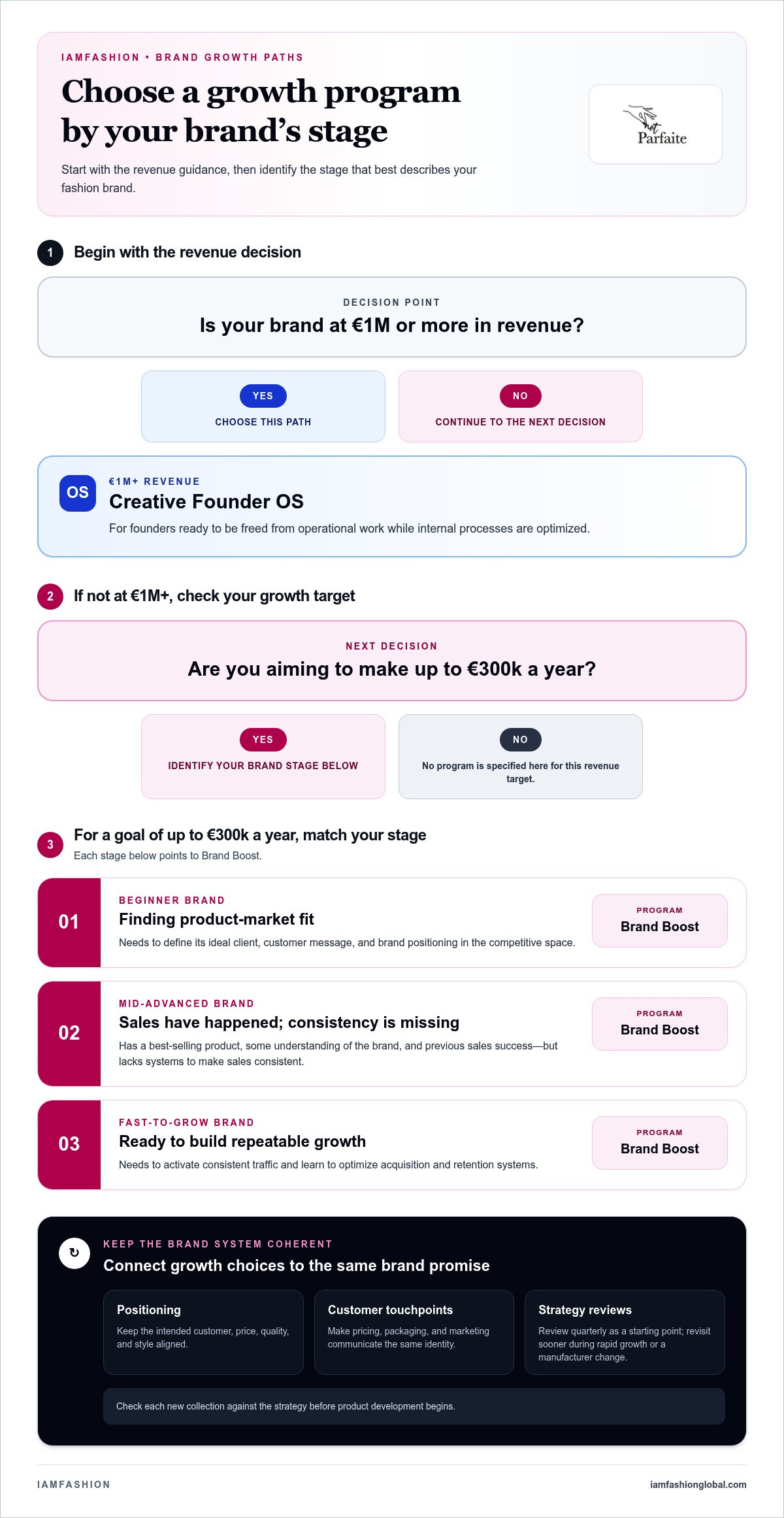
Build the process to match the workload. A workflow that works for ten styles can become difficult to maintain across 50 styles and multiple collections. Weak processes can become a crisis as a brand grows from £200k to £2M in revenue. At £1M+ in revenue, founders shouldn’t personally approve every sample, invoice, and purchase order. Clear ownership lets them focus on direction while teams manage repeatable decisions.
Build a more scalable fashion brand system by connecting brand direction with the workflows that support growth.
IAMFASHION: Brand Boost
IAMFASHION’s Brand Boost is a comprehensive 12-month program for fashion designers and creative brand owners building and scaling online.
Choose support that fits your stage. Early-stage brands need to define their ideal client, customer message, and competitive position. More established brands may have a best-selling product, a clearer understanding of their brand, and previous sales success, but still need stronger systems for consistency. Fast-growing brands need to build steady traffic and optimize acquisition and retention.
Contact IAMFASHION or visit iamfashionglobal.com to explore the next step for your brand.
Turn brand direction into your next growth move
A fashion brand management framework becomes valuable when it shapes decisions beyond the launch. Make your brand’s priorities actionable for the people developing products, communicating with customers, and guiding growth. That’s how creative direction becomes a business asset, not a document left untouched.
Choose your next move based on what your brand needs now. IAMFASHION offers Brand Boost and Creative Founder OS to support fashion founders building growth and strengthening their operations. Focus on the decision that will create the strongest foundation for your next stage.
Bring your current challenge and growth priorities into the conversation. Contact IAMFASHION to discuss your brand and explore a practical next step. Your creative vision can lead, backed by decisions built to move the business forward.
Frequently Asked Questions
What is a fashion brand management framework?
A fashion brand management framework is a decision system that ties a label’s commercial choices to its intended customer promise. It helps teams resolve trade-offs consistently, such as whether a proposed collaboration expands the audience or blurs the brand’s signature. Rather than prescribing one formula, it clarifies which priorities should guide product, communication, and growth decisions as the business changes.
What are the key components of a fashion brand management framework?
Core components include a defined customer, brand promise, product range logic, price architecture, visual and verbal standards, customer experience, and clear ownership of decisions. Add measures that show whether the plan is working, such as conversion by collection, repeat purchase behavior, and campaign engagement. Together, these elements help teams assess a collaboration, product extension, or sales channel before committing resources.
How do fashion brands define their positioning, target audience, and value proposition?
Define positioning by combining customer insight with a clear reason to choose the label. Study customer questions, product reviews, conversations, and sales patterns to identify unmet needs and the language customers use. Describe the ideal audience by style priorities, buying motivations, and context, not just age or location. A value proposition connects those needs to a distinctive product benefit and brand point of view.
What steps are involved in building a fashion brand strategy?
Build the strategy in sequence: clarify the business goal, research the audience and competitive space, choose a distinct position, and translate it into product and communication decisions. Then assign owners and select measures for customer response and commercial performance. Before adding a product category, assess whether it serves the same customer and strengthens the label’s promise. Document the reasoning to guide future choices.
Which marketing and customer experience strategies work best for fashion brands?
Effective strategies connect discovery, purchase, and post-purchase moments. Create content that answers a styling or product-care question, make product details easy to compare, and send relevant updates after purchase. For example, a capsule wardrobe guide can show several ways to wear one piece alongside a focused product edit. Choose channels based on audience behavior, then track which messages prompt engagement and sales.
How do luxury, mass-market, and direct-to-consumer fashion brand frameworks differ?
Luxury frameworks emphasize distinctiveness, controlled presentation, and experiences that support premium perception. Mass-market models focus on accessible assortments, broad demand, and repeatable merchandising decisions. Direct-to-consumer brands build customer relationships through their own sales channels, gaining closer access to feedback while taking greater responsibility for discovery and retention. The right structure depends on the brand promise, available resources, and route to customers.