Growth isn’t about adding every sales channel at once. A fashion brand online growth roadmap works best as a staged 12-month plan: find the market gap, build a brand customers want to follow, then strengthen awareness and distribution. Start with the numbers that shape your decisions, not a guess at one universal startup budget.
A strong product needs more than creative vision to sell consistently. It also needs a clear customer, a persuasive message, and enough working capital to support inventory and demand. The challenge is deciding what to prioritise first and what can wait.
This fashion brand online growth roadmap shows how to estimate launch investment by mapping inventory, operating needs, margins, and channel break-even points. It also explains how to choose between your own website, social commerce, and wholesale, manage launch risks with customer feedback, and set practical growth priorities. Build with discipline, adapt to evidence, and give your label room to scale.
Key Takeaways
- Map startup investment around working capital, inventory, margins, and the break-even point for each sales channel.
- Choose channels to match your customers and growth stage, then build connected systems as distribution expands.
- Use feedback from your strongest customers to sharpen your message and refine your product-market fit.
Using physical distribution, brand awareness, or a marketplace model to grow
Choose distribution and marketing tactics that match your brand’s stage: test demand first, then build reach and repeat sales. Keep inventory, customer data, and channel performance connected as the business grows.
Distribution and Marketplace Reach
Use your own retail website to control the customer experience, then test marketplaces or social commerce where your target customers already shop. Selected retail stockists can add visibility and reach people who may not discover your site. Before expanding, compare each route by audience, product presentation, margins, and inventory demands.
For US online fashion sales, plan for clear product and price descriptions, transparent return terms, privacy disclosures, and truthful marketing. Requirements can vary by state and sales model, so account for them in your channel plan.
Brand Awareness and Market Differentiation
Establish a clear position before another label occupies the same niche. Identify the specific apparel need your product meets, then make that difference visible in product photography, descriptions, and social content. For example, a label serving customers who want versatile work-to-weekend pieces should keep that message consistent across its website, marketplace listings, and retail presentation.
Use SEO to help shoppers find product and category pages, social media to show clothes in context, and influencer partnerships to introduce your brand to relevant audiences. Track which content brings qualified visits and sales, not just attention. Focused brand awareness helps you reach customers before competitors crowd your position.
Channel Testing and Scale Operations
Test direct-to-consumer, marketplace, and social commerce as distinct channels. Compare visits, orders, margins, and repeat purchases to see where demand translates into business value. Fashion ecommerce has no single typical conversion rate, acquisition cost, or average order value: product price, traffic source, and customer intent shape each measure. Review results by channel and product.
Improve product pages with clear sizing, fabric details, multiple product views, and straightforward delivery and return information. On mobile, simplify navigation and checkout so shoppers can move from choosing a product to payment with fewer distractions.
Track inventory alongside sales to identify fast-moving products and avoid promoting unavailable sizes. Use these patterns to guide marketing and reorder decisions. Build loyalty with useful follow-up messages and relevant offers that give first-time buyers a reason to return, without expanding the range too quickly.
Estimating startup investment and choosing international sales channels
Estimate investment by accounting for inventory, materials, labor, operating needs, and each channel’s break-even point. Then sequence sales routes according to available cash, margins, and the customers you need to reach.
Sales Channel Options
Direct-to-consumer ecommerce gives a label control over its storefront, customer relationship, and product presentation. Wholesale can provide validation and reach through retail partners, but requires clear pricing, retail-ready presentation, and enough margin to support the relationship. Compare these routes with physical retail before committing inventory or production capacity.
For international sales, combine your own website with social media platforms your target customers use. Assess each market’s audience, channel costs, shipping workflow, and likely order volume. Estimate startup investment for fabric and production, labor, initial inventory, photography, platform operations, and marketing. The mix will depend on product complexity and channel choice.
Channel Planning and Sequencing
Give each channel a clear role in your plan. A label can begin with direct sales to learn which products and messages convert, then use wholesale to extend reach when margins and supply can support retailer pricing. Alternatively, a retailer relationship may provide early validation when your brand needs visibility that its own audience cannot yet deliver.
Model working capital alongside channel break-even points and margins at different revenue levels. Include the cash tied up in inventory before sales arrive, plus the operational load of managing orders across eCommerce, retail, and wholesale. For international growth, prioritize platforms used by the intended customers, then compare results market by market. A clear fashion business growth plan can help connect channel choices with wider commercial priorities.
Managing launch risks and adapting to customer feedback
At product-market fit, a beginner label needs a defined ideal client, clear customer message, and distinct position in the competitive space. Start by reviewing the similarities among your 10 biggest customers. Note which clothing they buy, what occasions they dress for, and what they value, such as fit, price, or sustainability. These patterns help turn a broad audience into a specific person your designs and communication can serve.
Build customer insight into the design process before expanding a collection. Gather feedback on samples, product descriptions, fit, and intended use, then compare what customers say with their purchasing behavior. If shoppers praise a design but repeatedly ask for a different fit, treat that as a signal to refine the product. Use their responses to shape the next release instead of relying only on assumptions about market demand.
Make brand identity tangible by connecting your ideal client’s interests and needs to your visual language, product choices, and message. For example, a label targeting customers who value versatile clothing can test whether its styling, fabric choices, and product details support that promise. Keep your position focused enough to stand apart, while leaving room to develop variations of products customers already want.
Manage launch risk by matching production to evidence and operational capacity. Request manufacturer samples, assess fabric quality and sustainability standards, production timelines, minimum order quantities, and flexibility. Begin with small production quantities, then increase orders as customer response and quality control support the decision. A mid-advanced brand with a best-selling product and previous sales success may need systems to make results consistent. A fast-growing brand needs consistent traffic and stronger acquisition and retention systems. In either case, use feedback and sales patterns to decide what to improve before scaling or expanding the range.
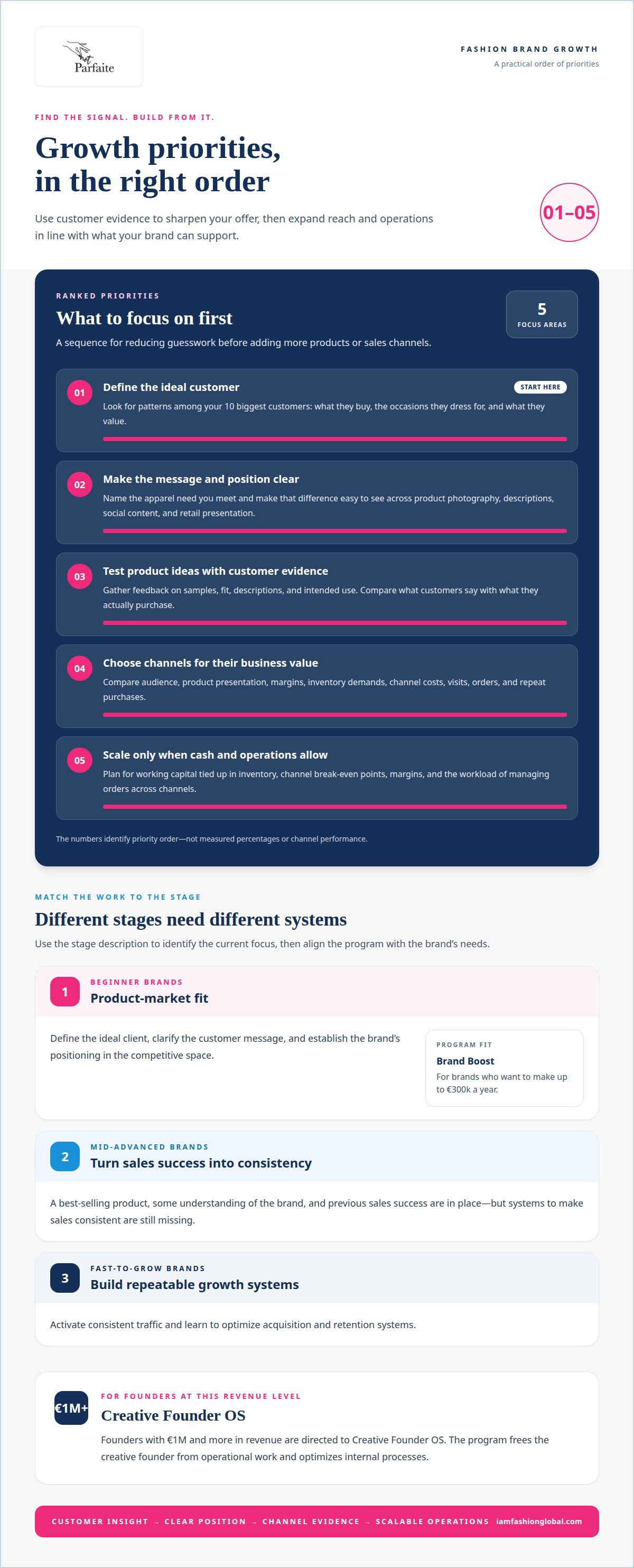
Prioritised 12-month growth roadmap
Turn the next 12 months into a sequence of decisions, not a list of disconnected tactics. Set a sales goal and a profit goal, then map the actions, cash needs, and measures that support both. A fashion brand’s growth moves through three stages: finding market whitespace, turning it into a lifestyle, and building awareness and distribution into a platform.
Start by naming your current stage. At Stage 1, define the underserved combination of price, product, use case, distribution, and aesthetic. Focus on proving demand before adding complexity. At Stage 2, build brand heat and create demand through a distinctive lifestyle. Plan for how that momentum can evolve, rather than assuming a label can stay “hot” indefinitely. At Stage 3, use awareness and distribution to capture and defend market share. Serve a broad but specific audience, not everyone.
Break the plan into four practical checkpoints. In the first quarter, sharpen your customer profile, positioning, and sales goals. In the second, implement channel and marketing priorities that fit your stage. In the third, review sales patterns, inventory, margins, and repeat purchases. In the fourth, decide what to scale, refine, or stop based on those results. These checkpoints provide a planning framework, but actions still need to match your brand’s capacity.
Keep each review tied to a decision. If a best-selling product sells but margins are weak, improve the economics before increasing volume. If awareness rises without consistent sales, strengthen the path from discovery to purchase. If operations cannot support demand, protect product quality before expanding distribution. Entrepreneurs can use this discipline to avoid mistaking more activity for progress. A clear 12-month roadmap links each growth action to a measurable commercial aim.
Build a focused growth plan around your brand’s stage, goals, and capacity.
IAMFASHION: Brand Boost
Choose it if you’re still finding product-market fit and need to define your ideal client, customer message, and position in the competitive space. It also suits brands with a best-selling product and previous sales that need systems for consistency, or brands working to build steady traffic and improve acquisition and retention.
Its framework helps creative founders reduce operational work and optimise internal processes, so the business can grow with stronger systems behind it.
Contact IAMFASHION to discuss which path fits your brand’s current stage.
Make your next growth move count
Turn ambition into a decision you can act on. Choose the business constraint that matters most now, whether that means clarifying your position, building reliable sales systems, or creating room for sustainable expansion. Make your fashion brand online growth roadmap a working tool: revisit it as customer behavior and business capacity change, and adjust priorities instead of chasing every new tactic.
Progress comes from choosing the right focus for your brand’s stage. Creative vision sets the direction; disciplined execution turns it into a stronger business. You don’t need to solve every challenge at once. Start with the decision that will make your next move clearer.
Contact IAMFASHION about your growth roadmap to explore a practical next step for your business. Keep building with intention, and give your ideas the structure to grow.
Frequently Asked Questions
What are the key stages of an online growth roadmap for a fashion brand?
The key stages are finding market whitespace, turning that position into a lifestyle customers recognize, and building awareness and distribution into a platform. A fashion brand online growth roadmap should match the label’s current stage: early customer response helps validate product-market fit, while repeat sales and stronger brand recognition can support broader growth. Let evidence guide the transition instead of applying identical tactics to every label.
How much does it cost to launch and grow a fashion brand online in the United States?
Startup investment depends on product complexity, production choices, inventory, and planned sales channels. A fashion brand online growth roadmap makes the estimate more useful by separating one-time launch needs from recurring operating costs and mapping when payments and sales occur. Include product development, samples, materials, production, photography, platform operations, marketing, shipping, and replenishment. Then compare how different sales scenarios affect working capital.
Which digital marketing channels drive the most ecommerce growth for fashion brands?
No single channel leads for every fashion label. SEO can attract shoppers looking for a product or style, social content can show how pieces look and fit, and relevant creators can introduce a brand to new audiences. Test channels with distinct campaigns and track qualified visits, purchases, and resulting margins. This helps show which channels bring buyers rather than just attention, and where further investment makes commercial sense.
What are the best strategies for customer retention, loyalty, and repeat purchases in fashion ecommerce?
Make the post-purchase experience useful and personal. Send care guidance for the specific fabric, styling suggestions that complement the item, and a simple way to share fit feedback. Use purchase history to make loyalty benefits relevant, such as early access to related releases rather than broad discounts. Track repeat orders and customer responses to identify follow-ups that strengthen relationships without training shoppers to wait for promotions.
What are the risks of scaling a fashion brand online, including inventory, fulfillment, and cash flow?
Scaling can strain cash before sales revenue arrives, leave popular sizes unavailable, or create excess stock in slower styles. Fulfillment delays and inconsistent quality can also undermine customer trust. Before increasing orders, review sales by product and size, production capacity, supplier timelines, and cash commitments. Set clear reorder triggers and assess whether fulfillment can handle more orders while maintaining quality and clear delivery communication.
How should fashion brands plan inventory, shipping, and returns as online sales grow?
Plan stock at the product and size level, and connect inventory records across sales channels. Match replenishment timing to production lead times and expected demand, then align shipping capacity with order patterns and destinations. Make delivery and return terms easy to find before checkout. Record return reasons, such as fit or product description, and use those patterns to improve sizing guidance, product pages, and future buying decisions.