More styles, larger orders, and louder marketing don’t automatically make a fashion brand stronger. Fashion brand scaling mistakes that strain stock and cash often begin when growth outpaces customer learning. A broad range can tie up money in products with unproven demand, while scattered marketing makes it harder to see what’s working.
It’s right to want your brand to grow, but ambition needs a plan that protects cash as well as creativity. Test demand before committing to inventory, choose a manageable range, and scale design, production, and marketing in response to customers. Build on what sells, strengthen the systems behind consistent sales, and keep stock and operations from getting ahead of you.
Key Takeaways
- Protect cash by testing demand and tracking stock by style and size before increasing your next order.
- Keep your first range focused, then use customer responses to guide which designs, production and sales efforts grow next.
- Build marketing around the customers you want to reach, using content and channels that help turn attention into repeat sales.
1. Managing inventory and supply-chain disruptions
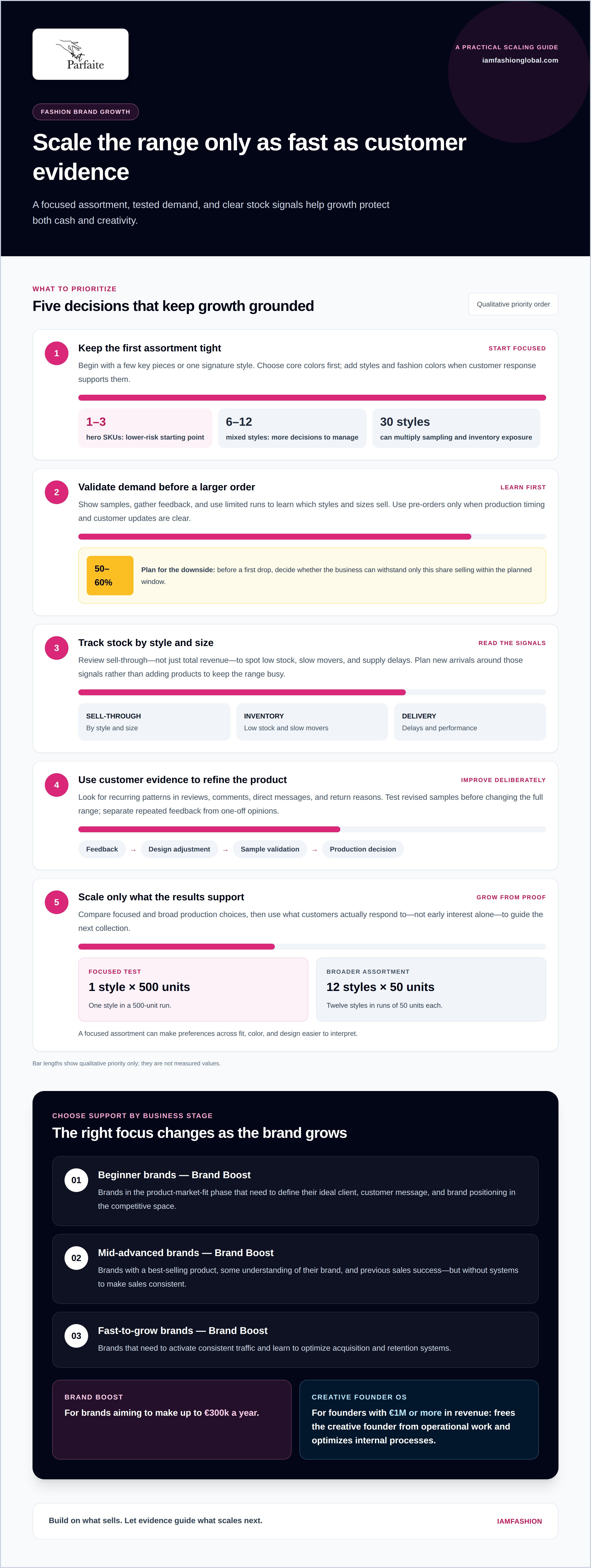
Keep the first buy tight. A 30-style first collection can multiply sampling and inventory exposure before demand is clear. Edit the range to a few key pieces, or test one signature style. Start with proven core colors, then add fashion colors when sales data supports them. Limit samples to designs that help confirm fit, fabric, trim, and production details.
Validate demand before committing to a larger order. Show actual samples where possible, gather customer feedback, and use pre-orders only when production timing and customer updates are clear. A limited run can reveal which styles and sizes sell. Track sell-through by style and size, not just total revenue. Before a first drop, decide whether the business can withstand only 50 to 60 percent selling within the planned window. Use real-time inventory records to spot low stock, slow movers, and supply delays. Plan new arrivals around those signals instead of adding products simply to keep the range busy.
Choose domestic or overseas manufacturing by comparing sample quality, communication, production capacity, minimum orders, lead times, logistics, and landed cost. Domestic production may make communication and sampling easier; overseas manufacturing may offer different capacity or cost structures. Test a sample and confirm specifications before expanding an order. The right choice depends on your product and the supply chain you can manage reliably.
For U.S. sales, review fiber, origin, care details, and environmental claims on product labels. Map each product and sales market against applicable rules before printing labels, and substantiate sustainability claims. For production growth, account for sampling, materials, manufacturing, shipping, packaging, and the risk of unsold stock. A new manufacturer also brings quality, communication, and timing risks, so test a small run before shifting larger orders.
Expand from direct-to-consumer into wholesale when repeat demand, fulfillment, and margins can support retailer orders. Before adding products or markets, review sell-through by style and size, returns, landed cost, margin, repeat purchases, and delivery performance. These measures help show whether growth is building durable demand or tying up cash in inventory.
2. Scaling design, production, marketing, and sales based on learning
Base each next move on customer evidence, not creative instinct alone. Review product reviews, comments, direct messages, and return reasons for recurring patterns. If customers praise a jacket’s fit but repeatedly mention its pockets, test a revised sample before changing the full range. Separate one-off opinions from repeated feedback, then prioritize changes that solve a clear customer problem. Two common fashion brand scaling mistakes are ignoring useful feedback and changing products without a specific reason.
Bring production realities into design decisions early. A garment with four pockets can require extra work, time, and cost, so ask a sample maker or factory how construction choices affect production. Test physical samples before a production run, and calculate landed cost rather than relying only on the factory quote. Include materials, shipping, packaging, and other relevant expenses when assessing whether the design supports a workable margin.
Use a limited run to learn before committing to bulk production. Daan Koster contrasts one style produced in a 500-unit run with 12 styles produced in runs of 50 units each. A focused assortment can make customer preferences easier to interpret across fit, color, and design. Use those results to refine the next collection, rather than repeating every original assumption or treating early interest as proof of future sales.
Protect consistency as orders grow. Keep an approved sample and clear measurement specifications for each style, then compare production pieces against both. Check fit across the size range and document defects or recurring measurement differences before approving reorders. For a strong seller, review sales pace, customer feedback, and remaining stock before deciding what to replenish. Avoid fashion brand scaling mistakes by increasing quantities only when the evidence supports the decision.
Make learning a repeatable strategy: gather feedback, adjust the design, validate the sample, and scale production when the signals support it. Brand Boost is designed for fashion designers and creative brand owners building and scaling their businesses online.
3. Choosing a manageable number of styles and colors
Keep the first assortment tight enough to learn from. A lower-risk starting point is 1 to 3 hero SKUs, compared with 6 to 12 mixed styles. Every added style can create more fabric, fit, and color decisions. Choose pieces that express the brand clearly, then expand the range when customer response shows what deserves a place. A focused offer helps customers understand what makes the brand distinct.
Define your audience before choosing hero products. Consider customers’ demographics, lifestyles, interests, and the problems their clothing choices solve. Streetwear enthusiasts, fitness-focused consumers, and minimalist fashion lovers, for example, need different products and messages. Select one priority audience, then shape product details, imagery, and language around its needs. A clear position in the competitive space gives customers a reason to choose your brand.
Let your audience shape color decisions, too. Start with a small set of colors that work across core products rather than adding prints and fashion colors just to make the range look larger. Review responses by product and color after each release. If a particular shade repeatedly attracts interest, test it on a limited basis before adding it to a broader assortment. That turns taste into a decision informed by demand.
Apply the same discipline to influencer choices. Before agreeing to a collaboration, check whether the influencer’s active followers match your intended customer. A large audience alone doesn’t show whether a partnership reaches people likely to care about the product. Align the creator’s content and audience with a specific style or customer message, then track engagement and resulting sales. Treat each collaboration as a learning test, not proof of success on its own.
Scale only the parts of the range that earn their place. Compare customer feedback, sales by style, and interest in each color before adding variations. A focused collection makes product choices clearer and directs design effort toward pieces supported by stronger evidence.
4. Social media, influencer, content, and email marketing
Start building awareness before a collection drops. Use Instagram and Pinterest to share product details, styling ideas, and behind-the-scenes content. Teasers and countdowns can build anticipation; launch posts can direct interested followers to the collection. Tie each message to a clear product benefit or brand story, so attention has somewhere useful to go. Posting without a clear audience or purpose is one of the fashion brand scaling mistakes to avoid.
Use email to reach people who want updates beyond a social feed. Send a preview before launch, a clear announcement when products become available, and useful follow-up content afterward. A clothing brand, for example, could share outfit combinations featuring the same core piece. Track clicks and purchases alongside social responses to learn which messages prompt action, not just likes.
Choose marketing materials that help customers understand the product and buy it. Prioritize a professional-looking website, strong product photos, and well-made line sheets if you’re approaching retailers. A blog can support product storytelling, while consistent social content keeps the brand visible. Build these assets around the collection’s intended customer and message; polished lifestyle photography won’t work hard if it doesn’t show why the product matters.
Marketing requires investment before orders arrive, so plan campaigns around available cash and expected profit. Whether you work with a digital marketing agency like Morpheus Consulting or direct hires, choose partners with creative business experience, then give each a defined goal, audience, and deliverable. Before committing to an influencer, assess whether their active followers match your target customer. A creator whose audience responds to practical styling may suit a versatile basics brand better than one focused on unrelated trends.
Measure each channel by its contribution to customer acquisition and retention. Compare email purchases, social referrals, campaign costs, and repeat orders, then shift effort toward combinations that support profitable sales. Avoid spreading resources across every platform at once. Prevent fashion brand scaling mistakes by keeping your message consistent as you test and grow. Strengthen your fashion brand’s online marketing with a focused strategy for reaching and converting the right customers.
IAMFASHION: Brand Boost
Choose it if you’re a beginner working toward product-market fit, a mid-advanced brand with a best-seller but inconsistent sales, or a fast-to-grow brand building consistent traffic and stronger acquisition and retention systems.
At the beginner stage, focus on defining your ideal client, customer message, and position in the competitive space. Mid-advanced founders can use Brand Boost to build systems for more consistent sales, while fast-growing brands can focus on optimizing customer acquisition and retention.
Creative Founder OS helps creative founders spend less time on operational work and improve internal processes. Contact IAMFASHION to discuss which program fits your brand’s stage.
Make your next growth move with intent
Growth doesn’t mean making every decision at once. Choose the next move that will make your business more resilient, whether that’s strengthening your operating rhythm, clarifying who owns each decision, or seeking external guidance from executive advisors like michelboutinstudio to align operational systems with long-term profitability. Avoiding fashion brand scaling mistakes starts with treating sustainable growth as a deliberate practice, not a race to do more.
As your priorities evolve, seek support that fits the business you’re building now. IAMFASHION offers Brand Boost and Creative Founder OS for fashion designers and creative brand owners at different stages of growth. Take the next step to sharpen your decisions and turn your brand’s ambitions into practical, sustained progress.
Contact IAMFASHION to discuss your brand and the direction you want to take next. Keep moving forward with purpose, protect the creative vision, and build a business ready for what comes next.
Frequently Asked Questions
What are the most common mistakes fashion brands make when scaling?
Common mistakes include taking on commitments before the business can reliably meet demand, treating revenue as available cash, and adding complexity without clear ownership. A founder might launch new channels while product development and fulfillment still depend on ad hoc decisions. Set a clear approval process for spending, production changes, and launches. This keeps growth choices connected to capacity and the customer experience.
How can fashion brands forecast demand and avoid overproduction?
Build forecasts from product-level evidence, not one overall sales target. Compare past sales patterns with current pre-launch interest, customer enquiries, and promotion timing. Create conservative, expected, and stronger-demand scenarios, then connect each to a production decision. If interest is concentrated in one size or color, don’t use total collection engagement as a reason to order more of every variation.
How should fashion brands calculate margins, customer acquisition costs, and lifetime value before scaling?
Calculate gross margin by subtracting product and landed costs from net sales, then account for other variable costs to understand contribution margin. Divide acquisition spending by the number of new customers it brought in to estimate customer acquisition cost. Estimate lifetime value from a customer’s repeat purchases and contribution per purchase. Compare these measures by channel and product before increasing spend.
What supply chain and lead-time challenges do growing fashion brands face?
Growth can expose weak points between fabric availability, sample approval, production scheduling, quality checks, and delivery. A delay in one stage can disrupt launch timing even when finished garments are ready. Keep a production calendar with decision owners, approval deadlines, and supplier updates. Record recurring delays by stage so future launch plans reflect actual workflows rather than ideal assumptions.
How do fashion brands scale marketing without overspending or weakening brand identity?
Set a campaign budget and success measure before choosing a channel. Test one audience, message, or creative direction at a time, then compare resulting sales and customer quality. Keep brand voice, visual standards, and product claims consistent across social posts, email, and paid campaigns. Scale combinations that attract suitable customers, and pause activity that uses budget without supporting a clear business goal.