More lessons do not automatically build a stronger fashion business. When comparing fashion business courses vs a brand accelerator, focus on the outcome: courses build knowledge, while an accelerator helps you apply business strategies to your brand’s current challenges.
Both can turn creative ambition into commercial progress, but they serve different needs. Compare their focus, learning outcomes, and practical work against your brand’s stage. If you are still testing product-market fit, clarify your ideal customer, message, and market position. If you have a proven product and sales history, you may need more consistent systems. A fast-growing brand may instead need to improve traffic, customer acquisition, and retention.
Key Takeaways
- Distinguish structured learning from hands-on business acceleration by identifying the kind of progress your brand needs next.
- Explore how fashion business education can build commercial foundations for aspiring entrepreneurs.
- See how practical assessments and industry-focused projects can turn ideas into decisions for a real fashion business.
- Use your brand’s current challenges and growth stage to decide which kind of support is the better fit.
Fashion business course focus and learning outcomes
A fashion business course teaches commercial foundations through lessons, exercises, and a defined curriculum. A student might study customer research, pricing decisions, merchandising, marketing, and the steps behind launching a collection. The fashion business courses vs brand accelerator comparison starts with the learning outcome: courses build knowledge, while accelerators focus on applying business strategy.
Choose a program based on the decisions you need to make. A founder preparing a first collection, for example, may need to define a target customer and sales channel. Another may need to work through product costing or a launch plan. Compare self-paced lessons with live teaching and feedback, too: the format affects how directly you can apply what you learn.
In the United States, course and accelerator costs vary by format, curriculum, mentoring, and included services. Compare the support and practical work provided rather than judging by the program label alone.
Accelerator eligibility requirements vary. Applications commonly assess a brand’s concept, product readiness, business stage, and founder goals. Be ready to explain what your business sells and where you need support.
Accelerators may offer business training, mentoring, networking, and operational support. Funding and retail access are specific to individual programs, not automatic outcomes. Review the actual offer before treating these opportunities as included.
There is no single best course or accelerator for every US-based designer. Match the curriculum or support to a specific gap, such as customer research, marketing, or operations.
Fashion business courses follow their own schedules, while fashion accelerator programs typically run for a few weeks to a few months. Check the time commitment alongside the learning goals.
An accelerator requires time and focus, and its business guidance may not develop your design skills. Alternatives include taking a focused course or tackling one business priority at a time, such as customer positioning or sales planning. Use the fashion business courses vs brand accelerator comparison to choose the format that fits your next decision.
Fashion business course for aspiring entrepreneurs
For an aspiring designer, a fashion business course can provide a structured starting point, helping turn a creative concept into commercial choices before production or promotion begins. An existing brand may need more targeted support, especially if it has a product and sales experience but no clear next step. The right fit depends on what the business needs now.
Use a course to build the foundations of a fashion venture. A student developing a capsule collection, for example, can define a target customer, shape the brand message, and plan how the collection will reach buyers. Practical assignments make lessons useful: apply each concept to your product, then use the result to inform a business decision.
- Define the customer: Describe who the product serves and what need it meets.
- Clarify the position: Explain what makes the brand distinct from alternatives.
- Plan the offer: Connect product choices, pricing logic, and sales channels.
These foundations can also help creative founders work confidently with specialists. A designer or creative director can use a clear customer profile to brief a photographer, plan a campaign, or select product imagery. Brand awareness is more purposeful when the audience and message are defined first, rather than treated as substitutes for a strong offer.
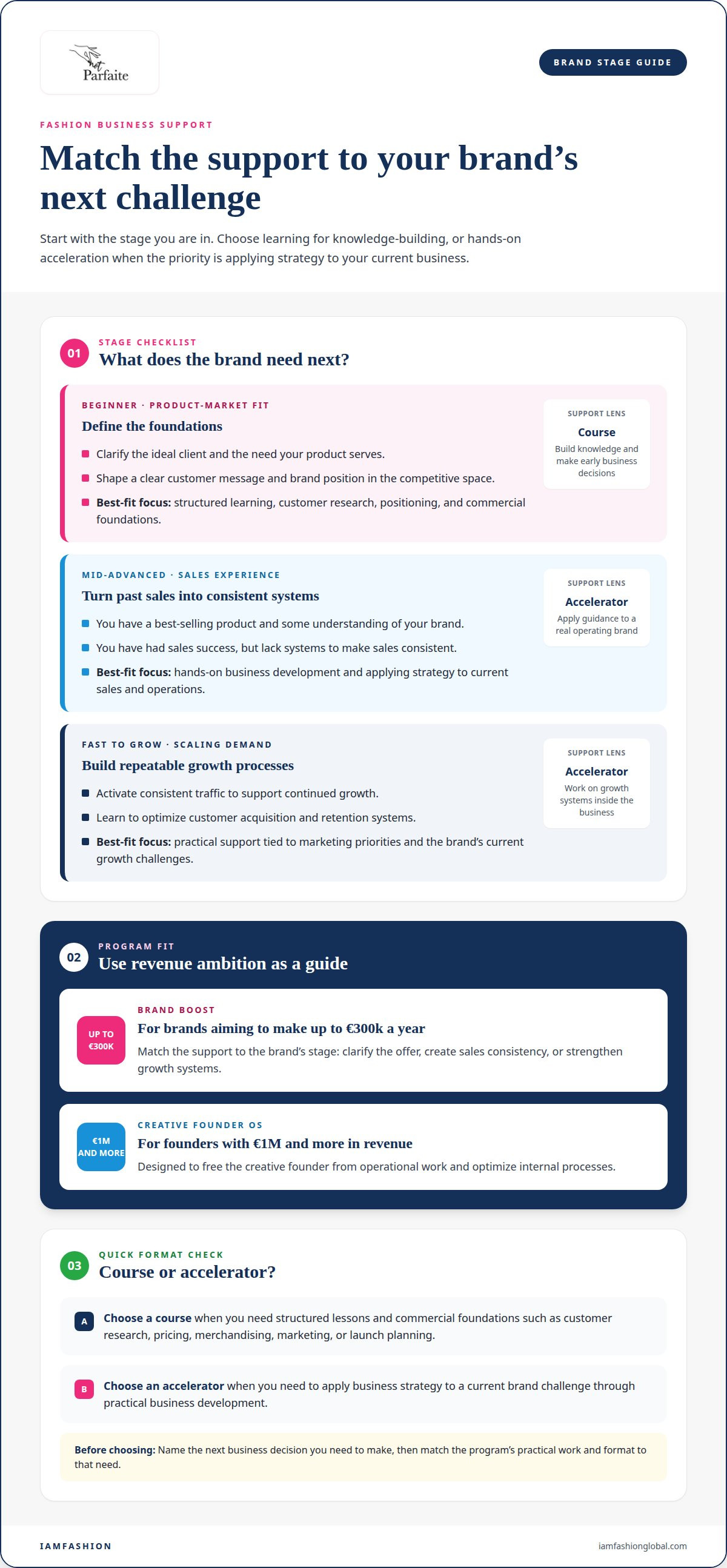
If your brand is still seeking product-market fit, prioritize customer definition, messaging, and competitive positioning. If you have a best-selling product and a sales history, focus on systems that support more consistent sales. A fast-growing brand may need steady traffic and stronger acquisition and retention processes. Choose a learning path that matches your business stage.
Before choosing, write down your next business decision, such as refining a customer message or improving repeat sales. Then match the program’s format to that task. A course suits structured learning; an accelerator may suit a brand that needs hands-on business development.
Practical assessments and industry-focused projects
A practical assessment tests whether you can apply a business concept, not just repeat its definition. A course assignment might ask you to outline a launch plan for a capsule collection, connecting its customer, product range, sales channel, and campaign message in one working document. These skills help turn creative ideas into clear commercial decisions.
Make every project answer a business question. A customer profile should guide product details and campaign language; a sales plan should connect the collection to a suitable channel. For a fictional knitwear label, a student might define its intended buyer, describe its point of difference, and plan how to introduce a new design. Each choice becomes more useful when it has a clear rationale.
- Test the offer: Describe the product, the intended customer, and the need it addresses.
- Build the launch plan: Map the message, channel, and content needed to introduce the collection.
- Review the sales path: Trace how a customer discovers a product and completes a purchase.
- Refine the next move: Use feedback to improve the concept, rather than adding unrelated tasks.
An accelerator project is usually tied more closely to an operating brand. Fashion accelerators focus on business development and may combine mentoring, training, seminars, or networking. A brand might review its product range, marketing, and operations to identify what is slowing progress. The value comes from applying guidance to current business decisions.
Compare the final outputs, not just the project titles. A course may help you create a launch brief or customer profile; an accelerator may help you assess sales processes or marketing priorities. Neither replaces design education. Choose work that fits the brand’s stage: early concepts need validation, while established products may need better systems for consistent sales and growth.
What is a fashion brand accelerator and how does it work?
A fashion brand accelerator is a time-limited business development program for fashion companies. Programs typically run for a few weeks to a few months. Unlike fashion school, an accelerator focuses on building the business, not teaching design skills. Its structure helps founders tackle commercial priorities with guidance and practical work.
Support may include business training, mentoring, educational seminars, networking, or workspace. Some programs also provide low-cost design studio space. Focus on whether the activities address your current challenge: a founder working on production planning needs different support from one refining customer acquisition.
A typical accelerator journey can move through clear steps:
- Set a priority: Define a business challenge, such as inconsistent sales or unclear marketing.
- Review the operation: Examine relevant areas, including financial planning, marketing, and day-to-day processes.
- Apply guidance: Turn mentoring or training into practical changes for the brand.
- Build connections: Use seminars and networking to exchange ideas and develop industry relationships.
A fashion label with strong products but uneven sales, for example, might review its marketing and customer journey. The work is business-focused: identify where the sales process breaks down, then develop a more consistent approach. An accelerator can support this work, but it does not replace design education or guarantee funding or retail access. Those outcomes depend on the individual program.
Choose an accelerator based on the work it helps you do, not just its name. Look for a direct connection between its activities and your business priorities, such as improving financial planning or strengthening operations. If you’re ready to turn creative direction into a more structured online business, explore support for fashion brand growth.
For new and startup fashion companies, business training or workspace can support business development. A program may also combine mentoring, educational seminars, and networking, with low-cost design studio space among its possible offerings. Services vary, so consider which forms of support address your company’s needs.
Fashion accelerators may also support financial planning, advanced marketing, and operations. These areas offer practical starting points: organize financial plans, strengthen marketing methods, or address operational work. Identify which priorities you would bring to an accelerator.
IAMFASHION: Brand Boost
IAMFASHION’s Brand Boost is a comprehensive 12-month program for fashion designers and creative brand owners building and scaling online.
If your brand is still seeking product-market fit, focus on defining an ideal customer, shaping the message, and establishing a competitive position. If you have a best-selling product and prior sales, work on systems for more consistent sales. Fast-growing brands may instead prioritize steady traffic and stronger customer acquisition and retention.
It can free creative founders from operational work and help optimize internal processes.
Contact IAMFASHION to discuss which program fits your brand’s stage.
Turn your next business decision into momentum
Choose the learning path that helps you make a real decision, then put it into action. Fashion business courses versus a brand accelerator matters less than the gap you need to close next. Set one clear priority, such as helping customers discover your brand or making daily operations more manageable. Use it to decide whether structured learning or applied business support fits your next move.
IAMFASHION offers Brand Boost and Creative Founder OS to support fashion entrepreneurs as they develop their businesses. Start with the work you want to move forward, then explore the program or framework that fits your next step.
Contact IAMFASHION to discuss your goals and identify a practical next step for your brand. Keep building with purpose, and give your creative vision the business foundation it deserves.
Frequently Asked Questions
What is a fashion business course and what does it teach?
A fashion business course teaches commercial decisions involved in developing a fashion label. Depending on its curriculum, it may cover customer research, merchandising, marketing, and sales planning. To assess the fit, connect a lesson to a decision you face: use customer research, for example, to decide which product concept best serves your intended buyer.
What are the differences between fashion business courses and brand accelerators?
Fashion business courses typically organize learning around lessons and a curriculum, while brand accelerators help fashion businesses develop through practical guidance and support. Choose based on your immediate need: a course may suit you if you are building foundational knowledge, while an accelerator may be more relevant if your existing brand needs help applying business strategies. Compare the actual activities with your priority.