A product roadmap focused only on launches can keep your team busy while leaving profitability to chance. A strong fashion business execution roadmap connects product choices with customer demand, delivery timing, and the margins your business needs.
Creative instinct matters, but commercial direction helps turn it into a sustainable business. The right roadmap depends on its purpose: setting long-term product strategy, coordinating near-term delivery, or showing customers what is changing.
Learn how to choose a roadmap for your business, map product decisions across development, launch, growth, and maturity, and account for priorities and dependencies as you plan. You’ll also see how to connect product choices to customer needs, sales goals, and margins, so your plan does more than schedule launches and supports deliberate growth.
Key Takeaways
- Choose a roadmap for its purpose: set strategic direction, coordinate delivery, or communicate planned changes to customers.
- Map product plans across development, launch, growth, and maturity, while accounting for priorities, dependencies, and potential roadblocks.
- Connect product decisions to customer needs and profit margins; prioritize products with healthy margins and reorder potential.
Visionary, delivery, and customer-focused roadmap types
Choose a roadmap based on the decision it needs to guide. For a new fashion brand, ecommerce, wholesale, and retail can all support sales. The right mix depends on how customers can access your products, your capacity, and how you want to present them.
Choosing a Roadmap Type
A vision roadmap sets long-term direction, a delivery roadmap organizes work, and a customer-focused roadmap communicates planned changes. Choose the type that matches the decision at hand, then connect it to clear business objectives and customer needs. A product strategy roadmap should guide choices through measurable objectives, not become a list of launches without a purpose.
Start by examining your 10 biggest customers for shared preferences, needs, and buying patterns. Use those similarities to clarify your ideal client, customer message, and position in the competitive space. For example, if repeat buyers value versatile garments, that insight can shape product priorities and the story your brand tells.
Customer-focused planning also includes the retail experience. Map how employees deliver service across online and in-person interactions, then identify where customer questions or handoffs arise. At some stores, retail employees average five to six months of tenure, so clear service guidance can help maintain consistency when staff changes.
Using Customer Feedback
Use customer feedback to revise your roadmap as you learn more about buying behavior. Gather comments from customer conversations, product reviews, returns, and post-purchase messages. Group them by issue, such as fit, fabric, or styling, then compare recurring themes with sales patterns before changing the product plan.
Turn each useful signal into a decision: keep the design, revise it, or test a new option. Record the reason and expected outcome, then revisit the choice after the next selling cycle. This makes iteration deliberate and prevents one person’s strong opinion from outweighing repeated feedback from customers.
Planning Marketing and Engagement
A marketing roadmap schedules customer-facing activity around the product story and the moments customers can act. Plan product previews, launch content, and follow-up messages, then align each with inventory and delivery readiness. Consistent marketing gives customers a clear path from discovery to purchase instead of a series of disconnected announcements.
Choose channels based on how your ideal customers discover and buy fashion. Ecommerce can support direct customer relationships, wholesale can introduce products through retail partners, and physical retail can create in-person product experiences. Give each channel a clear message and engagement step, such as answering fit questions or sharing styling ideas, then use responses to refine future communications.
Timeline planning and product lifecycle phases
A useful timeline links product decisions to business goals, production dependencies, and cash needs. For fashion brands, it should show what happens next and how each initiative moves a product through its lifecycle.
Start with a sales and profit goal for the next 12 months, then ground the plan in current customer demand, available resources, and industry conditions. A successful roadmap doesn’t schedule every possible idea. It prioritizes the work that supports the goal, makes dependencies visible, and leaves room to respond when new insights change the landscape.
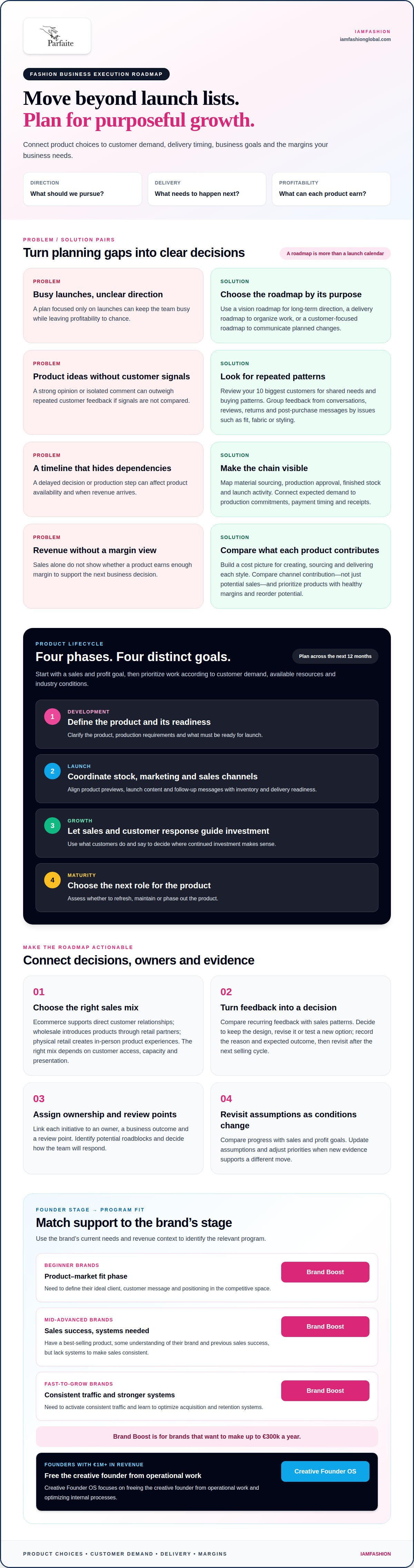
Organize each product’s journey into four phases: development, launch, growth, and maturity. During development, define the product, production requirements, and launch readiness. At launch, coordinate inventory with marketing and sales channels. In the growth phase, use sales and customer response to guide continued investment. At maturity, assess whether to refresh, maintain, or phase out the product. Set a distinct goal and activities for each phase.
For inventory, production timelines, and cash flow, connect expected demand to production commitments and the timing of payments and receipts. Map dependencies such as material sourcing, production approval, finished stock, and launch activity. This shows where a delay could affect availability or incoming revenue, and when cash may be committed before sales arrive.
Global ERP templates can make planning more consistent across regions by giving teams shared definitions for products, inventory, and financial data. Introduce a common template in stages: map existing workflows, agree on core fields, test the process with a representative team, and address gaps before wider adoption. Keep local differences visible rather than forcing every market into a process that hides useful information.
Protect focus by separating essential work from attractive distractions. Identify potential roadblocks, such as a production dependency or delayed decision, and decide how the team will respond. Link each initiative to an owner, a business outcome, and a review point. This makes the timeline actionable without mistaking completed tasks for meaningful progress.
Revisit the plan as conditions change, not only when a launch is at risk. Compare progress against sales and profit goals, update assumptions, and adjust priorities when evidence supports a different move. For founders shaping a 12-month growth plan, strategic fashion business planning can help connect the timeline to the wider business direction.
Financial performance, margins and profitability
A profitable product plan connects customer demand to what each product earns and the resources it consumes. Set a sales and profit goal, then assess whether the planned assortment, pricing, and supply chain can support both. Revenue alone does not show whether a product generates enough margin to fund the next decision.
Build a clear cost picture for each style before committing to production. Include the costs of creating, sourcing, and delivering it, then assess how channel choices affect what you retain. A garment sold wholesale may have a different cost structure from one sold through ecommerce. Compare each route’s potential contribution, not just its potential sales.
Pricing should reflect product costs, customer expectations, and the product’s place in the range. A Good, Better, and Best structure can organize choices around distinct value levels. For example, a core shirt could sit alongside a more detailed version and a premium fabric option. Make the differences clear so customers understand the value and your team can assess each tier.
Prioritize products with healthy profit margins and a reasonable chance of reorders. Repeat demand can make planning more predictable, while a product that sells once may need a new marketing push or costly redesign. Review sales alongside returns, discounts, and remaining inventory. These signals show whether strong demand translates into meaningful profit or excess stock is eroding the result.
Protect cash flow by connecting production commitments to expected sales and payment timing. A product may look profitable on paper but create pressure if cash goes out well before customer payments come in. Map when suppliers need payment, when inventory becomes available, and when each channel is expected to generate revenue. If a launch slips, reassess the timing and cash impact before committing to more supply.
Make financial reviews useful to everyone involved. Give design, operations, and marketing a shared view of product goals, costs, and performance. Review each style against its planned role: attracting new customers, generating repeat purchases, or strengthening the wider assortment. If results fall short, identify whether pricing, cost, demand, or channel mix is driving the gap before changing the product.
Keep the roadmap focused on profitable growth, not activity for its own sake. Choose a small set of financial measures, review them consistently, and use the findings to guide the next product decision. Founders ready to improve internal processes can explore support for operational systems.
IAMFASHION
IAMFASHION helps fashion founders connect business decisions to their brand’s current stage. Beginner brands working toward product-market fit need to define their ideal customer, message, and competitive position. Mid-advanced brands with a best-selling product and previous sales success may need systems to make sales consistent. Fast-to-grow brands need consistent traffic and stronger customer acquisition and retention systems.
Match the support to the challenge your brand needs to solve next.
Contact IAMFASHION to discuss which direction fits your brand’s current stage.
Turn Your Roadmap Into Forward Motion
Your next product decision can shape more than a launch. Treat your fashion business execution roadmap as a living business tool: use what you learn from each decision to sharpen the next one, rather than locking your team into a plan that no longer fits.
Choose a clear priority for the next phase, assign ownership, and agree on what progress should look like. This focus helps creative ambition and commercial discipline work together, while giving your team a shared basis for making trade-offs as conditions change.
As your needs evolve, your support should evolve too. IAMFASHION offers Brand Boost and Creative Founder OS to help founders build and scale their businesses. Choose the option that matches the challenge in front of you, whether you’re clarifying your foundations or improving how the business runs.
Ready to turn your next decisions into a more intentional plan? Contact IAMFASHION to plan your roadmap. Keep creating with purpose, and build a business that can move with your vision.
Frequently Asked Questions
Why Is It So Hard to Build an Independent Fashion Brand?
Building an independent fashion brand is difficult because creative work must succeed alongside the commercial decisions that sustain the business. Founders often balance product development, customer acquisition, operations, and cash management with limited time and resources. A compelling collection can still struggle if its target customer is unclear. Focus on one customer group and a clear product offer before expanding.
What are the key steps in a fashion business execution roadmap?
A useful fashion business execution roadmap turns a business goal into owned decisions and review points. Define the customer and product offer, assign responsibility for major work, and set a decision gate for each commitment. Before approving a new colorway, for example, agree on what demand signal would justify production. This makes it easier to pause, adjust, or proceed based on evidence.
How do you write a fashion business plan and validate demand?
Build a fashion business plan around a specific customer, product offer, route to market, and the resources needed to deliver it. Validate demand before scaling by presenting the offer to potential buyers and recording their responses, such as sign-ups, requests for details, or purchases. Distinguish enthusiastic feedback from behavior that shows customers are willing to act.
How should a fashion business price products and calculate profit margins?
Set prices by accounting for the full costs of making and selling each product, then assess what remains from each sale. Include materials, production, packaging, fulfillment, and channel-related expenses where applicable. For example, compare the contribution from a direct online sale with a wholesale order, accounting for each channel’s costs. Review discounts and returns too, since both can reduce what you retain.
What marketing strategies help a fashion brand launch and acquire customers?
Launch marketing works best when it gives a specific audience a clear reason to discover and consider the product. Create content that shows how a piece fits, feels, or works in everyday outfits, then direct interested customers to a clear next step. After launch, use customer questions and engagement patterns to shape follow-up content, retention messages, and future acquisition campaigns.
What are the main risks for a fashion startup, and how can they be reduced?
Key startup risks include weak demand, unclear differentiation, production issues, and committing resources before testing the offer. Reduce exposure by testing customer interest on a small scale, documenting product requirements, and assigning responsibility for supplier communication and quality review. If feedback reveals confusion about the product’s value, refine the message before increasing production or marketing commitments.