Duration isn’t a one-size-fits-all measure of value: some fashion business mentorship programs are structured over 12 months, while the right fit depends on your brand’s stage and the support you need. A longer runway can give you time to build and refine business systems, but focused guidance matters more than duration alone.
It makes sense to want clarity before committing your time. The best fit combines practical business guidance with access to mentors and a format that suits how you work. This article explains how program length, mentoring access, events, and business support shape the experience, then connects those options to your stage: finding product-market fit, building consistent sales systems, or optimizing growth. Use these differences to identify the guidance that can move your fashion business forward.
Key Takeaways
- Match career guidance to the work your brand needs next, from defining product-market fit to strengthening sales systems and customer acquisition.
- Clarify how mentor access, meeting agendas and confidentiality work so the support fits your schedule and priorities.
- Choose in-person or virtual event formats based on the kind of learning and professional connection you want to build.
Career guidance and professional development
Fashion business mentorship programs can develop practical skills in brand identity, product development, sales, marketing, and finance. Some also cover fabric sourcing and sampling. Guidance is most useful when mentors apply these topics to a current launch or business decision. Cash-flow, break-even, and business-plan templates, for example, can turn broad advice into concrete planning tools.
For product development and range planning, mentoring can connect the customer, collection, and commercial plan. A founder might review which products belong in a launch range and how each supports the brand’s position. Guidance on product development and sourcing can also cover finding textile suppliers, ordering fabric swatches, contacting production ateliers, requesting quotations, and producing samples. Each step connects a creative brief to a decision about materials, production, or the finished product.
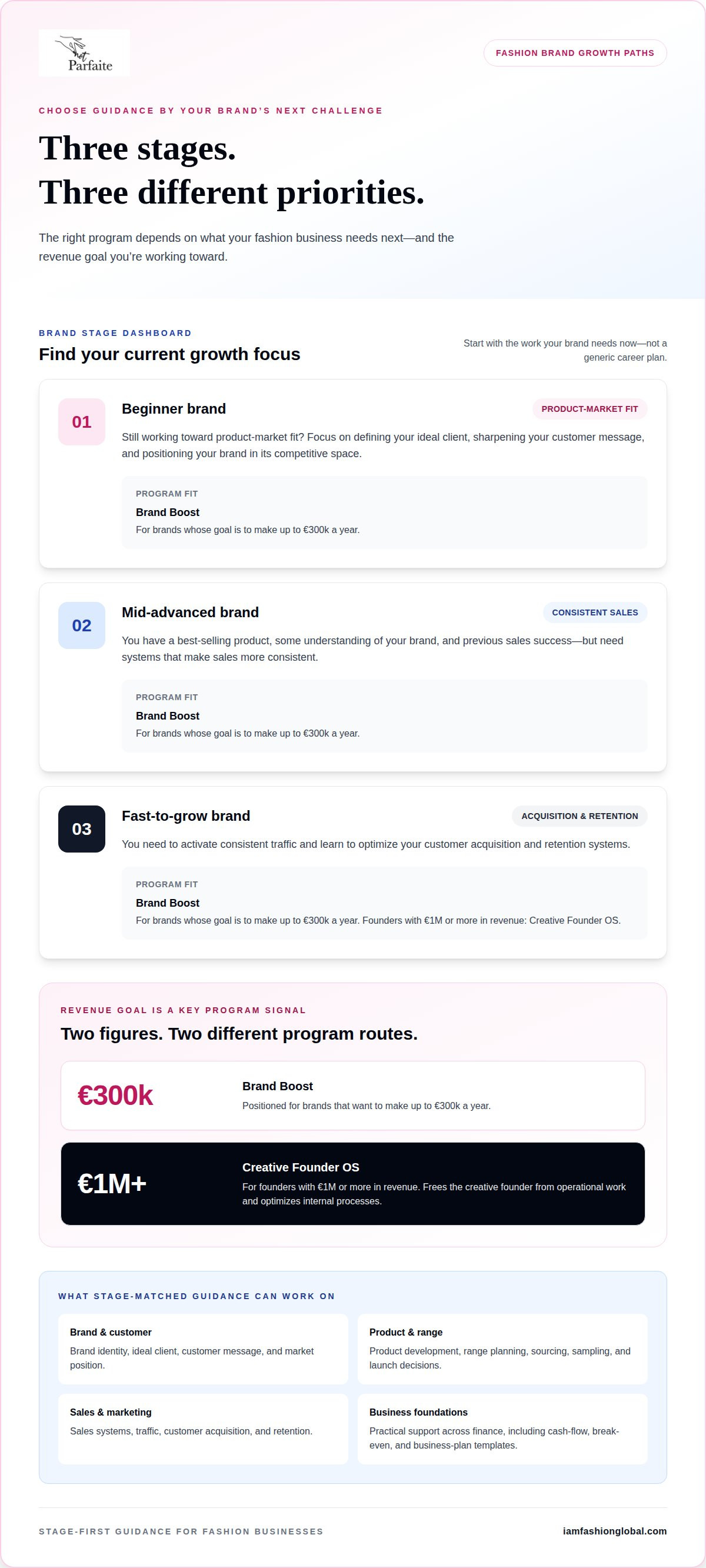
Choose guidance that fits your fashion brand’s stage. A beginner still working toward product-market fit needs to define an ideal client, sharpen the customer message, and position the brand in its competitive space. A more established brand may already have a best-selling product and a record of sales, but need systems for consistent revenue. A fast-growing brand may need reliable traffic and stronger customer acquisition and retention systems. Each stage calls for different priorities, not a generic career plan.
Stylist career development benefits from the same practical approach. For example, a stylist seeking a director role may need guidance on presenting a portfolio, communicating a creative point of view, and building professional relationships. A mentor can help a member identify the next career step and prepare for relevant conversations. According to the National Center for Biotechnology Information, mentors can facilitate professional networking by introducing protégés to influential people in academic and organizational contexts. That access can complement skill-building, while clear goals keep career guidance focused on the work ahead.
Mentoring access, scheduling and confidentiality
Set expectations before your first session. Clarify whether access includes private meetings, group sessions, written feedback, or a mix. Agree on meeting frequency, response channels, and rescheduling. For example, a founder preparing a sample can bring supplier questions to a scheduled session, then use agreed follow-up channels to resolve decisions that come up afterward.
Fashion mentorship differs from an incubator or accelerator in its focus: mentoring centers on guidance and feedback, while incubators and accelerators may combine mentoring with structured business development or other resources. Formats vary, so compare the actual support and commitments rather than relying on the label.
In the United States, options can include private, group, and institution-linked programs. The Fashion Scholarship Fund is one example of mentee-led access: mentees lead communication with mentors and set meeting agendas. If networking, funding, or retail connections matter to you, look for details showing how the program supports those goals. They are not automatic features of every mentorship.
Eligibility and deadlines depend on the individual program. Applications may ask for a brand overview, goals, or examples of current work, so review the stated requirements and timeline before applying. Fees and scholarships also vary. Compare the written terms, what sessions include, and any conditions attached to financial support.
Choose a mentor whose fashion industry experience matches your immediate challenge. Ask whether the relationship includes one-on-one time, how feedback works, and what confidentiality covers. If you plan to share a launch plan or sales information, understand how sensitive business details are handled before you share them. Clear boundaries build confidence and support candid learning.
One drawback is a mismatch between access and need: group advice may not resolve a specific sourcing decision, while infrequent sessions can slow action. Define the decision you need help with, then align the format and schedule to it. For founders focused on reducing operational demands, explore support for creative founders.
In-person and virtual mentoring events
Event format shapes how you practise skills and build professional connections. An in-person session lets a mentor review a garment sample, discuss fit, and respond to details together. A virtual workshop can bring someone with specialist knowledge into the conversation without requiring everyone to share a location. Choose the format around the work, not the trend.
Choose face-to-face events when your task benefits from shared materials or live discussion. For example, a collection review lets a mentor and founder examine fabric, construction, and range coherence in real time. A structured networking event can also help you introduce your fashion brand to potential partners. Treat each meeting as a working session: arrive with a specific decision to make and leave with a next step.
Virtual events can make learning accessible across cities and time zones. A video call suits a focused conversation about a launch plan, while a group session can expose members to different business challenges. Ask how participants are matched with mentors, how questions reach them, and whether follow-up feedback is part of the format. These details determine whether a session supports your goals or stays general.
Are there fashion business mentorship programs in your state or city? Local opportunities depend on organizers and event schedules, while virtual formats can connect you with mentors beyond your area. Compare the location, access method, and event purpose before choosing.
Make sure the format is worth your time. For an in-person event, check whether the agenda includes relevant feedback, introductions, or practical demonstrations. For a virtual event, consider how participants contribute, share materials, and continue discussions afterward. A useful event should connect directly to a skill you need, such as presenting a collection or explaining your customer proposition. Look for a clear match between the mentor’s expertise and your current challenge. Set one outcome for each session, such as refining a pitch or deciding which product to develop next. This keeps the experience purposeful, whether you meet in a studio or online.
Program duration and ongoing connections
Program length should reflect the decisions you need to make, not an arbitrary calendar. A focused launch question may suit a short engagement, while product development often involves several connected decisions. Map the work into milestones, such as refining a concept, reviewing a sample, and planning the next sales step. Then consider whether the schedule gives you enough time to apply feedback between sessions.
Compare what each program offers from start to finish. Some concentrate guidance into scheduled meetings; others combine meetings with learning materials or a course. If you’re new to the fashion industry, private mentoring alongside a Fashion Startup Online Course can connect foundational learning with specific business questions. Consider how each element supports your work, rather than judging value by session count alone.
Build continuity into the relationship. For example, bring a range plan to one session, test the recommendations, then return with supplier feedback. This sequence turns advice into decisions and gives your mentor useful context. Ask how progress is reviewed, whether meeting notes or action points are shared, and what communication continues between sessions.
Ongoing connections can be useful after formal mentoring ends, but their form varies. A program may provide an alumni community, continued group learning, or no structured follow-up. Treat each as a distinct feature, not an assumed benefit. Before joining, identify which connection would help next, such as peer feedback on product development or introductions relevant to a planned launch.
Use a simple selection process: define the outcome, match the program length to its milestones, then review the support available afterward. A founder who needs to test a new product concept has different timing needs from one improving an established collection. The right structure gives enough room to act on feedback without extending support beyond its useful purpose. For tailored business guidance, explore support for fashion founders.
IAMFASHION
IAMFASHION supports fashion designers and creative brand owners as they develop their businesses online. Match the program to your growth objective and the level of operational support you need.
Choose the direction that aligns with your business priorities, then contact IAMFASHION about the right program.
Turn your next decision into momentum
Make your next move specific. Choose one business decision that needs clearer direction, then use it to assess whether guidance is helping you build a more sustainable fashion business. The best next step is not simply more advice. It’s a clear decision followed by focused action.
Fashion business mentorship programs can support your progress when their guidance fits your commercial priorities. IAMFASHION offers Brand Boost and Creative Founder OS for fashion designers and creative brand owners developing their businesses online. Keep your current challenge at the center as you consider which kind of support aligns with your direction.
Build with intent. Strengthen your business foundations while protecting the creative vision that makes your brand distinct. Contact IAMFASHION about your next growth step and move forward with purpose.
Frequently Asked Questions
How long are programmes valid for?
Duration depends on the program’s structure and how long its materials or follow-up access remain available. Brand Boost is a comprehensive 12-month program designed to help fashion designers and creative brand owners build and scale online. For any option, distinguish the formal mentoring period from access to learning resources, and consider how each fits your business calendar.
How will mentoring help me?
Mentoring can turn a business priority into a sequence of decisions. For example, if you’re preparing a new collection, a mentor might help clarify what needs to be resolved before launch and what evidence will guide the next step. This makes feedback actionable instead of leaving you with broad ideas that don’t connect to your immediate work.
I live overseas - can I still access the mentoring support?
Yes, overseas founders can access support when the program’s format and schedule work for their location. IAMFASHION supports fashion designers and creative brand owners worldwide. Before joining a mentorship, establish how meetings are arranged across time zones and how you’ll share materials or receive feedback. Clear logistics make it easier to participate consistently from another country.
Who can benefit from the mentoring?
Fashion designers, brand owners, and creative founders can benefit when they have a clear business question to work through. A designer preparing to commercialize a collection, for instance, may need different guidance from a founder improving day-to-day operations. Start with the decision currently limiting progress, then seek a program whose expertise and format directly support that work.
Which fashion business mentorship programs are best for startups, designers, and small brands?
The best fashion business mentorship programs align the mentor’s expertise and program structure with the founder’s goals. A startup may value help clarifying its business model, while a designer may prioritize commercial planning for a collection. Small brands can focus on support for their next operational or growth challenge. Judge fit by the work the guidance helps you move forward.
What does the application process for a fashion business mentorship program involve?
Applications commonly ask you to explain your business, goals, and reasons for seeking guidance, though each program sets its own process. Prepare a concise account of your brand, current priorities, and the challenge you want to address. Follow the program’s instructions for supporting materials and submission steps. A focused application makes your needs easier to understand.