A fashion community can keep you connected, while an accelerator is designed to move your business forward with focused support. When comparing a fashion community vs accelerator program, look beyond the label: decide whether you need ongoing peer connection, structured business guidance, or both.
It makes sense to want a network of people who understand the realities of building a fashion brand. But encouragement alone won’t clarify your customer, sharpen your positioning, or create consistent sales. This guide explains how communities, incubators, and accelerators differ, what support they can offer, and how to match that support to your brand’s stage. Early brands may need to establish product-market fit; brands with a best-selling product may need stronger systems; and growing brands may need to improve acquisition and retention. Choose support for your business as it is today, then build toward what comes next.
Key Takeaways
- Choose a community for ongoing connection and shared learning; consider an accelerator when your brand needs structured guidance and focused business development.
- Match support to your stage: early brands need product-market fit, while brands with proven sales may need systems to make them consistent.
- For faster growth, focus on building reliable traffic and improving customer acquisition and retention; program costs depend on the support and structure offered.
Creative entrepreneurship networks
Fashion networks connect designers with peers, knowledge, and business resources. A community typically supports ongoing exchange, while an accelerator organizes focused development around a growth goal. Incubators can help earlier-stage brands build their foundations. When considering a fashion community vs accelerator program, start with the work your brand needs next, not the label.
These networks take different forms. A community brings founders together to share experience and build professional relationships. An incubator may add structured learning or access to a studio. An accelerator often combines business education, mentoring, and networking over a concentrated period. Business and technology accelerators commonly run from a few weeks to a few months, providing a defined period for progress.
Fashion programs focus on commercial development, not replacing design education. Their value is helping founders make decisions about positioning, sales, and business direction. Mentor networks can offer guidance across business areas, while workshops and seminars can turn ideas into practical plans. Some programs also provide workspace, including design studio space, linking business planning with creative work.
Fashion Revolution and the British Council have worked together for 3 years to develop toolkits, methods, approaches, and formats that can be replicated around the world. The Sustainable Fashion Accelerator offers another model: its programme ran over three years and combined expert-led workshops with one-to-one support. These examples show how networks can support a new generation of fashion businesses through shared learning and tailored guidance.
Use these steps to identify the structure that fits:
- Define the immediate need. Choose peer exchange for continued connection, or structured mentoring for a specific business challenge.
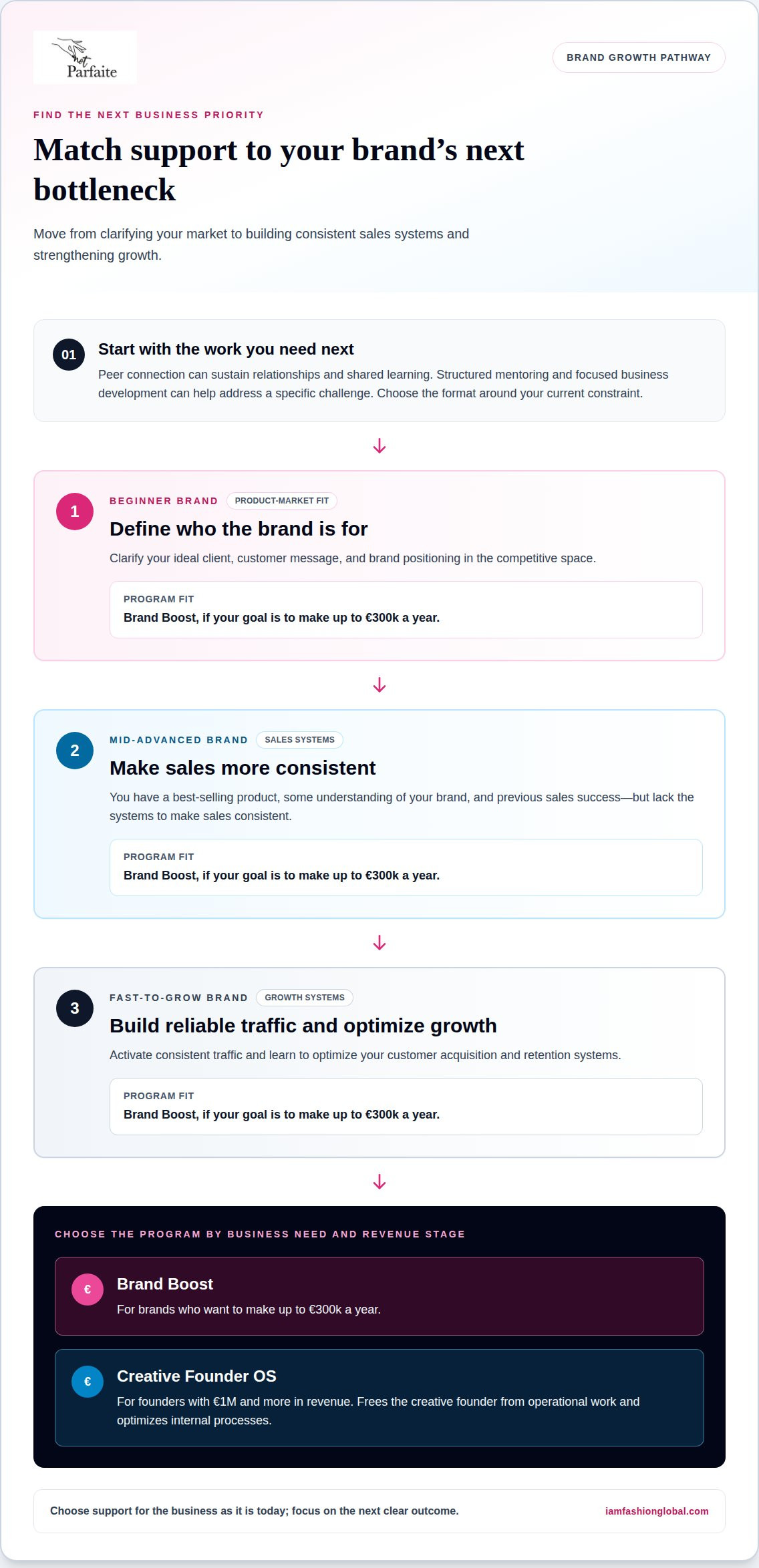
- Match support to your stage. Beginner brands working toward product-market fit need to define their ideal client, customer message, and competitive positioning.
- Identify the next bottleneck. A brand with a best-selling product and previous sales may need systems for consistency; a fast-growing brand may need stronger traffic, acquisition, and retention.
Use the fashion community vs accelerator program distinction to find support for your current constraint. Communities can sustain relationships; accelerators can set a focused development agenda. The right structure depends on the progress your brand needs, from clarifying its market position to strengthening its operations. Choose support with a clear outcome in mind, then apply what you learn.
What services and benefits do fashion communities offer?
A fashion community can offer peer connection, networking, and shared learning. Some networks also provide business training, educational seminars, mentoring, or workspace. The mix matters: one group may focus on exchanging experience, while another offers practical resources such as a design studio. Treat each benefit as a tool for a specific business need, not a promise of sales or growth.
Use peer exchange to test decisions that shape your brand. An early-stage designer, for example, can explain a product concept and learn whether its customer message is clear. A founder preparing for a launch can discuss positioning with other creative entrepreneurs. These conversations can raise questions worth investigating, but they don’t replace customer feedback or a sound business plan.
Mentoring and workshops offer a different kind of value. A mentor network can provide guidance across business areas, while a seminar can build knowledge on a specific topic. Go into each session with a clear objective: bring a question about pricing strategy, customer communication, or planning your next collection. Then turn the discussion into a decision or action for your business.
Workspace can connect creative production with business activity. A design studio, when offered through a network, gives founders a place to develop their work alongside other creatives. Networking can also help designers build professional relationships and learn how peers tackle shared challenges. The practical value is what matters: useful feedback, relevant knowledge, or a connection that supports a current priority.
To assess whether a community fits, compare its format with your immediate goal:
- For peer perspective: Look for regular opportunities to exchange ideas and discuss real brand challenges.
- For targeted learning: Choose a network that offers business training or seminars tied to your knowledge gaps.
- For business direction: Seek mentoring that addresses the areas where you need decisions, not general inspiration.
- For creative work: Consider whether workspace, such as a design studio, supports your production needs.
A community is most useful when you participate with intention. Bring one live challenge, share enough context for others to respond, and record the next step after each discussion. If your priority is turning creative direction into online business growth, explore fashion brand business support. Keep the goal clear: connections and advice create value when they lead to focused action.
Fashion acceleration programs help new and startup fashion companies develop through business training or workspace. Their guidance and resources should reflect each brand’s goals, not just the paths traditionally associated with design success.
How much does it cost to join a fashion community or accelerator?
There’s no single fee for joining a fashion network. A community might charge a membership fee, while an accelerator may charge for a structured program. Outside support may affect what participants pay. Compare the actual offer, not just the label. Review access, duration, mentoring, workspace, and learning format before assessing value.
Start by identifying the cost structure. A recurring membership provides access over time; a cohort-based program may charge for a defined period. A workshop or event may have its own fee, even if the wider network works differently. These are possible models, not a standard price list. The format determines what you pay to access and how closely it matches your needs.
Next, distinguish included support from extra expenses. A program might bundle seminars and mentoring, while studio access or specialist sessions may be separate. Find out what participation includes, how long access lasts, and whether the schedule fits your work. A founder seeking peer discussion has different priorities from one looking for focused business guidance.
Assess value against a specific business constraint. For a beginner brand, useful support could clarify its ideal client, customer message, and competitive position. A brand with a best-selling product and prior sales may need systems for more consistent selling. A fast-growing label may prioritize regular traffic and stronger acquisition and retention. Compare each opportunity with the work that could move your brand forward.
Use this simple comparison before committing:
- List the format: Note whether it’s ongoing membership, a cohort, an event, or a combination.
- Map included support: Record access to mentors, workshops, networking, and workspace separately.
- Identify added costs: Include travel, materials, or other participation expenses relevant to your situation.
- Set a success measure: Choose an outcome, such as clarifying positioning or improving sales processes, to assess the investment.
Judge the commitment by fit, not prestige. A well-known name won’t offset a programme that misses your immediate need, and a lower fee won’t make irrelevant support useful. Compare the time required with the practical access provided. Then decide whether the opportunity addresses a priority your business can act on now. To connect that decision with a growth plan, explore fashion brand growth support.
Fashion acceleration programs may offer low-cost design studio space, business mentoring, educational seminars, and networking. Consider these elements together when assessing cost: studio space can address a practical workspace need, while mentoring and seminars offer different forms of business support. Networking is another part of the offer to weigh. Review what the program includes and compare it with the support your brand needs most.
IAMFASHION
IAMFASHION helps fashion designers and creative brand owners develop their businesses online, with support tailored to their growth stage.
Beginner brands seeking product-market fit can use Brand Boost to define their ideal client, customer message, and competitive positioning. It also suits mid-advanced brands with a best-selling product and previous sales that need systems for more consistent selling.
To discuss which option fits your stage, contact IAMFASHION.
Build Support Around Your Next Move
When comparing a fashion community vs accelerator program, focus on the business constraint you need to solve next. Choose support that turns your current challenge into a clear decision, then make time to apply what you learn. The right structure should strengthen your direction, not distract you from building your brand.
As your business grows, its support needs change too. Peer connection can bring fresh perspectives, while business-focused guidance can help you build stronger foundations. IAMFASHION offers Brand Boost and Creative Founder OS for fashion and creative brand owners developing their businesses online.
Take the next step with a clear priority in mind. Contact IAMFASHION to discuss your options and identify a path that fits your business. Keep building with focus, and let your next move serve the brand you want to grow.
Frequently Asked Questions
What is a fashion accelerator program?
A fashion accelerator is a structured business-development program for fashion brands seeking focused progress. It may combine mentoring, workshops, and guidance on commercial decisions rather than teaching design skills. For example, a founder preparing to grow online sales could use an accelerator to clarify business priorities and turn them into an action plan. The format and support vary by program.
How does a fashion community differ from an accelerator program?
A fashion community generally centers on ongoing connections and exchange, while an accelerator offers a more focused development experience. A community might help a founder hear how peers approach a launch; an accelerator may provide a defined structure for tackling business challenges. Choose based on whether you need continuing relationships, concentrated guidance, or both.
What do fashion accelerator programs provide to designers and brands?
Fashion accelerators can provide business-focused support such as expert mentoring, workshops, and practical guidance. For a designer developing an online brand, that might mean working through customer positioning, marketing decisions, or growth priorities. Some programs also offer workspace or networking. Treat these as possible program elements, then compare the actual structure with the decisions your business needs to make.
Which fashion communities and accelerator programs are available in the United States?
US-based founders can consider local creative networks, online fashion communities, and accelerator cohorts serving fashion businesses. Their focus and eligibility vary, so match the format to your goals and location. IAMFASHION supports fashion designers and creative brand owners worldwide with online business development. Brand Boost offers structured growth support for founders.