Creative vision can start a fashion brand, but execution is what moves it forward. A fashion entrepreneur execution plan turns an idea into focused action: define the customer and position, develop products, prepare a launch, and build marketing around what the business needs next.
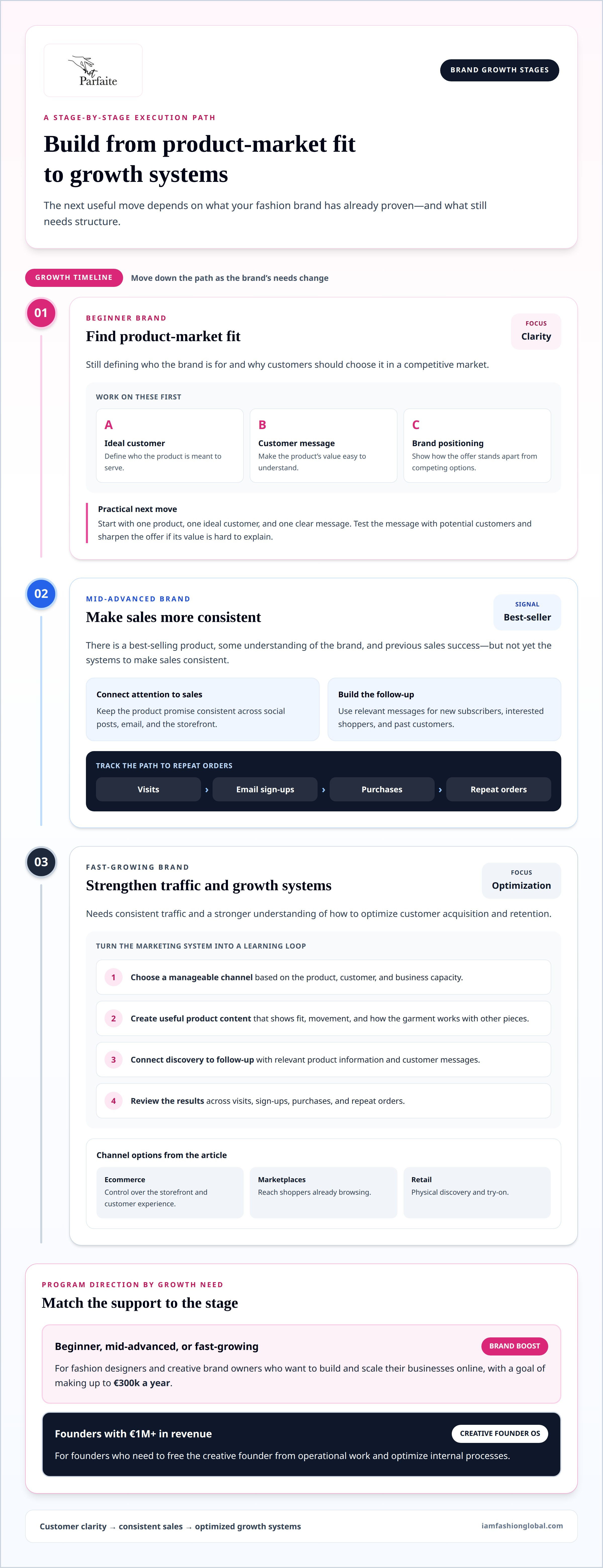
Your next move depends on your brand’s stage. Beginner brands are still working toward product-market fit: they need to define their ideal customer, sharpen their message, and find a clear position in a competitive market. Mid-advanced brands have a best-selling product and some sales success, but need systems to make sales more consistent. Fast-growing brands need steady traffic and stronger customer acquisition and retention.
Choose support that matches your brand’s stage. This guide breaks the work into practical steps, from business planning and product development to launch and marketing, so you can act with clarity instead of relying on inspiration alone.
Key Takeaways
- Build your plan around a clear customer, a distinct position, and practical steps that connect product development to sales.
- Shape your launch around a focused product offer and the channels that make it easy for customers to discover and buy.
- Match your marketing to your brand’s stage, then strengthen the systems behind traffic, customer acquisition, and retention as you grow.
Fashion business action planning
A fashion entrepreneur execution plan connects product decisions with customer demand, operations, and cash flow. Set milestones for testing, launching, reviewing sales, and deciding what the business should do next.
Business Plan, Budget, and Cash-Flow Forecast
Build your business plan around the customer, product range, sales channels, and launch milestones. List expected sales alongside costs such as materials, production, shipping, marketing, and operations. A cash-flow forecast shows when payments arrive and bills are due, helping you avoid production deposits falling due before sales come in. Update the forecast as orders and costs change.
Manufacturer and Supplier Vetting
Find clothing manufacturers through referrals, trade events, and supplier directories. Send a clear product brief, request a sample, and assess its fit, construction, materials, and finishing. Compare minimum order quantities, production capacity, communication, terms, and delivery estimates. Local manufacturing can simplify visits and communication; overseas production may offer different capabilities but requires careful coordination across distance and shipping.
Inventory and Supply-Chain Risks
Inventory can tie up cash in styles, colors, or sizes that sell slowly. Forecast demand by product and channel, then plan how to handle unsold stock. Supply-chain risks include material shortages, delays, and quality issues. Document specifications, set clear quality expectations, and identify alternative sources for important materials. Track each order from supplier confirmation through delivery.
Funding and Small-Business Resources
Funding options include personal savings, crowdfunding, business loans, and outside investment. Weigh each against your cash needs, repayment obligations, and willingness to share control. U.S. founders can also seek small-business mentoring and planning resources. Prepare a business plan and cash-flow forecast before pursuing funding, so the amount and purpose reflect your actual launch needs.
Plan expansion around repeatable demand, reliable production, and working capital. If you plan to sell or transfer the business, organize financial records, supplier agreements, product information, and operating processes. Review your fashion entrepreneur execution plan as the business changes, so growth and exit decisions follow a clear direction.
Launching a fashion brand or business
Turn the concept into a launch customers can recognize and choose. Align the product, brand identity, sales channel, and launch message before opening sales.
Brand Identity and Positioning
Define the customer before choosing the visual direction. A beginner brand still seeking product-market fit needs a clear ideal customer, customer message, and position among competing offers. Write a short positioning statement that names the customer, the product’s value, and why they should choose it. Use that statement to guide your website, packaging, and launch campaign.
Branding and Product Differentiation
Differentiate through choices customers can see and understand. A label might focus on a specific fit, a recognizable print language, or garments designed for a particular use. Keep the difference consistent across product names, photography, packaging, and descriptions. Then test the message with potential customers. If they can’t explain the value, sharpen the offer before expanding the range.
Licenses, Permits, and Labeling Rules
U.S. business registration, permits, and garment-label requirements depend on location, business structure, sales model, and product. There isn’t one checklist that fits every fashion brand. Map the requirements that apply to your business and products before selling, and include label review in product development. Keep records of product details and supplier information to support consistent labeling as the range grows.
Fashion Brand Startup Costs
There’s no single startup cost for a U.S. fashion brand. Build your estimate from the actual needs of the launch: design and sampling, production, inventory, packaging, ecommerce, photography, marketing, and operating expenses. A made-to-order launch has different cash needs from a stocked collection. Separate one-time setup costs from recurring expenses, then prioritize spending that helps customers understand and buy your first products.
For online brand-building support, Brand Boost helps fashion designers and creative brand owners build and scale their businesses online.
Marketing
Treat marketing as a system that connects customer attention to sales. Start with one product, one ideal customer, and one clear message. For example, a label selling adjustable-fit trousers can show the fit, explain the design choice, and direct shoppers to the product page. Keep the promise consistent across social posts, email, and your storefront.
The best sales channel depends on your product, customer, and capacity. Ecommerce gives you control over the storefront and customer experience; marketplaces can put products in front of shoppers already browsing; retail offers physical discovery and try-on. Start with a channel you can manage well, then add another when you can support its stock, service, and promotion needs.
Build content around specific customer decisions. Show how a garment fits, moves, and works with other pieces. Use product photography, styling examples, and clear descriptions to answer buying questions. A launch campaign might introduce the design process, reveal the finished product, and share a direct purchase link. Give each post a purpose, rather than using it simply to fill the calendar.
Connect discovery to follow-up. Give interested shoppers a reason to join your email list, such as launch updates or styling guidance. Send messages that reflect their actions: introduce the collection to new subscribers, explain product details to interested shoppers, and share related pieces with past customers. Track visits, email sign-ups, purchases, and repeat orders to see where attention turns into revenue.
- Awareness: Use styling videos or designer notes to introduce the brand.
- Consideration: Explain fabric, fit, care, and product differences on product pages.
- Purchase: Make the route from campaign to checkout clear and consistent.
- Retention: Follow up with useful updates tied to products customers bought.
Review results by channel and product, then make one focused adjustment at a time. If a campaign brings visits but few purchases, improve the product page or clarify the offer. If customers return for one item, test related styling content. Fast-growing brands should build consistent traffic and strengthen acquisition and retention systems, rather than relying on isolated launch spikes.
Product inspiration and development
Start with a customer need, not just a sketch. A useful product concept connects a clear purpose, a distinct design choice, and a buyer who values both. The Guide to Fashion Entrepreneurship frames fashion product work across creating, branding, sourcing, marketing, channeling, and merchandising. Treat those choices as connected, not isolated.
Turn inspiration into a product brief. Name the intended customer, occasion, silhouette, materials, and design detail that sets the piece apart. For example, a workwear label might develop a washable overshirt with practical pockets. Check whether the concept fits your brand’s position and complements existing products. Then turn the brief into sketches and specifications a maker can interpret consistently.
- Define: Record the customer need and the product’s purpose.
- Design: Choose materials, construction, fit, and distinctive details.
- Develop: Review a sample for comfort, finish, and design accuracy.
- Refine: Adjust specifications before committing to production.
Keep development focused. Each sample review should answer a specific question, such as whether a sleeve allows movement or a fabric holds its intended shape. Record changes in the product specifications so later samples and production follow the same direction. A clear process helps prevent attractive concepts from drifting away from customer needs.
Set a price based on the product’s full economics and its position in the market. Account for materials, manufacturing, packaging, shipping, platform charges, marketing, and the margin needed to operate. Then compare the proposed price with the value customers perceive and the alternatives they consider. If the numbers don’t support the price, revisit materials, construction, order volume, or the product offer before launch.
Build products that support the business you want to run. Founders ready to improve internal processes and reduce their operational load can explore a more scalable fashion business approach.
IAMFASHION
IAMFASHION helps fashion designers and creative brand owners develop their businesses online. Beginner brands still seeking product-market fit can use Brand Boost to work on the foundations for growth. Mid-advanced brands with a best-selling product and past sales success can use Brand Boost to build toward more consistent sales.
Creative Founder OS helps free creative founders from operational work and optimize internal processes. Match your next step to the business challenge you’re ready to solve.
Contact IAMFASHION to discuss the next stage of your fashion business.
Make Your Next Move Count
Your next step is to turn one priority into a decision you can act on. Choose the product or business constraint that matters most right now, then set a clear direction for addressing it. A fashion entrepreneur execution plan should evolve with your brand, keeping creative ambition connected to the choices that move the business forward.
IAMFASHION offers Brand Boost and Creative Founder OS for fashion founders at different stages. Choose the program that fits your current business needs, whether you’re clarifying your foundation or looking to free yourself from operational work. Progress comes from choosing deliberately, then building the systems to support your next move.
Contact IAMFASHION to plan your launch, and take the next step with focus and confidence.
Frequently Asked Questions
What are the steps to launch a fashion business from idea to first sale?
Move from a defined customer problem to a focused offer, then prepare the buying experience before announcing the launch. Confirm the design, product details, fulfillment process, and checkout flow. Create product pages with clear sizing and care information, then place a test order to catch issues. Open sales with a specific launch message, and review customer questions and orders to guide your next decision.
How do you validate demand and choose a target market for a fashion brand?
Validate demand by testing whether a specific group will take a meaningful buying step, not simply praise an idea. Share a sample concept with likely customers, invite email sign-ups for launch updates, or test a small product release. Look for repeated interest in the same benefit, such as fit or versatility. Choose the group whose needs, buying behavior, and product expectations align with what you can deliver.
How do fashion brands price products and calculate profit margins?
Set a price that covers the product’s unit cost and variable selling expenses while leaving room for profit. To calculate gross margin, subtract the cost of goods sold from the selling price, then divide the result by the selling price. Include costs that change with each sale, such as packaging or payment processing. Check the resulting price against customer value and channel requirements before finalizing it.
How should a fashion entrepreneur plan marketing, launch, and customer acquisition?
Plan backward from the launch date, assigning each campaign asset a role: introduce the problem, demonstrate the product, and make the buying step clear. Use one consistent message across email, social content, and product pages. Give each campaign a trackable link or code, then compare visits, sign-ups, and purchases. After launch, review which audience and message produced qualified interest, and use what you learn to shape the next campaign.