A fashion founder workflow system should connect the decisions behind a design with the details production needs and the information e-commerce uses to sell it. When everyone works from the same product record, handoffs are clearer and creative work has a more direct path to market.
Design, sampling, production, and online selling may feel like separate jobs. But when product details are copied between disconnected tools, updates get missed and founders lose time to avoidable coordination. The answer isn’t more software by default. It’s a deliberate workflow that gives each stage the right information at the right time.
Learn how to connect design, production, and e-commerce tools, organize key handoffs, and assess whether a workflow change is worth the time and money. You’ll also see how to adapt the system as your brand grows, from finding product-market fit to building consistent sales and reducing day-to-day bottlenecks.
Key Takeaways
- Connect design, production, and e-commerce around shared product information, clear handoffs, and status updates to reduce repeated data entry.
- Shape your workflow around your brand’s stage, from defining product-market fit to building consistent sales and streamlining operations as you grow.
- Assess time and cost savings by identifying manual handoffs, revisions, and sampling decisions that create the biggest bottlenecks.
1. Connected design, production, and e-commerce tools
Independent fashion brands often rely on 6-8 disconnected software tools across design, production, and delivery. A useful fashion founder workflow system links those tools through shared product records, so a fabric change made during development reaches production and the online product listing. The U.S. Bureau of Labor Statistics describes fashion as an industry shaped by short product life cycles, erratic demand, varied products, and complex supply chains. Clear handoffs help teams respond without hunting through scattered files.
Small fashion brands can start with a shared product catalog, file storage, and clear approval statuses. Established labels may need role-based access and integrations across larger teams. Both need one reliable version of each design. Store sketches, measurements, fabric details, colorways, and revision dates together, then label the approved version before sampling. This helps prevent marketing assets from showing an outdated color or detail.
For collaboration, give each design a status such as “in development,” “sample approved,” or “ready for e-commerce.” Attach comments and revised files to the relevant style record instead of sending detached attachments. Generative AI can help teams explore design directions or develop colorway concepts from a base idea; designers still decide which versions fit the collection, fabric, and brand position. Keep approved assets separate from exploratory concepts.
A node-based workflow maps tasks as connected stages: design input, concept generation, review, asset preparation, and handoff. Each node passes the right file or decision forward. For example, design approval can trigger preparation of product images and descriptions, while a pending sample keeps the listing in draft. This visual structure makes dependencies easier to spot than a folder of unrelated files.
E-commerce, fulfillment, and customer service work best when product details, order status, and inventory updates stay connected. Link the approved product record to its listing, then connect order updates to fulfillment and support workflows. Staff can answer a customer’s order question using its current status, while inventory changes show whether the product remains available.
To track cash flow, margins, and inventory together, connect sales and stock records to each product’s costs. A shared dashboard can show sales, remaining units, and costs at a glance, helping founders see how inventory decisions affect cash and product margins. Keep product identifiers consistent across design, inventory, sales, and finance tools so reports refer to the same item.
A useful workflow system links design, production, e-commerce, fulfillment, and inventory through shared product records. Look for a shared catalog with file storage and approval statuses, integrations for larger teams, and a dashboard that connects sales, stock, and product costs.
2. Fashion founder workflow
A fashion founder workflow turns a creative idea into a product customers can buy. Start with a collection plan, then assign each style an owner, decision point, and due date. For example, a jacket might move from concept to pattern approval, sample review, production release, product-page preparation, and campaign launch. The founder sets priorities; specialists own technical decisions and record each handoff. This keeps creative direction connected to commercial output.
Organize suppliers by material or production role in a shared vendor record. Keep contact details, capabilities, specifications, open questions, and related styles together. Create a purchase order once quantities, sizes, colorways, and milestones are aligned, and link it to the relevant style and supplier. The production schedule should show dependencies, such as fabric readiness before cutting and sample approval before bulk production. This makes delays visible while there’s still time to adjust.
Give each style a clear stage, from concept through delivery. At every stage, record the decision owner, required input, and next action. A pattern change, for instance, should identify the affected sample and notify the person responsible for approval. This simple practice helps keep technical updates from getting lost in email threads or detached files.
Schedule review points before campaign deadlines. Product photography, descriptions, and launch dates depend on approved samples and accurate product details. If production timing shifts, update the launch plan and tell the relevant team. Keep one current schedule as the source of truth instead of maintaining separate manual calendars for design, sourcing, and marketing.
Use a weekly founder review to resolve blocked decisions, not to revisit every task. Scan overdue approvals, supplier questions, and upcoming production milestones; assign each issue an owner and next step. As the business grows, repeatable handoffs let the founder focus on creative direction and commercial priorities. Founders ready to strengthen internal processes can explore operational systems for creative founders.
3. Fashion workflow costs and time savings
Measure workflow costs before making a change. For one garment, record the time spent transferring a sketch, revising specifications, chasing approvals, and preparing manufacturing files. Multiply staff time by its labor cost, then add direct expenses such as sample materials and shipping. This baseline shows whether the biggest drain is manual coordination, repeated revisions, or physical sampling.
Separate cash savings from time savings. A virtual prototype may reduce the need for a physical sample at every design decision, but it doesn’t remove the need to assess fit, fabric behavior, or construction. Use digital visuals to reject unsuitable options early, then reserve physical samples for decisions that require touch or wear testing. Track avoided sample rounds alongside any new software or production costs.
AI-powered tools can also change the economics of early design work. Compare the time needed to develop a pattern manually with the time required to generate and review a digital draft. Include human review and technical corrections in the calculation; otherwise, the estimate leaves out essential work. For image production, compare the cost of creating commerce assets through photography with AI-generated visuals, including editing and approval.
Assess each change by collection, not by a broad promise of efficiency. For example, compare one capsule collection’s development schedule, revision count, sample expenses, and approved assets with those of a previous collection. Use the same categories in both records. This makes it easier to see whether faster sketch exploration actually shortens the path to a production-ready garment.
Review the results after each launch. Check whether production delays, excess inventory, or late campaign changes offset gains made during design. A useful cost model includes setup and subscription expenses, staff time, sample decisions, and the effect of inventory on cash flow. Keep the workflow only if saved time or reduced rework supports better manufacturing decisions and stronger commerce outcomes.
4. How do fashion founders manage design, sampling, and production workflows?
Manage design, sampling, and production as connected decisions, not separate projects. The U.S. Environmental Protection Agency describes product development as a system linking the product, processing, distribution, and management. For a fashion label, that means connecting a design change to its sample, production instructions, delivery plan, and final product record.
Start with one style record containing the technical package, bill of materials, fabric details, and current sample status. Add milestones for design approval, material readiness, sample review, and production release. Metadata can flag bill-of-materials readiness, sample approval stages, and compliance checkpoints, making blocked work easier to spot. Assign an owner to each decision so unresolved fit feedback doesn’t go unnoticed between teams.
Use a consistent review process for every prototype. Record the sample version, fit notes, requested changes, decision owner, and approval date. Then connect each revision to the specific pattern or construction detail it changes. Brands produce an average of three to five physical prototypes per design, so clear records help teams compare versions and avoid repeating feedback.
Set production release criteria before sampling begins. A style should move forward only when its design, materials, and specifications are approved. Keep the supplier’s production schedule linked to those milestones, and update downstream distribution plans when approval timing shifts. Consolidating feedback and making decisions before requesting another revision can reduce sample rounds from four to two.
Review the workflow after each production cycle. Compare planned milestones with actual approvals, note where specifications changed, and identify which handoff created delay or rework. Then refine the next style’s checkpoints instead of adding more manual tracking. For support in optimizing internal processes, explore creative founder workflow support.
IAMFASHION: Creative Founder OS
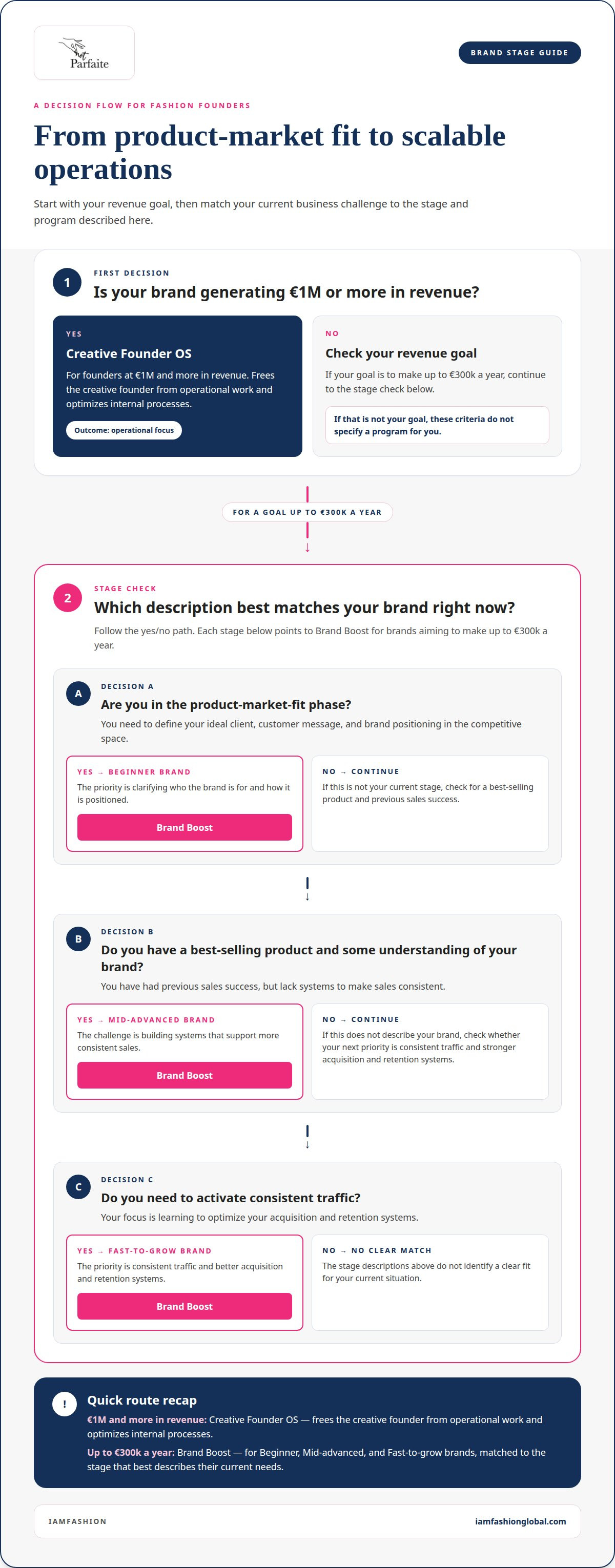
Choose Brand Boost if you’re a beginner working toward product-market fit and defining your ideal client, customer message, and market position. It also suits mid-advanced brands with a best-selling product and previous sales success that need systems for consistency, as well as fast-to-grow brands focused on consistent traffic and stronger acquisition and retention.
Match the program to your brand’s current stage and the challenge you need to solve. Contact IAMFASHION to discuss the next step for your business.
Make your next workflow decision count
Your next move doesn’t need to be a complete operational overhaul. Choose the recurring decision that still depends too heavily on you, then create a clearer way for the right person to move it forward. This can make more room for creative leadership while keeping the commercial choices that keep your brand moving in view.
A fashion founder workflow system should grow with your ambitions, not lock you into processes that no longer fit. IAMFASHION offers Brand Boost and Creative Founder OS for founders at different stages of building and scaling their businesses. The right next step depends on the challenge your brand needs to solve now.
Contact IAMFASHION to discuss your workflow and identify a practical direction for your business. Keep building with intention, and give your creative vision the structure to move forward.
Frequently Asked Questions
What workflows should a fashion startup founder manage?
A fashion startup founder should manage the decisions connecting product planning with sales and cash. Alongside development and production, include demand forecasting, product costing, supplier payments, returns, and customer feedback. For example, if a size sells out quickly, record that signal and use it when planning the next buy. Regularly reviewing sales, outstanding bills, and customer issues helps founders make timely decisions without losing sight of the collection.
What are the risks of manual workflows for an independent fashion brand?
Manual workflows can leave a brand making decisions from incomplete or outdated information. For example, a stock count in one spreadsheet may not reflect recent online orders, leading the team to promote an unavailable item. Re-entering product details also creates conflicting specifications, while scattered approvals can obscure which version production should follow. Set one source of truth, name an owner for updates, and keep a clear record of changes.