The more established option isn’t automatically the better launchpad. A fashion launch program versus a brand accelerator is a choice between building the foundations of a label and strengthening a business that’s already selling. Launch support can help an early-stage designer find product-market fit, define an ideal client, and sharpen brand positioning; an accelerator typically suits an operating brand ready to build momentum.
You may already know that creative vision needs a solid business behind it. The challenge is identifying which kind of support matches your brand’s current stage, not simply choosing the program with the biggest promise. This guide explains who fashion launch programs and brand accelerators are for, how their purpose and structure differ, and what networking opportunities they can open up. You’ll also see how the choice shifts as a brand moves from testing its offer to selling a best-seller, building consistent sales systems, and optimizing customer acquisition and retention. Use that distinction to focus your next step on the business problem you need to solve now.
Key Takeaways
- Choose support by your brand’s current challenge: early-stage labels need to test product-market fit, while established sellers may need stronger systems for consistent sales.
- Look beyond the word “accelerator” and assess whether its participants, learning format, and mentor access match your goals.
- Use networking with purpose: build relationships that can help you sharpen your business decisions, not just expand your contact list.
Fashion accelerator programme purpose and target participants
A fashion accelerator helps an operating label strengthen its business, not just prepare a first collection. These programmes typically target small brands operating for less than five years. Applicants must already be actively selling products online, such as through their own website. That sales activity gives the programme a real offer to assess and improve.
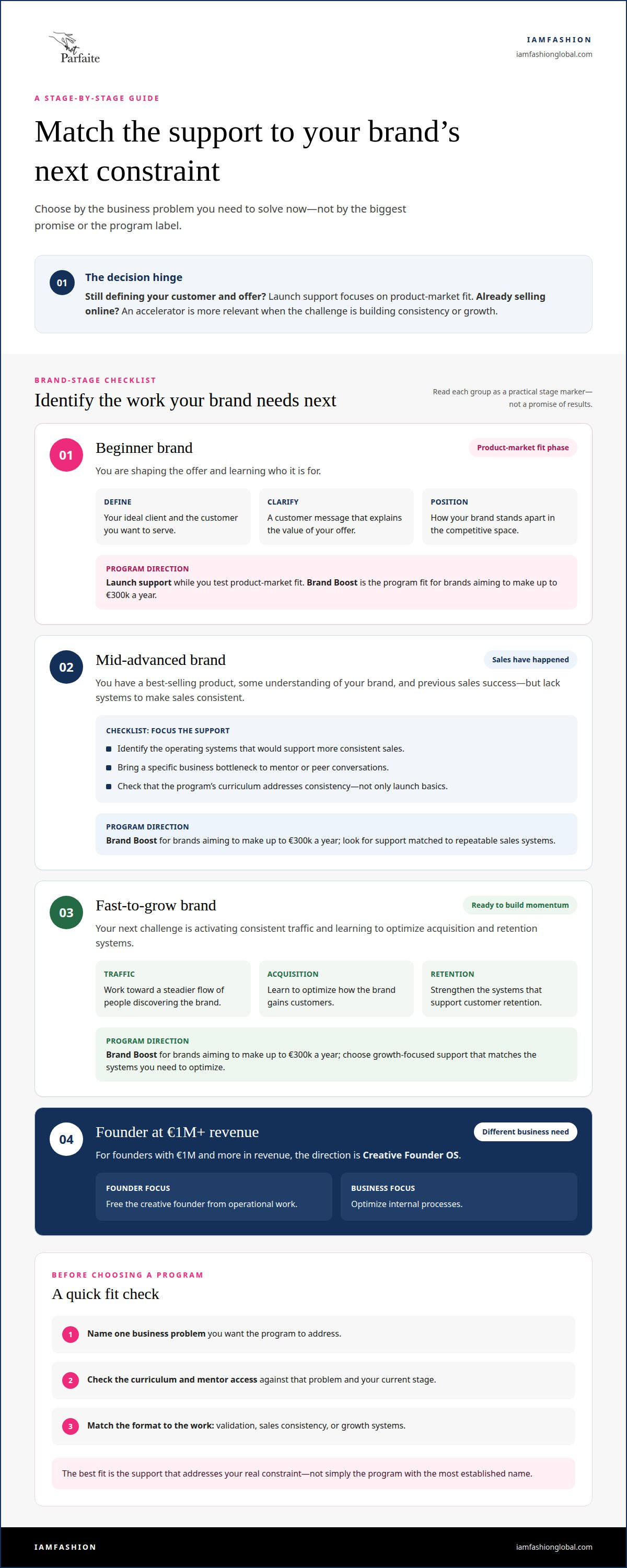
Choose based on your brand’s current bottleneck. A beginner brand still testing product-market fit needs to define its ideal client, customer message, and position in the market. A more established brand with a best-selling product and previous sales may need systems for consistency. A brand ready to grow may need steadier traffic and stronger customer acquisition and retention. Match the program to the specific challenge holding your business back.
How long do these programs last? Duration depends on the curriculum, mentorship format, and whether sessions run as a short cohort or extended support. Compare the schedule with the work your business needs, including time to apply lessons between sessions. How much do fashion launch programs and brand accelerators cost? Fees vary with program length, mentor access, and included support; the price depends on the case and is given after a quote request.
What are the risks and drawbacks of fashion brand accelerators? A poor fit can take up time without addressing your real constraint. A brand still validating its offer may not benefit from growth-focused guidance, while a seller with proven demand may need operating systems more than launch basics. Check the curriculum’s focus against your current stage and priorities.
What are the best fashion startup launch programs and accelerators in the United States? The best fit is the program whose participants, mentorship, and curriculum address your current business stage. Compare practical details: expectations for online sales, mentor access, peer connections, and whether the work supports validation, consistency, or growth. Choose based on what the program helps you do, not its label.
Use a clear decision rule: seek launch support while defining your customer and offer; choose an accelerator when online sales are underway and your next challenge is repeatable growth. Before committing, identify one business problem you want the program to address and make sure its activities are relevant to that problem.
Networking opportunities
Networking matters when conversations connect to a clear business need. A launch program may introduce an emerging designer to peers facing similar decisions, such as refining a customer message or choosing which products to test. An accelerator can bring together operating brands focused on growth challenges, including sales consistency and customer retention. What matters is the relevance of the people and conversations, not simply the size of the network.
Look for structured opportunities, not vague promises of “industry connections.” A useful format could include a mentor reviewing your product range, a peer discussion about customer feedback, or a buyer-facing presentation. Each serves a different purpose: peer sessions help founders compare approaches, mentor conversations provide focused guidance, and industry events create opportunities to meet potential collaborators.
Make each interaction specific:
- Prepare a concise description of the label, its customer, and its current need.
- Ask a mentor about one decision, such as how to explain a best-selling piece.
- Share a useful contact or insight with another founder, then follow up with context.
- Record next steps after a conversation, such as sending a line sheet or arranging a discussion.
For example, a designer testing product-market fit could compare how customers respond to two different messages in a peer discussion. A brand with repeat sales could ask an experienced mentor how to turn a successful product into a more consistent selling system. Neither conversation guarantees a result. Each is more useful when it addresses a defined business question.
Assess the network by who participates and how access works. A cohort of designers may provide candid peer feedback, while sessions with mentors or buyers can expose different perspectives. Before enrolling, map the relationships you need: creative peers, experienced operators, retail contacts, or potential collaborators. Then match those needs to the program’s actual activities. For practical support connecting brand vision with business growth, explore fashion brand growth guidance.
What is a fashion launch program?
A fashion launch program helps a designer turn a creative concept into a business offer. It suits an early-stage label still testing product-market fit. For example, a designer preparing an accessories range can use the process to clarify who might buy it, what makes it distinctive, and how to explain its value. The aim is not simply to produce more designs. It is to build a clearer route from idea to customer.
That work starts with three connected decisions: ideal client, customer message, and brand positioning. A label might define its audience around a specific lifestyle, then test whether its product descriptions speak to that buyer. Positioning also means identifying how the brand differs from alternatives in its competitive space. These choices guide product, content, and sales decisions.
- Define the offer: identify the product range and the customer problem or desire it addresses.
- Describe the customer: clarify who the designs serve and what influences their purchase decisions.
- Sharpen the message: explain the label’s value in language customers can understand.
- Test the position: compare the brand’s point of difference with similar options customers might consider.
A launch pathway can help founders connect those decisions to practical steps. A designer could choose one product to test, create a focused product page, and gather customer responses. Those signals help show whether the offer and message make sense together. If shoppers respond to the design but misunderstand its purpose, clearer messaging may be a better next step than developing a new collection.
Choose this type of support when your main challenge is defining the foundation, not scaling a proven sales engine. A brand with a best-selling product and previous sales may need systems for more consistent revenue. A founder seeking faster growth may need to focus on steady traffic and customer acquisition and retention. Match the program to the decision currently blocking progress, then use each session to move that decision forward.
What services and mentorship do fashion launch programs provide?
A useful launch program turns creative decisions into business tools. For an emerging label, that can mean clarifying the customer, shaping the offer, and building a practical route to market. Strong support connects each lesson to a decision the founder needs to make, such as which product to test or how to explain its value.
Core guidance often covers customer definition, brand positioning, product planning, and marketing foundations. A mentor can help a designer distinguish a design detail that is distinctive from a message customers understand. For example, a small bag label might test whether buyers respond first to material, function, or styling. That insight can inform product descriptions, campaign content, and decisions about the next collection.
- Customer and positioning work: clarify the ideal client and how the label stands apart.
- Offer development: focus the product range around a clear customer need or desire.
- Marketing direction: connect brand messaging, content, and sales channels.
- Business planning: translate creative goals into priorities and workable next steps.
Mentorship should move beyond general encouragement. A focused session might review a product page, refine a customer message, or assess feedback from a product test. Peer feedback adds another perspective, while a specialist mentor can help connect design choices with commercial decisions. The value comes from applying guidance to the label’s actual products and audience.
Before choosing a program, map its sessions against your immediate needs. If customers don’t understand the offer, prioritize positioning and messaging. If the offer is clear but sales are uneven, look for practical work on marketing and business systems. Find out how feedback is delivered, what participants produce, and how each session leads to action. A useful program helps you make decisions and gives you tools to apply, not just inspiration.
Turn your design direction into a stronger business foundation with fashion brand business guidance.
IAMFASHION: Brand Boost
IAMFASHION’s Brand Boost is a 12-month program for fashion designers and creative brand owners building and scaling online. If you have a best-selling product and past sales but lack systems for consistency, focus on the next step: developing repeatable growth. Brands seeking consistent traffic and stronger customer acquisition and retention can also consider this stage of support.
Creative Founder OS focuses on freeing creative founders from operational work and optimizing internal processes, rather than addressing an earlier launch stage. Choose the path that matches your current business priorities and the role you want to play as the brand grows. To discuss which direction fits your fashion business, contact IAMFASHION.
Choose your next move with purpose
Make your next move a commitment to execution, not just another planning exercise. The choice between a fashion launch program and a brand accelerator matters when it helps you turn insight into decisions your business can act on. Give each new idea a clear purpose and a way to assess its usefulness.
As you move forward, record what you learn and how it changes your decisions. That record can help you see which assumptions hold up, where your attention belongs, and what deserves more work. Progress comes from applying insight consistently, not collecting more advice.
Bring your current challenge and next ambition into the conversation. Contact IAMFASHION to discuss your next step, then keep moving with clarity and confidence.
Frequently Asked Questions
What is a brand accelerator for fashion businesses?
A brand accelerator is a structured development experience designed to help a fashion business make progress on defined growth priorities. It may combine expert guidance, practical learning, and a framework for turning business challenges into decisions. For instance, a founder could map the steps from a customer discovering a label to completing a purchase, then identify where the process needs attention.
How do fashion launch programs and brand accelerators differ?
Program names can vary, so compare the curriculum, format, and expected work rather than relying on the label. Look for clear information about mentor access, feedback, peer sessions, and what participants are expected to put into practice. A well-structured program makes its learning process clear, so you can judge whether it fits your schedule and preferred way of working.
What do fashion brand accelerators typically offer?
Fashion brand accelerators may include guided learning, mentor feedback, founder discussions, and practical business exercises. Before choosing one, review what happens between sessions: whether participants receive feedback on their work, how progress is tracked, and what materials they take away. These details help distinguish an active learning experience from one that mainly shares general advice, and show whether the support fits your working style.
What are the best fashion startup launch programs and accelerators in the United States?
The best fit is a program whose participants, mentorship, and curriculum match your current business stage. Compare online sales expectations, mentor access, peer connections, and whether the program supports validation, consistent sales, or growth.