Growth isn’t the finish line. The real test of how to scale a creative business is building one that delivers excellent work without relying on the founder for every decision, sale, or solution.
Attracting more clients can create momentum, but premium growth takes more than a full pipeline. It depends on choosing a clear market, communicating the value of your work, and building the capacity to serve clients consistently. Add people without shared values or reliable systems, and growth can quickly become another source of pressure.
This guide breaks the process into four practical moves: position your brand for premium clients, choose a market with room to grow, build a team culture that empowers people, and create systems that support sustainable expansion. Whether you’re still finding product-market fit, building on a best-selling offer, or improving acquisition and retention, start with your business’s current stage. Grow with intention, not just activity.
Key Takeaways
- Make your offer’s value clear and show premium clients why your creative work is the right fit for their needs.
- Choose a market where your strengths meet real customer demand, then sharpen your positioning as you learn.
- Build a team culture that encourages sound decisions and gives the founder more room to lead strategically.
1. Positioning a creative brand to attract premium clients
Positioning starts with a clear promise: whom you serve, what problem you solve, and what changes because of your work. Name a focused outcome instead of listing every skill. For example, a fashion creative could specialize in helping emerging labels build cohesive seasonal brand identities. A clear message makes your offer easier for premium clients to recognize and remember. Review your recent projects, identify the work that produced the strongest results, and shape your offer around that strength.
Make your portfolio prove the promise. Use six to eight detailed case studies to show the brief, your process, and the result. Keep the selection edited rather than displaying more than 50 design pieces. Then present pricing in terms of client value: explain how your work supports their goals, not just the hours it takes. If you win more than 70% of proposals, your pricing may be too low. Test a 20% increase on your next three proposals, and explain the value behind the rate. One creative business example raised its project minimum by 30%.
Build on existing relationships while seeking new work. After a successful project, propose a relevant next step, such as adapting a brand identity for a product launch. Stay connected with interested prospects through useful email updates, and follow up with past clients as their needs evolve. Keep multiple acquisition channels active so referrals aren’t your only source of leads. Diversify your clients and industries, too: a strong creative business shouldn’t rely on one anchor client or sector.
In the United States, legal, tax, and licensing obligations depend on location, worker classification, and the work being sold. Use written agreements that cover scope, payment, and intellectual-property rights, and seek US legal and tax guidance on applicable worker, tax, and licensing requirements.
2. Choosing a niche and target market
Choose a niche where your skills meet a specific customer need. Review past inquiries, repeat requests, and projects that energized your team. A brand designer, for example, might focus on independent fashion labels that need a cohesive visual identity before expanding their product range. Test the fit by identifying the buyer, their urgent problem, and what distinguishes your approach. A focused niche gives you a practical foundation for scaling a creative business without diluting its vision.
Build digital and content marketing around that customer’s decisions. Share a process breakdown, a project case study, or practical guidance that helps prospects recognize their challenge. For example, a packaging designer could explain how material choices affect a product’s shelf presence. Use each piece to lead toward a clear next step, such as an inquiry or email signup. As you plan how to scale a creative business, maintain two to three acquisition channels and prioritize the ones that bring qualified prospects.
Refine your marketing with a repeatable review process. Track which topics lead to relevant inquiries, which channels attract the right buyers, and where prospects stop responding. If social posts get attention but bring poor-fit leads, adjust the audience and message before increasing output. Preserve your brand identity with clear editorial rules for voice, visuals, and the problems you solve. Scale distribution, not the core promise. That’s how creative businesses can grow their marketing without losing their identity.
Use marketing automation for routine steps, not creative judgment. A workflow can tag new inquiries by project type, send a welcome email, and schedule a thoughtful follow-up. Keep personal input where it matters, such as tailoring a proposal to a prospect’s goals. As strategic brand growth takes shape, review automated messages against your voice and customer promise. Better systems free up attention for original ideas and stronger relationships.
3. Empowering teams and building a sustainable culture
An agency scales sustainably when people can make sound decisions without waiting for the founder. Assign clear ownership at each project stage: creative direction, client communication, production, and final review. For example, one lead can gather feedback while another protects delivery standards. This turns individual skills into a shared workflow instead of sending every question to one person. The founder’s role shifts from solving each design problem to setting priorities, coaching leads, and building a culture that supports quality.
Delegate with clear decision boundaries. A team member might resolve a small client issue independently, while larger scope changes go to a project lead. One practical example sets £50 as the threshold for decisions team members can make without approval. The exact boundary should fit the business, but the principle is consistent: define authority before pressure hits. Pair each responsibility with the information and tools needed to act, then review outcomes in regular one-to-ones. Trust grows when people know what they own and where to escalate.
Use detailed case studies to show how your team thinks, not just what it makes. A strong example explains the client’s challenge, the creative choices, the collaboration behind the work, and the outcome. Credit the people who led research, design, or delivery so prospects can see the team’s range of skills beyond the founder. Case studies also help new hires understand the standards and problem-solving approach expected on real projects.
Build culture through consistent leadership habits. Recruit for adaptability, mindset, and cultural fit alongside technical ability. Document how feedback works, how deadlines are communicated, and how creative disagreements are resolved. A weekly project review, for example, can surface blockers early, while individual check-ins give team members room to raise concerns. These practices make empowerment concrete. The founder can spend less time directing every task and more time developing leaders, protecting creative quality, and guiding sustainable growth.
4. Creating scalable business systems
Scaling means growing revenue and delivery capacity without making every result depend on the founder. Your business is ready when demand is repeatable, your offer sells, and delivery follows a documented workflow. Choose a model based on the work clients repeatedly need and your team’s ability to deliver it well. Then test whether the process can move forward without constant founder intervention.
Productize the predictable 20% of creative work: define a repeatable scope, process, and outcome while preserving room for client-specific ideas. For example, a branding studio might package a recurring brand review while tailoring recommendations to each client. Recurring revenue can also come from retainers tied to ongoing creative needs. Even 30% of agency revenue from retainers can transform cash flow, giving the business more visibility than relying only on one-off projects.
Build systems around capacity, not optimism. For an agency in its systems phase, target 65-75% utilisation of available hours on billable work and £80,000-£120,000 annual revenue per person. Track delivery time, project margin, and payment timing so new work doesn’t outrun available cash. Hiring ahead of demand or accepting uneven workloads can strain cash flow; clear scopes, deposits, and invoicing routines help manage those pressures.
Document the three processes the team performs most often, then use coaching and regular reviews to make them practical. Test the system with a two-week holiday without email: if approvals or delivery stall, clarify ownership and decision rights. A scalable operation protects creative quality while giving the founder room to lead. Build founder-independent business systems that keep work moving forward.
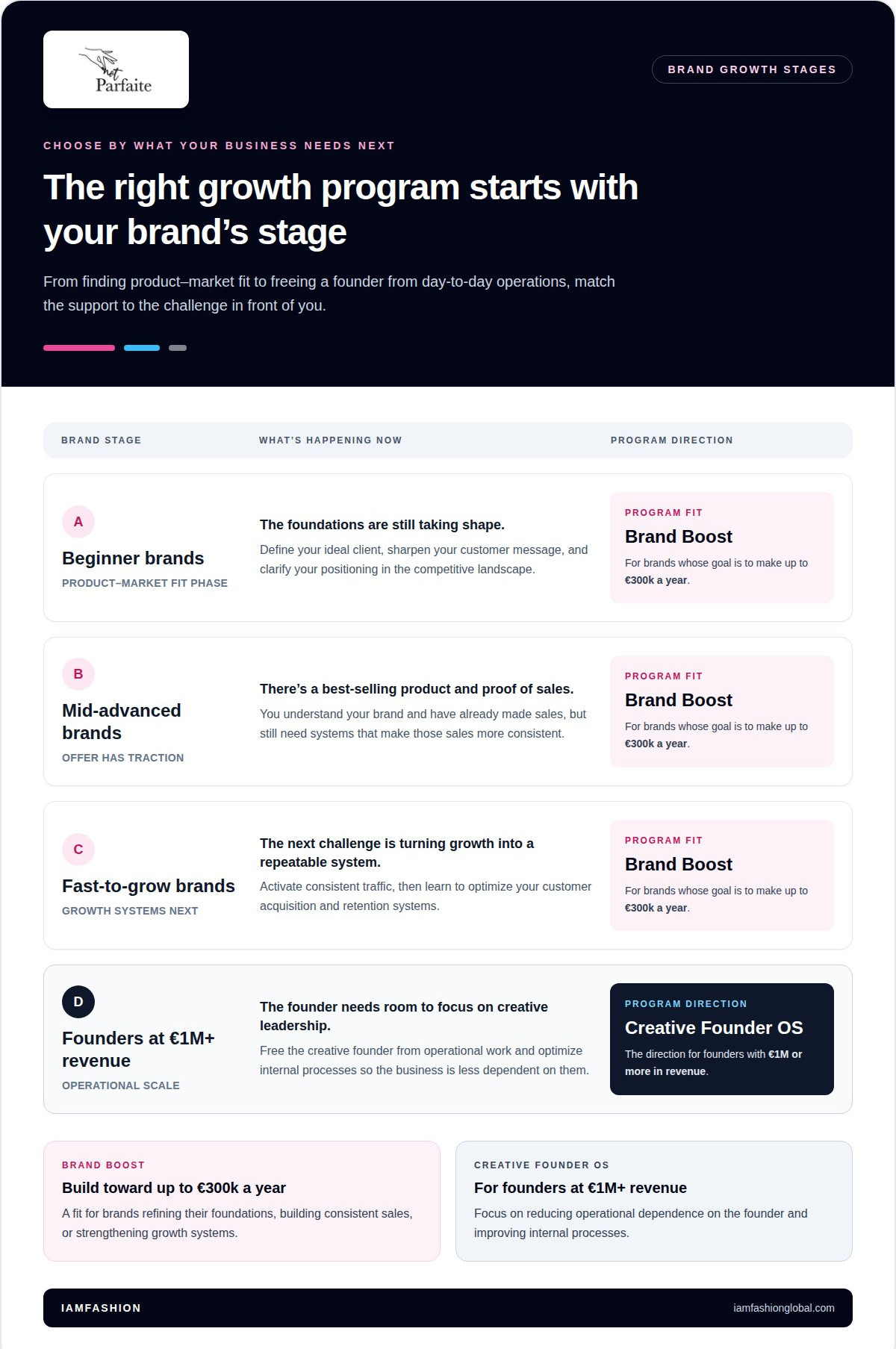
IAMFASHION: Creative Founder OS
It supports the shift from carrying every decision to building a business that can run more effectively without constant founder involvement.
If your brand is still finding product-market fit, clarify your ideal client, customer message, and position in the market. If you have a best-selling product and previous sales, focus on systems that make sales more consistent. If your brand is growing quickly, work toward consistent traffic and stronger acquisition and retention systems.
Choose the program that matches your current challenge and growth goals. Contact IAMFASHION to discuss the next step for your creative business.
Build the business your next stage requires
Growth is a design choice, not just a bigger version of today. Decide how to scale a creative business in a way that protects the work you care about and gives you more control over how the company runs. Your next move should address the challenge in front of you, not an imagined future version of your brand.
Choose a path, then commit to building the capabilities that make growth more sustainable.
Contact IAMFASHION to discuss your growth and identify a practical next step. Your creative vision deserves a business built to carry it forward.
Frequently Asked Questions
What Comes After Scaling?
After scaling, focus on making growth more resilient and valuable, not simply larger. Review which offers produce healthy margins, which clients return, and where quality slips as demand rises. Then decide whether to deepen your expertise, develop new leaders, or improve the customer experience. A creative business that runs without constant founder intervention can give its founder more freedom to shape what comes next.
How do creative businesses price services and products profitably?
Set prices with a clear picture of delivery costs and customer value. For a service, account for production time, project management, revisions, overhead, and the profit the business needs to reinvest. For a product, include materials, packaging, fulfillment, and selling costs. Compare the final price with the offer’s distinct value, then review actual margins after delivery. If projects repeatedly exceed estimates, tighten the scope or adjust pricing.
What are the best ways to get more clients for a creative business?
Build trust before prospects are ready to buy. Ask satisfied clients for introductions, collaborate with complementary businesses, and contribute useful ideas to communities your ideal customers already follow. A photographer, for example, could partner with a stylist on a shared editorial project that highlights both perspectives. Follow up promptly with interested prospects, personalize each message, and track which relationships lead to well-matched work.
When should a creative business hire employees or freelancers, and what does it cost?
Hire when a recurring responsibility limits delivery, sales, or leadership, and the business can support the added commitment. A freelancer may suit a defined project or specialist skill; an employee may be a better fit for ongoing work central to daily operations. Costs depend on location, role, experience, hours, and employment arrangement. Map the work first, then compare the full expense with the capacity or expertise it adds.
What systems and software help creative businesses streamline operations?
Choose tools based on the work that regularly slows your team. A customer relationship manager can organize leads and follow-ups; project management software can clarify owners, deadlines, and approvals. Accounting tools help track invoices and expenses, while shared file storage keeps current assets accessible. Start with one bottleneck, define the workflow, and choose software that supports it. Too many disconnected tools can create more admin instead of reducing it.