The right apparel startup accelerator program should solve your brand’s current growth bottleneck, not just offer a prestigious name. Accelerators typically run for 3-6 months and may provide mentorship, connections, and funding in exchange for equity, often 5-7%. That makes the fit a business decision, not a badge of honor.
It’s reasonable to expect an accelerator to bring structure and momentum, but that support matters only when it fits your stage. If you’re still finding product-market fit, prioritize guidance on your ideal customer, message, and positioning. If you have a best-selling product and past sales but lack consistency, look for practical help building systems for repeatable growth.
This guide explains how accelerators work, what to consider before applying, and which types of support suit beginner, mid-advanced, and fast-growing brands. You’ll be better equipped to choose a program that moves your business forward, protects your creative direction, and builds toward sustainable sales.
Key Takeaways
- Choose support for your brand’s stage: beginners need product-market fit, while established brands may need stronger sales systems or optimized customer acquisition and retention.
- Assess mentorship, funding, market validation, program format, and equity together to judge whether an accelerator’s terms support your goals.
- Build an application around your customer, positioning, and evidence of sales traction so your growth opportunity is clear.
What is a Startup Accelerator?
A startup accelerator is a focused program that helps a young company test its business model and prepare to grow. For an apparel founder, that might mean refining a product launch, validating demand, and building relationships in fashion retail and production. Unlike a general business course, an accelerator connects advice to the venture’s next commercial steps.
Mentoring should help turn a business challenge into a decision. For example, a founder unsure whether a collection suits its target customer can use mentor feedback to refine the offer, test customer responses, and adjust the launch plan. Funding may support this work, but programs use different models: some invest in exchange for equity, while others offer guidance without taking ownership. Compare the support and terms, not just the program name.
A typical accelerator investment is $100,000, and a funded startup may give up a 7% stake. Equity is an ownership share, so weigh the capital against the long-term value of the stake. Ask how the program handles follow-on funding: an initial investment may introduce founders to later investors, but it doesn’t mean additional capital is automatic.
Apparel accelerators focus on fashion-specific needs, such as product development, sourcing, and retail access. Fashion incubators typically support earlier-stage development of a business or product, while general accelerators apply broader startup tools across industries.
In the United States, apparel founders can consider fashion-focused accelerators, fashion incubators, and general startup accelerators that accept consumer brands. The right fit depends on whether you need apparel expertise, foundational support, or broader business growth.
For sustainable, circular, or inclusive apparel, seek programs whose mentorship and market connections address those specific models. Fashion for Good’s interactive sustainable-fashion innovation museum opened in October 2018, but a museum is not itself an accelerator.
Options vary by cohort and local ecosystem. Search your region for fashion business networks, manufacturing resources, and startup support. If a nearby cohort isn’t a fit, consider remote programs.
Program duration and delivery format
Startup accelerator programs typically run for 3-6 months. That window gives founders time to set goals, test decisions, and build momentum without treating the program as a substitute for execution. For an apparel label, connect each milestone to a business task, such as validating a product range, preparing a launch, or improving the sales process.
Cohorts can include 100-300 startups. A large group can bring varied perspectives, while a smaller working group may make it easier to get focused feedback. Ask how founders receive individual guidance within the cohort. For example, a shared workshop on pricing helps only when your specific product and customer are part of the discussion.
The delivery format shapes how founders use a program. In-person sessions offer direct contact with mentors and peers, while remote sessions can remove location barriers. A hybrid format may combine scheduled online learning with in-person events. Before committing, compare the format with your production calendar, customer commitments, and ability to travel.
Review the program calendar, not just its advertised duration. Find out when mentors meet founders, when they review progress, and whether you’ll have time to apply feedback. If a session covers customer research, plan to use what you learn in your next product or marketing decision. Connecting learning with action makes the cohort more valuable.
Imagine a founder preparing a first apparel launch during a cohort. They need customer feedback and a clear launch plan. Mentor sessions can help refine the offer, with feedback applied to the product messaging. The goal is a stronger decision-making process, not simply attending every session.
Before applying, make sure the program’s pace and format suit your current stage. A beginner still testing product-market fit needs time to clarify the ideal customer, message, and positioning. A brand with a best-selling product may benefit more from sessions on building consistent sales systems. Choose a cohort that leaves room to implement what you learn, rather than taking on capital or commitments without a clear operating plan.
Typical accelerator investment amounts
A typical startup accelerator investment is $100,000, and a funded startup may exchange a 7% stake. That stake implies a valuation of about $1.5 million. Treat these figures as a reference point, not a universal offer. The actual value lies in the terms, timing, and support attached to the capital, especially for an apparel company managing product development and inventory.
Compare the investment with what your business needs next. A founder preparing a launch may need production funding, while another may prioritize customer acquisition. Tie each use of capital to a business milestone, then assess whether giving up equity is a fair exchange. Mentors and investors can add value, but introductions matter most when they address your specific growth needs.
Investor connections can support fundraising beyond an accelerator’s initial investment. Find out how the program helps founders prepare financial materials, explain their growth model, and meet relevant investors. For example, a label with early sales can use customer and order data to make its funding case more concrete. A warm introduction helps, but a clear investment story makes the meeting count.
Look at both investment and exit counts when assessing a program’s track record. Alphacap Berhad has made 15 investments, but an investment total alone does not show how many companies reached a successful exit. Compare portfolio investments with realized exits, and consider whether those outcomes reflect businesses at a stage like yours. A low exit count can also reflect a younger portfolio, so timing matters.
Before accepting terms, make a simple comparison: note the cash investment, equity requested, support offered, and approach to follow-on funding. Then weigh the offer against your growth plan. If the investment funds a specific milestone and the program provides relevant investor access, it may help you progress. If the equity costs more than the support is worth to your business, pursue a funding path better suited to your goals.
Application process and selectivity
Deadlines and eligibility vary by program and application cycle. Some programs accept early-stage or pre-revenue founders, assessing the product concept, customer insight, and plan to test demand rather than past sales. A founder with a prototype can explain who it serves and how they’ll learn from potential buyers. Make sure your application fits the program’s stated stage and selection criteria.
Most accelerator programs claim to accept only 1-3% of startup applicants, so make your case specific. Compare apparel startup accelerator programs by the founders they serve, the evidence they value, and the support they offer. For a beginner brand, explain how you’re defining the ideal client, customer message, and position in the competitive space. If you haven’t made sales yet, use product feedback or customer conversations to show what you’re learning.
Build your pitch around the customer, product, evidence, and next milestone. A pre-revenue label might describe its prototype, intended audience, and plan to test demand. A brand with sales can explain what customers buy and where growth stalls. Ground your claims in actual feedback, orders, or product testing, then connect the support you need to a clear business decision.
Most accelerator pitch calls last 5-10 minutes. Lead with the apparel brand’s customer and product, then explain what you’ve learned and what you need to prove next. Practice concise answers about production, pricing, and customer acquisition. Some apparel startup accelerator programs may ask follow-up questions, so prepare to explain the reasoning behind your choices without overstating traction.
Applicants usually receive a decision within a week of a pitch call. Use that time to assess whether the program’s schedule, terms, and mentorship fit your priorities. Clarify your fashion brand’s growth priorities so you can make a focused next move.
Look for programs that state they accept early-stage or pre-revenue founders. These programs may assess your product concept, customer insight, and plan to test demand rather than your past sales.
IAMFASHION
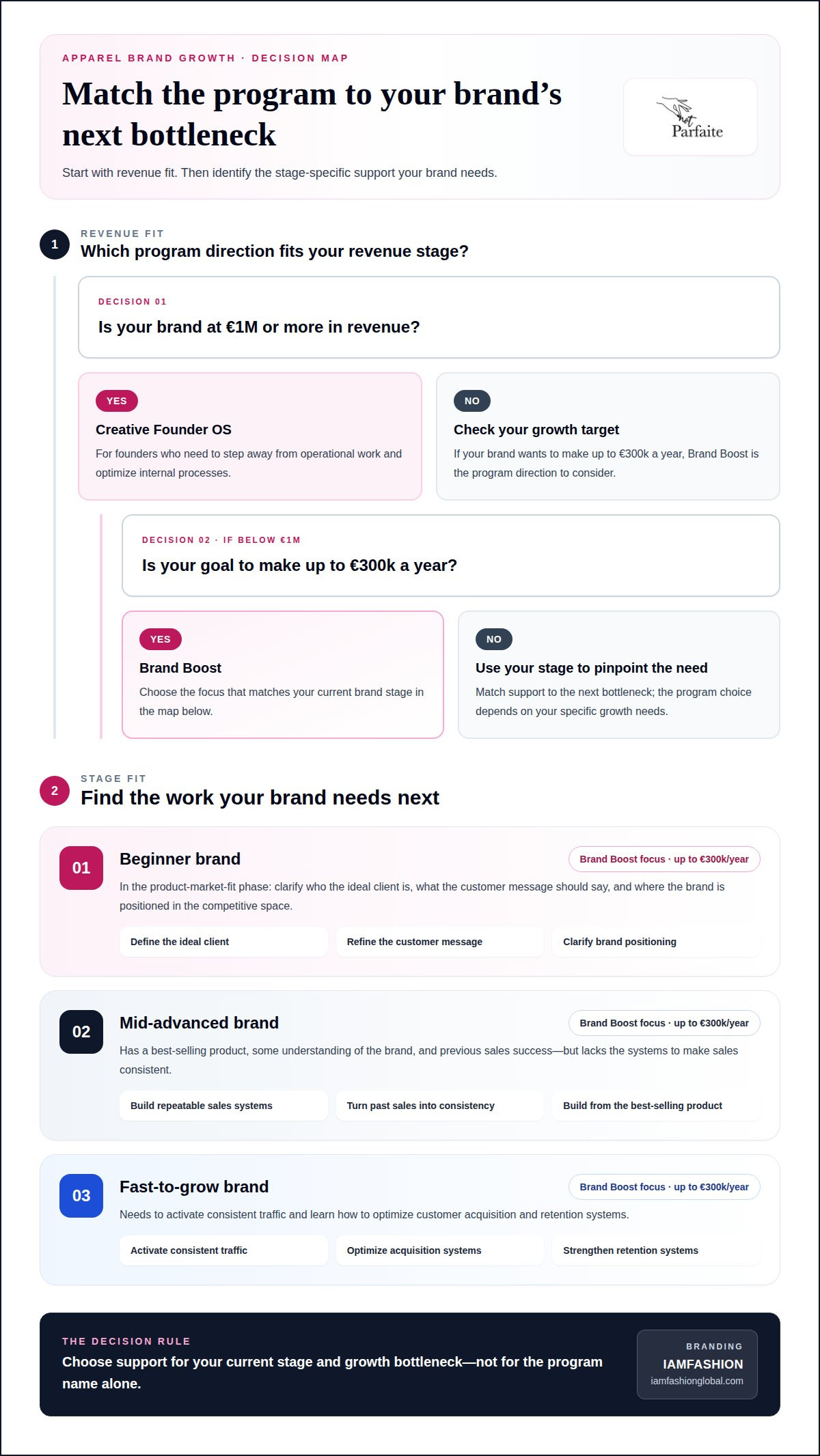
IAMFASHION supports fashion designers and creative brand owners as they develop their businesses online. Beginner brands still finding product-market fit can use Brand Boost to clarify their ideal client, customer message, and market position. Mid-advanced brands with a best-selling product, an understanding of their brand, and previous sales can use it to build systems for more consistent sales. Fast-growing brands can focus on steady traffic and stronger customer acquisition and retention.
Contact IAMFASHION to discuss the next step for your brand.
Choose Support That Moves Your Brand Forward
The best apparel startup accelerator programs match your next business priority. Base your decision on what your brand needs now, not a program’s reputation. A beginner brand still finding product-market fit needs clarity about its ideal client, message, and market position. A brand with a best-selling product and previous sales may need systems for consistent revenue. A fast-growing label may need steadier traffic and stronger customer acquisition and retention.
Match your stage to the right kind of support. The goal is focused progress, with your creative direction informing commercial decisions.
Ready to define your next move? Contact IAMFASHION and take the next step with confidence.
Frequently Asked Questions
What are the application deadlines and eligibility requirements for apparel startup accelerators?
Deadlines and eligibility vary by program and application cycle. Some accept early-stage or pre-revenue founders, assessing the product concept, customer insight, and plan to test demand rather than past sales. For example, a founder with a prototype can explain who it serves and how they’ll learn from potential buyers. Make sure your application fits the program’s stated stage and selection criteria.
How much equity or fees do apparel accelerators require, and what funding do they provide?
Equity-based accelerators commonly exchange funding for ownership, while program terms determine whether fees also apply. A typical accelerator investment is $100,000, and many programs take 5-7% equity. Compare the cash, equity, and any fees together. Also clarify when funding is paid, what milestones or conditions apply, and whether later investment is a separate decision.
What mentorship, manufacturing access, retail connections, and other benefits do apparel accelerators offer?
Benefits vary by program and may include mentor guidance, introductions to manufacturers or retailers, peer collaboration, and help refining a go-to-market plan. Their practical value depends on relevance: a founder preparing a small initial collection needs different manufacturing guidance from a label planning broader distribution. Look for a clear connection between each benefit and a concrete business need, such as improving product readiness or retailer outreach.
How do I apply to an apparel startup accelerator, and what should my pitch include?
Start by reviewing the application requirements, then shape your pitch around the customer, product, evidence of demand, and next growth priority. A pre-revenue label can explain its target customer and how it will test the offer. A brand with sales can show what those sales reveal and where growth stalls. Keep claims grounded in real customer feedback, order history, or product testing.
What risks or drawbacks should founders consider before joining an apparel accelerator?
Consider equity dilution, time commitments, and whether the program’s advice fits your brand’s needs. Giving up equity affects future ownership, while a packed schedule may pull your attention from production, customers, or sales. Manufacturer and retail connections matter only when they fit your product and operating model. Weigh each commitment against the specific capability or access you expect to gain.
Which apparel accelerators accept early-stage or pre-revenue startups?
Some accelerators accept early-stage or pre-revenue founders, assessing their product concept, customer insight, and plan to test demand. Review each program’s stated stage and selection criteria.