A bigger collection won’t fix an unclear brand. To grow an independent fashion label, define a distinct design vision and the customer it serves, then test demand before committing to larger production runs. Build from evidence: what sells, what customers say, and where your audience is ready to find you.
You may know the feeling: the creative direction is clear in your head, but turning it into consistent sales takes more than a strong product. Decide who your label is for, what makes it different, and how to expand without losing the point of view that drew people in.
This guide shows you how to shape your vision, choose production quantities that match demand, reach new markets, and use sales patterns and customer feedback to refine your next move. Start with a sharper position, then build growth around what customers actually respond to.
Key Takeaways
- Define the customer and design point of view your label can own before expanding the collection.
- Test demand with a focused production run, then adjust quantities as sales reveal what customers want.
- Build a consistent marketing rhythm and explore new markets through partnerships that fit your brand.
- Use customer feedback and sales patterns to decide what to refine, repeat, or leave behind.
Finding manufacturers and choosing production quantities
Match production to demonstrated demand, not imagined scale. A focused first run can help protect cash while you learn what customers will buy.
-
Find suitable manufacturers
Shortlist small-batch manufacturers or local artisans who can develop prototypes. Compare their aesthetic, production timeline, minimum order quantity, and fit with your budget. Ask how they handle revisions and quality checks before committing. A maker who understands your construction and finish requirements is a stronger fit than one chosen on price alone.
-
Start with made-to-order products
Consider a made-to-order launch when you need customer evidence before holding inventory. Set clear order terms and realistic delivery expectations, then track which designs attract purchases. This approach can reveal demand, but each item still needs a workable production process. Avoid offering more custom options than you can reliably make.
- Build a distinctive collection around a clear point of view. Carry a consistent design detail, fabric choice, or print across coordinated pieces, then document each style in a tech pack with measurements, materials, construction, and finish. Review samples against the specification before approving production.
- Choose quantities by style and evidence. Producing 10 copies of one item is faster than producing 10 different items, so a tighter range can simplify the first run. Negotiate a smaller minimum order quantity to test sales before scaling.
- Plan wholesale cash flow before accepting an order. A wholesale payment advance of at least 30 per cent has been cited as a benchmark for supporting independent designers’ production costs. Build production financing around confirmed terms and avoid relying on unpaid invoices to fund every next step.
- Practice your sales pitch and make direct outreach through calls and conversations at events. Explain the product’s distinct value, intended customer, and retail price clearly. Calculate wholesale and retail margins using production, packaging, shipping, and selling costs. Revise the price if either channel leaves too little room.
- For U.S. business licenses and taxes, requirements depend on business structure and operating location. Clothing-labeling obligations also depend on the product and materials, so build compliance into product development and packaging before launch.
- Protect brand assets with records of original designs, dated development files, and clear written agreements with collaborators and manufacturers. Treat the brand name, artwork, and garment design as separate assets, and seek appropriate protection for each.
- Estimate launch costs by listing samples, materials, production, packaging, marketing, and operating expenses. The total depends most on product complexity, order quantity, and sales channel, so model those choices before placing a production order.
Marketing and international expansion
Build visibility through channels that show your clothing clearly and reach buyers consistently. Expand when your message, audience, and fulfilment process can support new demand.
-
Market to press and buyers
Pitch fashion editors, bloggers, influencers, and independent clothing retailers with a focused introduction. Include a concise brand story, clear product images, and details that explain what sets the label apart. Tailor each pitch to the recipient: show an editor the collection’s point of view, and show a retailer how the pieces fit its customers. Fashion weeks aren’t the only route; 61 per cent of surveyed fashion brand owners did not participate in fashion weeks. Build direct relationships instead of relying on a single event.
-
Use short-form video marketing
Plan short videos around one visual idea at a time: show how a garment moves, reveal a detail, or capture the making process. Use a recognizable setting, styling, or opening image to reinforce the brand across posts. Add a clear next step, such as viewing the collection or joining the email list. Review which videos prompt meaningful conversations and product interest, then shape future content around those signals.
- Keep email active between launches. Send useful updates more often than every few months, with product stories, styling ideas, or behind-the-scenes details. Give each message one purpose, such as introducing a new piece or drawing attention to a customer favourite. Consistent email helps keep the relationship alive when social posts move quickly through a feed.
- Test international demand through independent retailers and international platforms before widening distribution. Start with a specific audience or market, then assess product interest, customer questions, and fulfilment needs. Micro-influencers, described as creators with roughly 1,000 to 100,000 followers, can help a label reach a focused community. Choose creators whose content and audience align with your clothing, rather than chasing reach alone.
- Connect the channels: use video to introduce a collection, email to deepen the story, and press outreach to build awareness. Sustainable growth depends on a repeatable rhythm, not a single viral post. If you’re ready to strengthen that rhythm, explore fashion brand marketing support.
Using sales data and customer feedback to guide growth
Use customer signals to make deliberate decisions, not guesses. To grow an independent fashion label, connect sales patterns with what customers say and do.
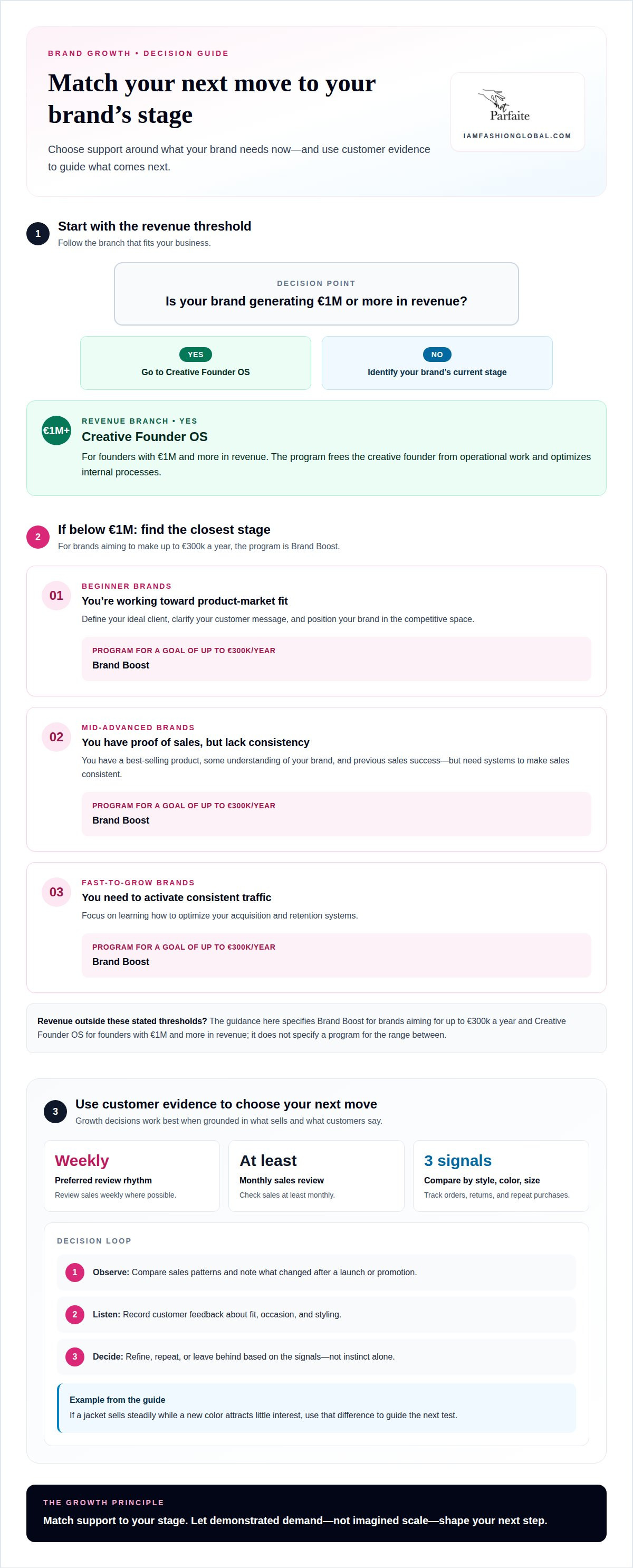
- Review sales at least monthly, with weekly reviews preferable. Compare orders, returns, and repeat purchases by style, color, and size. Note what changed after a launch or promotion. If a jacket sells steadily while a new color attracts little interest, use the difference to guide your next test rather than relying on instinct alone.
- Clarify your target customer through buying patterns and direct conversations. Record what customers say about fit, occasion, and styling. If buyers describe a piece as workwear, for example, explore whether that use case can sharpen your niche and product message. Pair comments with purchase behavior to distinguish a passing opinion from a meaningful signal.
- Sort feedback into recurring themes before changing a design. Group comments about sleeve length, fabric feel, or sizing, then compare them with sales trends. One customer’s suggestion can prompt a question; repeated requests alongside product interest provide a stronger reason to test an adjustment.
- Test new ideas with early supporters or through curated platforms before expanding the range. Share a concept, sample, or limited release, then track questions, orders, and requests. Use responses to decide what deserves further development. Likes can show attention, but they don’t prove customers intend to buy.
- Build relationships through direct social media conversations, in-person events, and useful email content. Ask customers how they wear a piece, then respond with relevant styling suggestions. These exchanges make the audience part of the brand’s ongoing conversation rather than turning each interaction into a sales pitch.
- Give your community a clear role in product development. Invite early customers to react to fabric options or a revised fit, then share how their feedback informed your decision. If you’re trying to grow an independent fashion label, this two-way connection can reveal what customers value and help turn a purchase into an ongoing relationship.
Defining a fashion label’s niche and design vision
A clear niche connects a designer’s point of view to a specific customer. Define both before expanding the range, so every product and message strengthens the same position.
-
Identify a fashion label niche
Choose a customer and a need your label can serve distinctively. For example, focus on versatile occasionwear for customers who want statement pieces they can style repeatedly. Describe that audience, its priorities, and the alternatives available. Then write one sentence explaining why your label belongs in the market. If it could describe any clothing brand, sharpen the positioning.
-
Shape the design vision
Set a few design principles to guide each collection, such as sculptural shapes, expressive color, or adaptable layering. Use them to decide which ideas belong and which distract from the label’s identity. Build a reference board with garments, textures, and images that express the same mood. A consistent point of view doesn’t mean repeating one design; it means making every piece feel connected.
- Start a U.S. fashion label by defining its customer and market position, developing a focused product concept, and testing interest with potential buyers. Next, choose a business structure, handle relevant registration and tax requirements for your location, and establish a sales channel before launch.
- Protect your vision from common mistakes: designing for everyone, producing too many unrelated styles, or treating social attention as proof of purchase intent. A collection without a clear customer or a message that changes with every post can weaken a launch. Use customer conversations and early sales to refine, not abandon, the core idea.
- Turn the positioning into practical choices: product names, photography, styling, and launch messaging should all signal the same identity. If you’re ready to make that direction commercially sharper, develop your fashion brand strategy around a clear niche and design vision.
IAMFASHION
IAMFASHION supports fashion founders with growth strategies suited to their business stage. Beginner brands working toward product-market fit can use Brand Boost to define their ideal client, customer message, and competitive positioning. Mid-advanced brands with a best-selling product, a clear understanding of their brand, and previous sales success can use Brand Boost to build systems for more consistent sales.
Fast-growing brands that need consistent traffic and stronger acquisition and retention systems can also choose Brand Boost.
Contact IAMFASHION to discuss which stage best describes your brand.
Make your next move with intention
Growth becomes more manageable when your next decision serves a clear purpose. Choose one priority for the coming season, whether that’s sharpening your message, building a steadier sales process, or creating more room for creative work. Then give it consistent attention instead of chasing every new opportunity.
The right support should match both your ambition and your label’s current needs. IAMFASHION offers Brand Boost and Creative Founder OS for fashion founders working toward different business goals. Creative Founder OS provides structured workflows, strategic tools, and execution roadmaps to help organize your business. The aim isn’t growth at any cost. It’s to grow an independent fashion label without losing sight of the creative direction that makes it yours.
Contact IAMFASHION to discuss your label and the next step you’re considering. Your vision can lead, backed by decisions that help your business move with purpose.
Frequently Asked Questions
What Does it Take to Run an Independent Fashion Brand Today?
Running an independent fashion brand takes creative direction and disciplined business management. You need to coordinate product development, cash flow, inventory, fulfilment, marketing, and customer care. These activities affect one another: a delayed production decision can disrupt a launch calendar and customer communication. Set a regular planning rhythm, assign clear ownership for essential tasks, and protect time for both design work and business decisions.
What systems does a business need?
A fashion business needs repeatable workflows for planning, orders, finances, customer communication, and performance reviews. For example, use one calendar to coordinate collection development, content, and launch dates, then keep order and inventory records in a consistent format. Document how customer questions are handled and how sales are reviewed. Clear processes reduce reliance on memory and help you see where work is getting stuck.
How do independent fashion labels find manufacturers and set minimum order quantities?
Find manufacturers by matching their capabilities to your garment’s construction, materials, and finish. Share a clear product specification, request a prototype, and discuss revisions before agreeing to production. Minimum order quantities depend on the maker, materials, and production method. Explain your testing needs and ask whether a smaller initial run is workable, then choose quantities that suit expected demand and available cash.
What are the best ways to market an independent fashion label on a limited budget?
Focus on a small set of channels you can maintain consistently. Use one product shoot to create website images, social posts, and email content, then tailor the message to each channel. Share useful details such as styling options or how a piece is made. Track which messages lead to product page visits, enquiries, and orders so future effort follows customer interest, not just engagement.
How can a new fashion brand sell through its own website, marketplaces, and boutiques?
Use each channel for a distinct role. Your website gives you control over product presentation and the customer journey. Marketplaces can introduce products to shoppers beyond your existing audience, while boutiques offer a physical retail setting and buyer relationships. Keep product descriptions, imagery, and brand messaging consistent across channels, and monitor stock carefully so you don’t promise the same inventory twice.
How much does it cost to launch a small clothing brand?
Launch costs depend on product complexity, order quantity, and sales channel. Estimate samples, materials, production, packaging, marketing, and operating expenses before placing a production order.