A fashion brand doesn’t scale on attention alone. To scale a fashion business, build a consistent brand identity, reach the right customers through digital marketing and purposeful influencer partnerships, and strengthen supplier diversity and supply-chain visibility so your operations can support growth. Make the brand recognizable, then make the business reliable.
You already know that great design matters. But creative instinct needs a clear customer message, disciplined marketing, and dependable systems to turn demand into sustainable sales. This article shows how to connect those pieces: refine your brand position, use organic content to guide paid campaigns, choose influencer partnerships with purpose, stay adaptable without losing consistency, and build a more resilient supply chain. The goal isn’t growth at any cost. It’s a fashion business that can reach more customers while staying true to what makes the brand distinct.
Key Takeaways
- Use organic content to learn what resonates, then shape targeted paid campaigns and influencer partnerships around that audience.
- Keep your brand’s core message consistent while using customer research to decide which trends fit your identity.
- Build supplier diversity and improve supply-chain visibility to make growth more resilient and easier to manage.
- Match your next growth move to your brand’s stage, from clarifying product-market fit to strengthening sales systems and founder operations.
1. Digital marketing and influencer partnerships
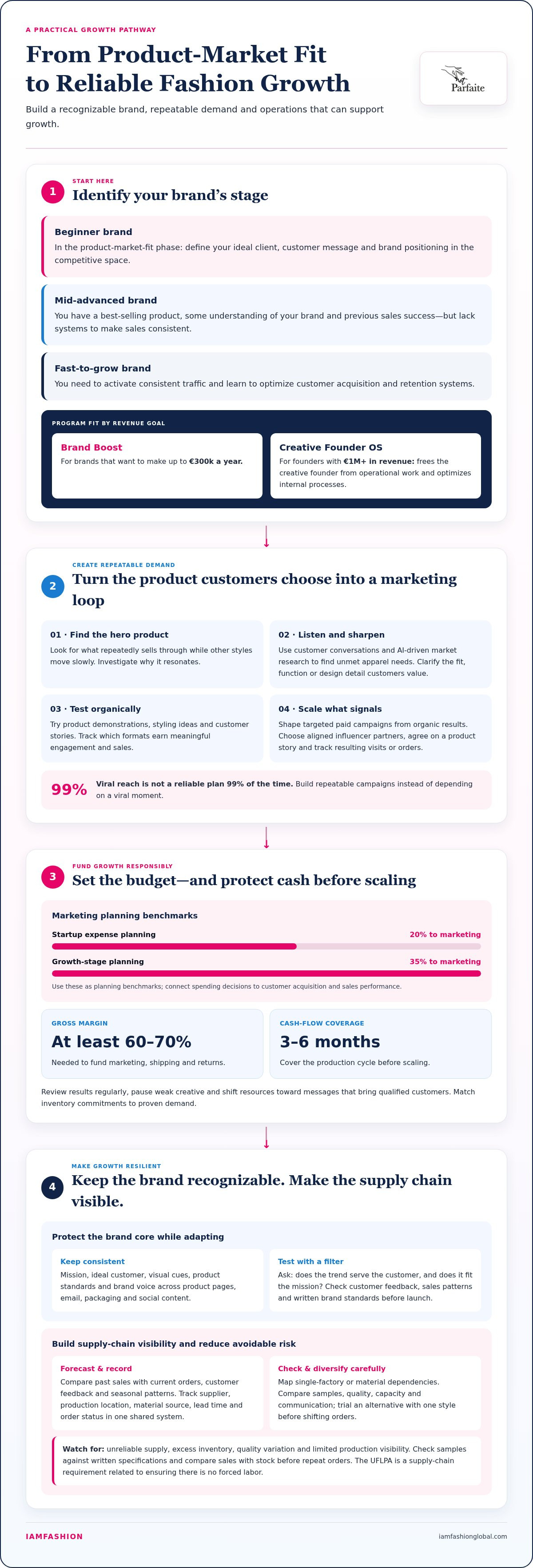
The key stages are product-market fit, repeatable sales, and then scaling customer acquisition and operations. First, define your ideal customer, brand message, and market position. Next, prove a hero product can sell beyond one-off launches. Then build systems that make demand and delivery more consistent.
Start with the product customers already choose. If one jacket repeatedly sells through while other styles move slowly, make it your hero product and investigate why it resonates. Use customer conversations and AI-driven market research tools to identify unmet apparel needs. Then sharpen the product story around the fit, function, or design detail customers value. This gives your content and influencer partners a clear message to share.
Build a content loop before increasing ad spend. Test product demonstrations, styling ideas, and customer stories organically; track which formats earn meaningful engagement and sales. Use those signals to shape targeted paid campaigns instead of guessing at creative. Choose an influencer whose audience and style align with your ideal customer, then agree on a specific product story and a way to track resulting visits or orders. Viral reach is not a reliable plan 99% of the time, so build repeatable campaigns.
Plan marketing as a deliberate share of your spending, not whatever remains after production. Startup expense planning assigns 20% to marketing, while growth-stage planning assigns 35%. Use those benchmarks to think through campaign capacity, but connect spending decisions to customer acquisition and sales performance. Review campaign results regularly, pause weak creative, and shift resources toward messages that bring qualified customers.
Protect cash before scaling. Fashion businesses need gross margins of at least 60-70% to fund marketing, shipping, and returns. A suitable time to scale also includes enough cash flow to cover a 3-6 month production cycle. Improve the margin by reviewing product costs, pricing, and discounting; protect cash by matching inventory commitments to proven demand. This keeps marketing growth from outrunning the money available to make and deliver products.
2. Balancing brand consistency with adaptability
Protect your brand’s core, then adapt how you express it. Write down its mission, ideal customer, visual cues, and product standards before changing a campaign or collection. For example, a label built around practical, long-lasting clothing can test a new silhouette while keeping durable materials and straightforward product descriptions consistent. That boundary lets the design evolve without leaving returning customers unsure what the brand stands for.
Use a simple two-part test for every trend: does it serve the customer, and does it fit the mission? British Vogue reported increased demand for low-rise jeans in 2025, as consumers moved away from high-waisted styles. A fashion brand could assess that shift through customer feedback and product interest, then test a limited design direction before changing its wider range. The trend is a signal to investigate, not an instruction to abandon a proven identity.
Keep recognizable elements consistent across channels. Use the same brand voice on product pages, in email campaigns, packaging, and social content, while adapting the format for each platform. A concise product benefit might lead a short video, while a detailed fit explanation supports the product page. Customers encounter different formats, but they should recognize the same promise and design point of view.
Build a review step into product and marketing decisions. Before launch, compare the idea with customer feedback, sales patterns, and your brand’s written standards. If an experimental color attracts attention but conflicts with the collection’s palette, test it through content before committing to production. This keeps decisions responsive while limiting costly changes to products customers already understand.
Make adaptability a deliberate process, not a reaction to every trend. A clear positioning statement helps teams decide what to test, what to retain, and what to decline. For founders refining their brand positioning strategy, use that statement as the filter for each new collection and campaign.
3. Diversifying suppliers and improving supply-chain visibility
Forecast demand by comparing past sales with current orders, customer feedback, and seasonal patterns. Update the forecast as sales come in, then make inventory decisions based on each product’s performance rather than relying on one estimate for the whole collection.
Build supply-chain visibility from the product backward. Record each supplier, production location, material source, lead time, and order status in one shared system. If a cotton shirt uses separate suppliers for fabric and sewing, for example, connect both records to the same style and purchase order. That makes delays easier to spot before they disrupt fulfillment.
Diversify suppliers where doing so reduces a real risk. Map which products depend on a single factory or material source, then identify alternatives for the styles that drive your business. Compare samples, quality standards, capacity, and communication before shifting orders. Moving every product at once can create new quality problems. A controlled trial with one style lets you assess an alternative supplier’s consistency.
Common scaling risks include unreliable supply, excess inventory, quality variation, and limited production visibility. Reduce them by tracking supplier dependencies, checking samples against written specifications, and comparing sales with stock before placing repeat orders. The U.S. Customs and Border Protection identifies the UFLPA as a supply-chain requirement related to ensuring there is no forced labor.
Use organic demand signals as well as order history. Customer requests for a sold-out size, repeated restock questions, and strong sell-through can indicate where demand is building. Compare those signals with remaining stock and supplier capacity before reordering. If a style sells slowly, investigate its size mix, product description, and customer response before committing to another production run.
Make supplier reviews part of your regular operations. After each delivery, record whether the order met expectations for quality, timing, and quantity. Use those records to guide future allocations and keep a backup source active for critical materials. Clear records turn supplier diversification into a practical response when a production challenge arises.
4. Building a consistent fashion brand identity
A clear identity helps you scale a fashion business without confusing customers as your range expands. Turn your mission into a working guide that defines your customer, product promise, visual choices, and brand voice. Apply it to product pages, packaging, email, and social content. If your brand champions expressive tailoring, for example, show that point of view through consistent styling, photography, and product descriptions—much like how niche fitness apparel labels such as Team Industry anchor their aesthetic in a specific athletic community. Customers should recognize the brand before they read its name.
Choose sales channels based on customer behavior and your ability to deliver. Direct-to-consumer gives you control over the customer experience; wholesale can bring products to retail partners; marketplaces offer another route to shoppers; and physical retail lets customers experience fit and fabric in person. Start where you can maintain clear product presentation and service. Add channels when your team can manage their different inventory, fulfillment, and customer expectations.
For growth in the U.S., make compliance part of product development. Review applicable labeling, product, advertising, and sustainability requirements for the products and markets you sell in. Assign someone to maintain label copy, product records, and support for environmental claims. Documenting a review before production helps prevent avoidable edits to labels or marketing materials after a launch is underway.
Build operations around clear ownership. Assign responsibility for product development, inventory, customer service, and marketing, even if one person holds several roles. Document practical workflows, such as sample approval, product-page updates, and issue resolution. A launch checklist can track fit approval, photography, stock readiness, and campaign copy in one place. Review missed handoffs and recurring delays, then improve the processes behind them.
Use your identity guide to evaluate new decisions, not to block every change. A consistent foundation helps teams test new ideas without losing the customer promise. That’s a practical way to scale a fashion business while keeping the brand recognizable. If you’re finding it difficult to turn your positioning into a consistent customer experience, take the next step toward a stronger brand identity.
IAMFASHION: Brand Boost
IAMFASHION’s Brand Boost is a comprehensive 12-month program for fashion designers and creative brand owners building and scaling online. It also suits mid-advanced brands with a best-selling product and previous sales success, but without systems for consistent revenue. Brands ready to grow further can focus on activating steady traffic and improving customer acquisition and retention.
Creative Founder OS helps creative founders streamline internal processes and reduce operational friction, so the business can grow without every decision running through the founder.
Visit iamfashionglobal.com to explore the right next step for your brand.
Turn your next growth move into a clear decision
If you’re deciding how to scale a fashion business, focus on the next constraint holding your brand back. It may be unclear positioning, inconsistent customer acquisition, or too much operational work resting with you. Name the constraint, choose one practical improvement, and give it consistent attention before adding complexity.
Growth doesn’t require you to trade creative direction for business discipline. It requires decisions that protect both. IAMFASHION’s Brand Boost and Creative Founder OS support fashion founders working toward stronger, more sustainable businesses. Choose your next move based on what your brand needs now, not pressure to grow in every direction at once.
Contact IAMFASHION to discuss your brand and take the next step with clarity. Your creative vision deserves a business built to carry it forward.
Frequently Asked Questions
How much capital does a fashion business need to scale?
There’s no fixed capital amount; it depends on your growth plan and when cash leaves and returns to the business. Map upcoming commitments, including production deposits, freight, payroll, and campaign spending, against expected sales receipts. Then model a slower-sales scenario alongside your main forecast. This shows whether available cash can fund growth or whether a smaller, phased rollout makes more sense.
How can fashion businesses scale manufacturing and find reliable suppliers?
Scale manufacturing by turning product expectations into clear production instructions before increasing order volume. Prepare a complete tech pack with measurements, materials, construction details, and approved fit references. Agree on quality checkpoints and delivery milestones, then review a production run before expanding orders. Compare suppliers on communication, consistency, capacity, and problem-solving, not just sample appearance. Document decisions so production standards hold even when staff change.
What marketing strategies help fashion brands grow customer acquisition and retention?
Pair audience-specific customer acquisition with a post-purchase experience that gives people a reason to return. Organize customers by what they bought or browsed, then tailor product recommendations and launch messages to those interests. For example, customers who purchased a matching top could receive styling ideas featuring related pieces. Track new-customer orders separately from repeat purchases to see which campaigns attract buyers and which experiences encourage them to come back.