Fashion mentorship should help a brand make better decisions, not just offer encouragement. Effective mentorship for fashion entrepreneurs connects relevant experience to the work at hand: positioning a product, choosing marketing channels, building routes to market, and turning sales into a repeatable system.
It’s reasonable to look for a mentor who understands both fashion and direct-to-consumer business, and to clarify what the program includes before you commit. The right fit depends on your brand’s stage, the mentor’s expertise, and whether the format offers useful guidance and accountability.
This guide explains what to look for in a mentor’s experience, how marketing and B2B and B2C routes to market can fit your goals, and what fashion networks may add. It also breaks down how to assess programme fees, session terms, and cohort options without assuming every offer includes the same level of support. Use those details to choose a structure that matches your needs and helps you make your next commercial move with confidence.
Key Takeaways
- Match a mentor’s fashion and commercial expertise to your priorities, from marketing and routes to market to building stronger industry connections.
- Compare programme fees alongside session frequency, format, access between sessions, and the practical support included.
- Choose support that fits your brand’s stage: clarify product-market fit, build consistent sales systems, or optimize acquisition and retention.
Marketing, public relations, and routes to market
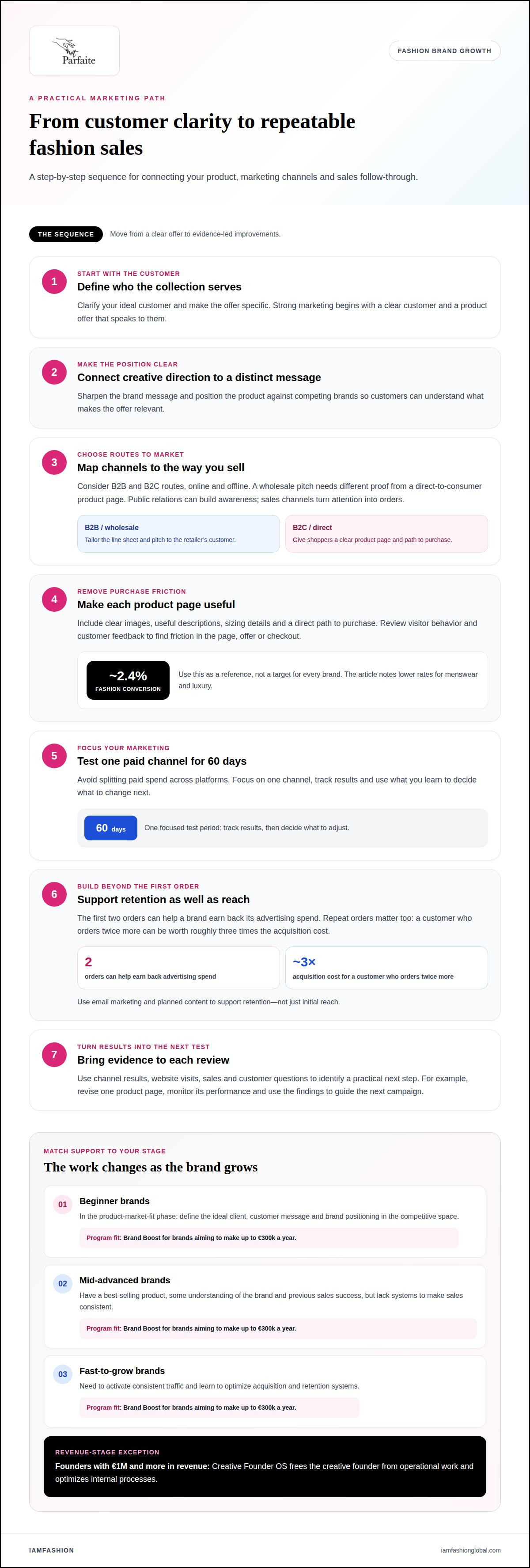
Strong marketing starts with a clear customer and a specific offer. A mentor can help connect your creative direction to customer acquisition: define who the collection serves, sharpen its message, and position it against competing brands. Then map routes to market across B2B and B2C, online and offline. A wholesale pitch, for example, needs different proof from a direct-to-consumer product page. Public relations can build awareness, while sales channels turn that attention into orders.
Make the website do more than display a lookbook. Give each product page clear images, useful descriptions, sizing details, and a direct path to purchase. Fashion conversion is around 2.4%, with lower rates for menswear and luxury. Treat that as a reference, not a target for every brand. A mentor can review visitor behavior and customer feedback to identify friction, then help prioritize changes to the page, offer, or checkout.
Choose marketing channels with discipline. Rather than splitting paid spend across platforms, focus on one channel for 60 days, track results, and decide what to change next. The first two orders can help a brand earn back its advertising spend; repeat orders matter too. A customer who orders twice more can be worth roughly three times the acquisition cost. Use email marketing and planned content to support retention, not just initial reach.
- For Instagram, test product storytelling and direct shoppers to a relevant product page.
- For email, share a launch, useful styling content, and a clear next step.
- For wholesale, tailor a line sheet and pitch to the retailer’s customer.
- For press outreach, give editors a concise brand story and strong product imagery.
Bring specific evidence to each mentoring conversation: channel results, website visits, sales, and customer questions. A marketing director’s skills may help, but practical feedback should lead to a testable action. For example, revise one product page, monitor its performance, and use the findings to guide your next campaign.
Access to fashion networks and career opportunities
A useful fashion network connects you with people who can help move your business forward. A mentor may introduce you to potential retail partners, production specialists, photographers, or experienced brand operators. The value lies in relevant connections, not a large contact list. A designer preparing for wholesale, for example, needs retailer insight and a clear pitch, while a label refining production may benefit more from supplier conversations.
Ask how network access works in practice. Does the guidance include introductions, group discussions, or advice on approaching contacts independently? A mentor’s background should match the opportunity you’re pursuing. Someone with retail experience may help you prepare for a buyer meeting; a founder with online sales experience may offer a different perspective on digital growth. Clarify the purpose of each connection and the next step after an introduction.
Turn each conversation into a professional action. Prepare a concise brand introduction, specify the support you need, and follow up with a relevant update. If you meet a potential partner at a cohort session, for instance, send a short note explaining your product, audience, and proposed collaboration. Treat every member as a possible source of insight, not as someone obliged to provide access or business.
Some fashion programmes extend network access beyond scheduled mentoring. One programme provides access to monthly meetings after the programme, so participants can continue working on brand growth. That format can support ongoing peer feedback and fresh connections as priorities change. Ask how meetings are structured and whether discussions focus on concrete business challenges, such as preparing for a buyer conversation or strengthening a launch plan.
Career opportunities can include more than employment. A founder might discover a collaborator, retailer relationship, supplier lead, or speaking opportunity through a focused network. Mentorship works best when those possibilities connect to a clear business goal. For ongoing fashion business growth support, connect network-building with practical decisions about the brand’s next stage.
Mentoring programme fees and session terms
Program fees and scope vary, so compare what each option includes rather than focusing only on its headline price. One-to-one guidance differs from cohort learning, while a plan review offers focused feedback. For example, a founder who needs help with a launch plan has different priorities from one seeking ongoing business guidance.
Clarify the session structure before committing. Ask how sessions are scheduled, what each meeting covers, and whether follow-up support or group discussions are included. A one-to-one session can focus on a specific decision, such as reviewing a collection plan. A cohort session brings founders together to share challenges and perspectives. Choose the format that provides the access and feedback your work needs.
Look for practical outputs between conversations. A fashion mentoring programme may include a review of your plan, plus cash-flow, break-even-point, and business-plan templates. These tools turn discussion into decisions: map expected income and outgoings, identify the sales level needed to cover costs, then organize priorities in the plan. A sample session agenda might cover one business challenge, review evidence, and leave with agreed next steps.
- Confirm the programme’s duration and session frequency.
- Clarify whether sessions are individual, group-based, or both.
- Ask what preparation, feedback, and follow-up each session includes.
- Check whether templates or plan reviews are part of the programme.
Session terms also matter when production decisions are involved. Some programmes help participants find textile suppliers and production ateliers, obtain quotations, and develop samples. That support can be useful when a founder needs to move from concept toward production. Set a clear meeting goal, such as identifying supplier criteria or reviewing sample feedback, so each conversation advances a decision.
Finally, define what success means for your engagement. It might be a clearer plan, stronger cash-flow visibility, or a production decision informed by sample feedback. Tie the intended outcome to the sessions and tools offered. That makes it easier to assess whether a program fits your needs, without assuming every mentor or platform works the same way.
Fashion mentorship cohort options
A cohort brings founders together to work through shared business challenges. One member might be refining production while another is testing sales channels; both can gain peer feedback alongside mentor guidance. One-to-one support is more focused, while a cohort makes comparison and shared problem-solving part of the experience. Choose based on whether you need personal attention, peer exchange, or both.
Fashion mentorship programs may serve founders online or focus on a particular area. The format shapes whether connections center on local production and retail or bring together brands working across wider markets.
Ask a potential mentor: “What fashion businesses have you supported, and at what stages?” Then ask, “What will sessions cover, and what practical feedback or introductions can I expect?” For example, a founder preparing samples needs different guidance from a brand working to strengthen repeat sales.
Paid coaching carries risks if the mentor’s background doesn’t match your needs, the scope is vague, or the advice stays generic. Pressure to buy extra support can also obscure the value. Agree on deliverables, session terms, and the work each meeting will address.
Match cohort content to your brand’s stage. A beginner seeking product-market fit needs help defining an ideal client, customer message, and competitive positioning. A brand with a clearer identity, a best-selling product, and prior sales may need systems for consistent sales. A fast-growing brand may need steady traffic and stronger customer acquisition and retention practices.
Before joining, review the format, mentor access, peer profile, and practical outputs. A valuable cohort should connect discussion to decisions, such as refining a launch plan or setting priorities for production. For brands seeking a clearer growth path, explore fashion brand growth support.
IAMFASHION
IAMFASHION helps fashion designers and creative brand owners develop their businesses online. Choose the program that matches your stage and growth priorities. Beginner brands working toward product-market fit can use Brand Boost to define their ideal client, customer message, and competitive positioning. Mid-advanced brands with a best-selling product, sales experience, and a clearer brand identity can use it to build more consistent sales systems.
It helps free creative founders from operational work and optimize internal processes.
Make your next growth decision count
Use mentorship for fashion entrepreneurs to turn a business challenge into a clear decision, not another open-ended discussion. Before taking the next step, define what needs to change: your brand’s direction, sales consistency, or the way the business operates. That focus makes it easier to judge whether a mentor’s experience and working style fit the work ahead.
IAMFASHION offers Brand Boost and Creative Founder OS to support fashion and creative businesses as they develop online. Consider which program best matches your priorities, then start a conversation about where your brand is now and what progress should look like. Clear goals make the conversation practical, whether you’re building stronger foundations or creating more room to lead creatively.
Contact IAMFASHION about mentorship and take the next step with confidence. Your creative vision deserves a business strategy built to move it forward.
Frequently Asked Questions
Are these real DTC and fashion experts, and how do I book?
Look for relevant fashion and direct-to-consumer experience, plus clear examples of how guidance applies to a brand’s decisions. IAMFASHION provides structured mentorship and expert guidance through Brand Boost and Creative Founder OS. To discuss which approach fits your needs, contact IAMFASHION and explain your current challenge, such as validating a product or organizing growth.
What mentorship programs are available for fashion entrepreneurs in the United States?
Options include online brand-growth programs, individual coaching, group cohorts, and regional initiatives. The right format depends on whether you need tailored attention, peer exchange, or remote guidance. IAMFASHION supports fashion designers and creative brand owners worldwide through Brand Boost, a 12-month program designed to help build and scale businesses online.
How can fashion entrepreneurs find a mentor with relevant industry experience?
Start by matching the mentor’s experience to your business model and immediate decision. Mentorship for fashion entrepreneurs is most relevant when the mentor understands the stage and type of business you’re building. Ask for a concrete example of a challenge they’ve helped address, and listen for clear reasoning about the decisions involved, not just broad claims about success.
What do fashion business mentorship programs cost, and are there free options?
Program fees vary with scope, format, access, and included support, so compare what each option covers rather than relying on a headline price. Free learning materials can also help you build foundational skills. IAMFASHION offers free resources, articles, and training on creative business organization, market discovery, and workflow coordination.
What qualifications and experience should a fashion business mentor have?
Prioritize relevant operating experience over impressive titles alone. A mentor should understand the decisions your brand faces, such as developing a product range or managing online growth. Ask how they approach a challenge, what information they use, and how they adapt advice to different businesses. Clear reasoning and relevant examples make expertise easier to assess.
What topics do fashion entrepreneurs typically cover with a mentor?
Mentorship for fashion entrepreneurs can cover product assortment, launch planning, inventory decisions, and the workflows that keep a creative business moving. For example, a founder preparing a capsule collection might discuss which styles to prioritize and how to coordinate design, production, and launch tasks. The agenda should reflect current decisions rather than follow a generic business checklist.