Your next fashion-business program should match your brand’s bottleneck, not just your ambition. The right online growth program for fashion designers helps you choose a focused path, build practical design and business skills, and make progress in a way that fits your schedule.
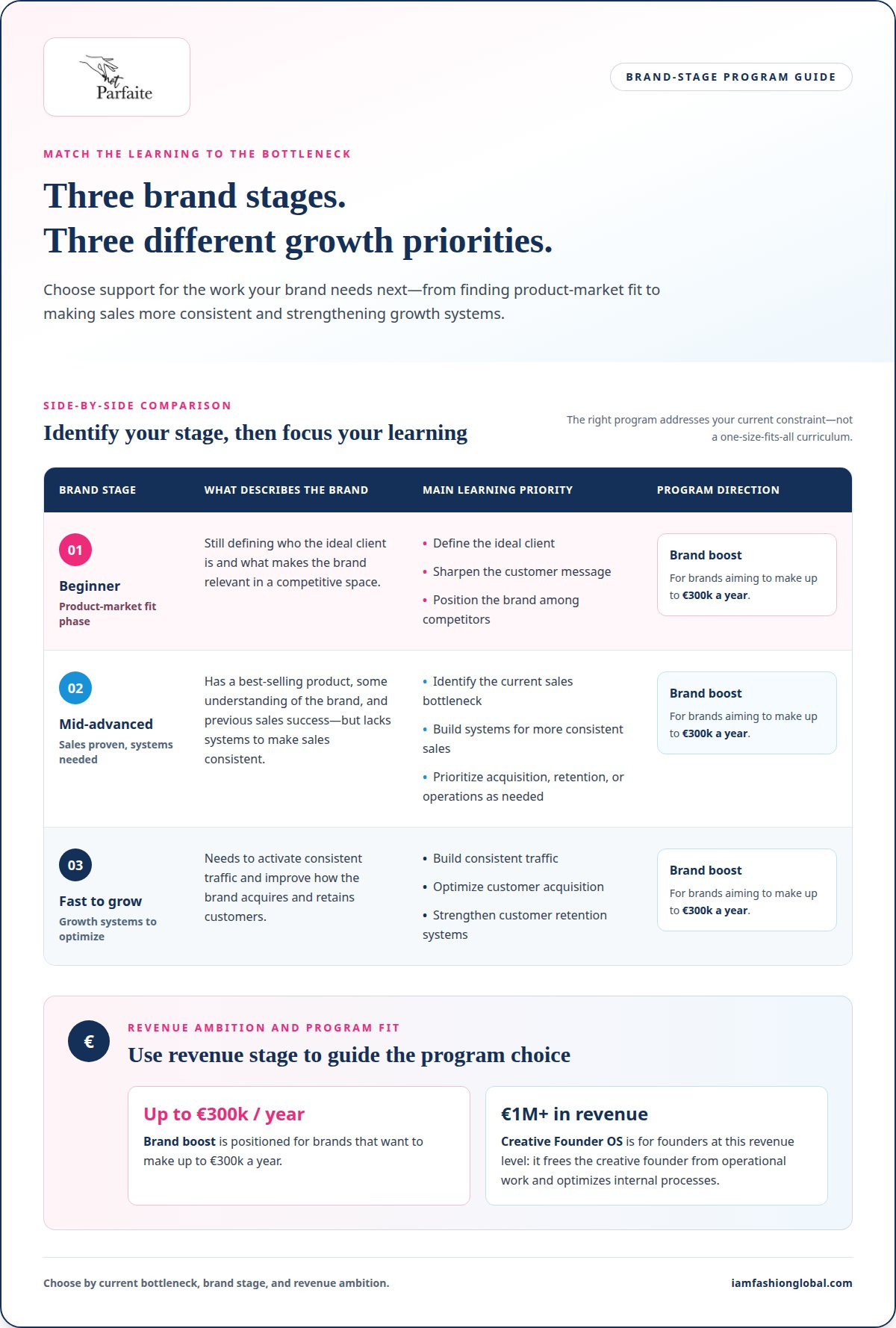
Start with your brand’s stage. Emerging brands still working toward product-market fit need to define their ideal customer, sharpen their message, and establish a clear market position. Brands with a best-selling product and previous sales success need systems to make sales more consistent. Fast-growing brands need to build consistent traffic and improve customer acquisition and retention. Choose a program that addresses your current constraint, rather than one offering the same curriculum to every brand.
As you compare options, look for relevant learning on design, marketing, operations, and business growth, plus meaningful ways to connect with fashion professionals. This guide explains how to match a program to your career goal and available time, what skills and support to look for, and how to recognize when your business needs a more advanced growth framework.
Key Takeaways
- Choose a learning path around your brand’s current goal and the time you can realistically commit.
- Build both creative and commercial skills, so your designs are supported by a clear business strategy.
- Match support to your stage, from finding product-market fit to building consistent sales and optimizing growth systems.
How a professional helps fashion designers choose a program based on career goals and schedule
Start by identifying your target role, current skills, and available study time. A designer building a clothing label needs different support from someone pursuing textile design, patternmaking, or retail merchandising. Then pinpoint your main gap: design technique, portfolio direction, customer insight, or business planning. That focus helps you choose an online growth program for fashion designers that serves your actual goal.
Portfolio development should connect creative vision to the work a role requires. The U.S. Bureau of Labor Statistics says applicants to fashion design programs usually submit sketches and other examples of artistic ability. For example, a portfolio for clothing design can show silhouettes, fabric choices, and how concepts develop into finished looks. A professional can help organize relevant examples and align skill-building with your intended path, rather than treating every textile or design exercise as equally useful.
Fashion careers span design studios, manufacturing, textiles, and retail, but salaries depend on the specific occupation. In the United States, tailors, dressmakers, and custom sewers had a median annual salary of $40,860 in 2024. That figure describes those occupations, not all fashion designers or fashion-industry roles. A professional can distinguish between a design career goal and a custom-sewing path, then help you choose education that develops the needed skills, such as garment construction, material knowledge, or commercial planning.
Eligibility requirements and application deadlines vary by program. Applicants to fashion design programs commonly prepare sketches and other examples of artistic ability, but each program sets its own entry process and schedule.
Before enrolling, compare the curriculum with your goal, workload, and preferred learning format. A garment-construction program may not cover retail strategy, while a business-focused course may not develop your portfolio. Map the lessons to your priorities and schedule, then decide whether the format will help you make steady progress alongside your existing work.
Online fashion design and business education
Online learning can strengthen technical design skills or help build the business behind a fashion label. Choose the format and guidance that connect directly to the outcome your business needs.
Online Growth Program Options
In the US, online options include self-paced lessons, guided business programs, and courses focused on fashion design skills. Compare their practical focus: drawing and garment construction develop technical ability, while customer research and marketing support business growth. A designer developing a collection may need different lessons from a founder preparing for production. Choose based on how closely the content matches your current challenge.
Business Planning and Logistics
Planning connects customer demand with the work of developing and selling a garment. Organize decisions around your product range, production process, inventory, and sales channels. For example, a designer planning a small collection should align its pieces with the intended customer and the business’s capacity. Mapping these dependencies keeps product, production, and marketing decisions connected.
Sales, Branding, and Business Skills
Choose a program that matches your brand’s stage and revenue ambition.
For sales and branding, look for learning that connects customer understanding to marketing and business decisions. The best fit addresses the specific capability your brand needs next, rather than adding unrelated lessons.
Applying to a Growth Program with Professional Guidance
To find a suitable program, clarify your brand’s current stage, offer, sales experience, and growth priorities. For example, decide whether your priority is clarifying a new offer, making existing sales more consistent, or improving growth systems. This context helps you match learning to practical business goals.
Beginner-to-advanced learning
The right program depends on whether you’re developing a first collection, building repeatable sales, or strengthening operations. Emerging designers need to establish the foundations; brands with sales experience need targeted learning that addresses their current growth constraint.
Learning for Emerging Designers
If you’re an emerging designer, focus first on product-market fit, not a broad mix of disconnected lessons. Useful learning helps you define your ideal customer, shape a message that speaks to them, and position your brand among competing clothing options. For example, feedback on fit, materials, and style from a first collection can help clarify your target audience. Design study can build creative skills, while business learning supports decisions about building a viable brand.
Learning for Established Designers
Designers with a best-selling product and previous sales success can focus on systems that make sales more consistent, rather than repeating introductory design lessons. Identify the bottleneck, such as customer acquisition, retention, or internal operations, and prioritize learning that addresses it.
Match the program to your brand’s stage. A brand still seeking product-market fit needs to clarify its ideal customer, message, and competitive position. A brand with proven sales but inconsistent results needs stronger sales systems. A fast-growing brand needs consistent traffic and improved customer acquisition and retention. Each stage calls for different learning priorities, even when the designer has a strong creative vision.
Check what you can apply from each program. If customers respond to one garment but not the wider collection, look for learning that helps you interpret that signal and decide what to do next. If demand exists but growth is uneven, prioritize systems over introductory design content. The right sequence turns creative ability into decisions suited to your brand’s current audience and stage.
What online growth programs are available for fashion designers in the US?
US-based designers can choose online learning focused on design practice, business development, or both. Choose a format based on whether you need to develop a collection, strengthen sales, or improve how your brand operates.
Self-paced courses suit designers fitting study around client work, production, or another job. You might study branding in the evening and apply it to an upcoming launch. Guided programs add expert input to help founders connect customer insight, marketing, and business decisions. Compare the guidance on offer with the challenge you need to solve.
Technical courses focus on fashion skills such as garment construction, drawing, textiles, and pattern development. Business programs address customer definition, brand positioning, sales, marketing, and planning. For example, a designer with strong samples but an unclear customer message may gain more from positioning work than additional drawing lessons. A professional can help identify the gap and direct attention toward relevant learning.
Consider how the program supports practical application. Lessons are more useful when they connect to business decisions, such as clarifying a product offer, improving customer communication, or planning a launch. A design-technique program may not cover sales systems, while a business curriculum may not teach sewing. Compare the learning focus with the outcome you need instead of relying on labels such as “fashion” or “entrepreneurship.”
A brand still working toward product-market fit needs to clarify its ideal customer, message, and market position. A brand with a best-selling product and previous sales may need systems for consistency. Fast-growing brands need consistent traffic and stronger customer acquisition and retention. These are different priorities, so match the program’s focus to your brand’s stage.
Before choosing, outline the current bottleneck, preferred learning format, and schedule. Then assess whether the program addresses that bottleneck with relevant guidance and practical business application. Explore professional growth guidance to connect your learning priorities with your fashion brand’s next stage.
IAMFASHION
IAMFASHION helps fashion designers and creative brand owners grow their businesses online through structured mentorship, expert guidance, and practical strategies. The right focus depends on your brand’s stage: emerging brands need to establish product-market fit, brands with previous sales may need systems for consistency, and fast-growing brands need to build traffic and improve customer acquisition and retention.
These distinct paths help match support to your business priorities instead of treating every brand as though it faces the same challenge.
For guidance on which direction fits your fashion business, contact IAMFASHION.
Turn your next growth goal into a clear direction
Your next move doesn’t need to solve every challenge at once. Choose one priority that could make the biggest difference, then let it guide your learning and decisions. An online growth program for fashion designers is most useful when it connects directly to that priority and your longer-term vision.
Bring your current questions into the conversation: where your brand stands, what feels hardest to move forward, and what you want your business to support. Clear priorities help you choose a relevant next step, whether you’re strengthening the foundations or preparing for a new phase of growth.
IAMFASHION offers Brand Boost and Creative Founder OS for fashion designers and creative brand owners. If you’re ready to explore which direction fits your business, contact IAMFASHION to explore programs. Keep your ambition high, your next step focused, and your creative vision moving forward.
Frequently Asked Questions
What Will You Learn?
Learn to turn creative work into clear business decisions. An online growth program for fashion designers can help you connect a collection launch to its customer journey, from the message introducing a piece to the reasons someone chooses to buy. You can also identify which business task needs attention first, so design development and commercial priorities move forward together.
What is included in each program, such as mentorship, courses, and networking?
Brand Boost is a 12-month program that combines AI-driven marketing techniques, modern brand strategies, and hands-on mentorship for fashion entrepreneurs. Creative Founder OS is an operating framework with actionable workflows, strategic tools, and execution roadmaps for managing and scaling a creative business. These descriptions focus on mentorship and practical business resources; they don’t establish a separate course or networking component as an inclusion.
How do online fashion designer programs compare by outcomes, reviews, and industry connections?
Compare programs by whether they build technical design skills or support business goals such as consistent sales and growth, and by the guidance and connections with fashion professionals they offer. Self-paced courses provide flexibility, while guided programs add expert input.
What eligibility requirements or application deadlines do fashion designer programs have?
Applicants commonly prepare sketches and other examples of artistic ability. Entry requirements and application deadlines vary by program.